“People still think of libraries as old dusty books on shelves, and it’s a perception we’re always trying to fight,” said Michael Colford, director of information technology at the Boston Public Library.”
From the New York Times, 15 Oct. 2009.

Book Conservation
“People still think of libraries as old dusty books on shelves, and it’s a perception we’re always trying to fight,” said Michael Colford, director of information technology at the Boston Public Library.”
From the New York Times, 15 Oct. 2009.
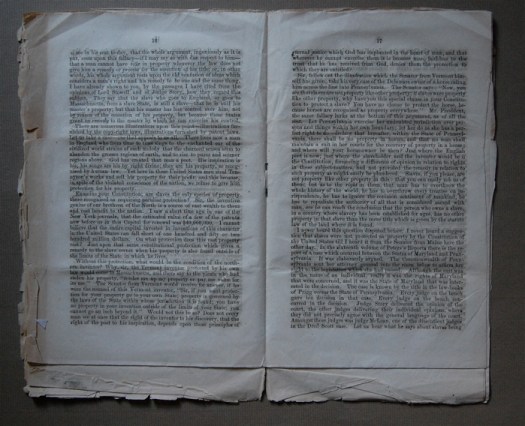
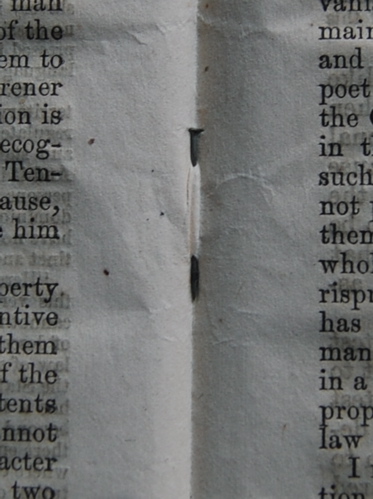
The terminology may be debatable, but I doubt there is a simpler method of “binding” a pamphlet. These 32 pages were printed in 1858, and presumably the pin was inserted around that time as well. A pin may be less damaging than a staple, since the ends of a staple turn in on themselves and often pierce the inner folio. Both staples and pins are prone to rust, though pins are more easily reversed. If the head of a pin is too large, it can damage the adjoining pages. Pamphlets from this time are often side stitched in a figure of eight style, which restricts opening. Some of the horizontal creases in the paper may have happened when the pin was inserted 150 years ago. Of course, sewing through the fold is the best method of attaching pages together.
In this case, however, the pin was not causing any apparent damage, the owner (thanks for permission to post these images!) and I decided to leave it in place. Later, I will do some minor surface cleaning, flattening and paper repairs.
Perhaps because pins were on my mind, last weekend I purchased a box of NOS at the Hell’s Kitchen Flea Market . I was intrigued by the fact that the pins were not described as merely plated, double-plated, triple-plated, but were in fact “Superplated”.
After opening the box and seeing them gleam, I decided this is to be a truthful description– well worth the $2 price.


“Homicide in Hardcover ” is a new bibliophile murder mystery by Kate Carlisle. The blurb on the back reads, “Brooklyn Wainwright is a skilled surgeon. Sure, her patients might smell like mold and have spines made of leather, but no ailing book is going to die on her watch.” Kate Carlisle has done our profession a huge favor by communicating to the general public some of the exciting things conservators do. Of course there are many little inaccuracies, but it is a little too easy and unfair to nitpick about things that only those on the inside of conservation know. The most important point is that this book serves to raise our public profile in a reasonably accurate way; it even discusses minimal intervention and the importance of written and photographic documentation.
Amazingly this book also includes a reference to Peachey knives! The protagonist, Brooklyn, and her arch-enemy, Minka, are sneaking around Abraham’s (a master restorer) studio fighting over who gets these knives, after he was found dead in a pool of blood.
“I’m just looking,” I said, and picked up a polished wood box with the initials “AK” engraved on the top.
Abraham’s personalized set of Peachey knives.
“I have dibs on those, ” she (Minka) said. “Get your ditry meat hooks off them.”
I shook my head at her. “You’re a pathetic thief.”
“Those are mine.”
“No, these belong to Abraham.”
She lunged for the box and I whipped my hand away.
“You’re such a bitch!”
“That may be true,” I said. “But these still don’t belong to you.”
“He can’t use them and I found them first.”
My eyes widened. I couldn’t help it. Her lack of a moral compass never failed to shock me. “That dosen’t mean they belong to you..”
“God, I hate you,” she said through clenched teeth. She swept the rest of her booty to her chest and stomped out. Then she turned back and glared at me. “I hope you die.”
“Back atcha,” I yelled after her.” (pp. 75-76)
I plan to make a set of these knives, in a polished wood box with the initals “AK” engraved on top. Would this be considered theoretical product placement? A real knife is the basis for a fictional one, then the fictional knife is transformed into a real knife?
This isn’t the kind of book I usually read, but I enjoyed it. The descriptions of bookbinders at work were realistic and there are a number of laugh out loud scenes. And this book seems to resonate with the public: “I always assumed that book-binding and restoration would be a dull, dry subject but the historical facts and bits of trivia sprinkled throughout this book were so fascinating that instead of being bored I found myself wanting to know more.” “Who’d have thought book restoration could be so exciting?” “Who knew leather and vellum could be so captivating?”
Thanks to Marieka Kaye (and her open minded literary taste!) for bringing this to my attention.
 Peachey Conservation