
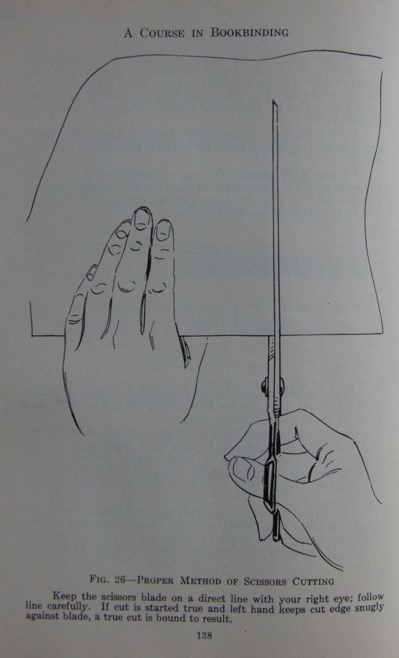
 Palmer, E.W. A Course in Bookbinding for Vocational Training. New York: Employing Bookbinders of America, 1927.
I’ve never thought too much about using a scissors, and can’t even recall ever being taught. I’d usually hold the sheet of paper on the left side, with my thumb on top of the paper. But after reading Palmer, I’m a convert the “proper method”. It seems to result in a straighter cut, since the paper ends up slightly curling parallel to the direction of cutting, as well as acting as a more stable counter point for the action of the blade. This right eye view, shows the exact perpendicularity of the scissors to the paper plane, as well as reminding us that often diagrams can show essential information much more clearly than a photograph can.
Of course, this is a small matter, and not using the “proper method of scissors cutting” will not hasten the end of civilization as we know it. But it does relate to the demise of technical education in general, and makes one worry about the hundreds (hundreds of thousands?) of other techniques that have disappeared, are almost forgotten or will become lost in the future.

 Peachey Conservation