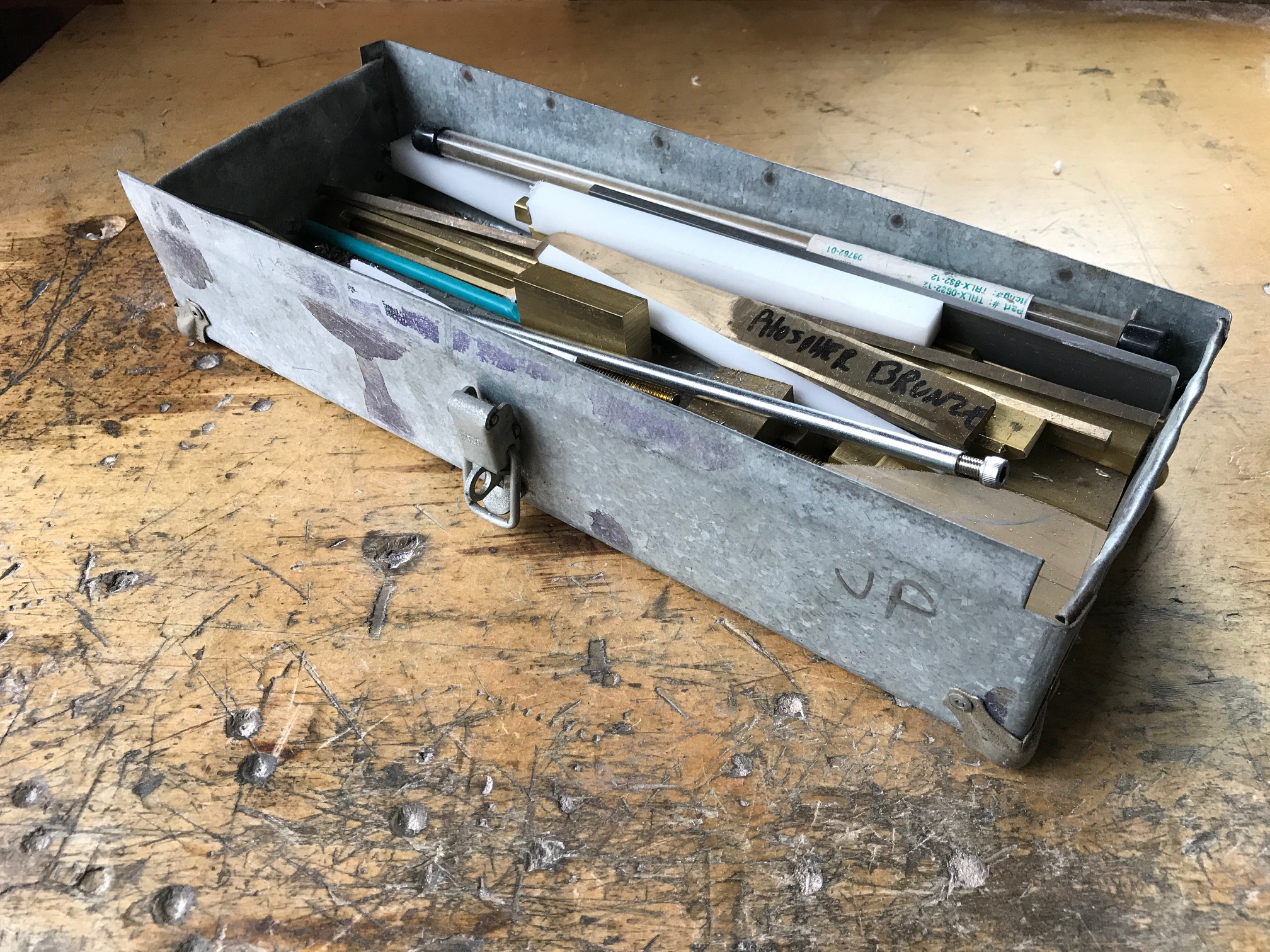
Bottom half of a sheet metal tool box I made in shop class.
A few days ago I wondered, what is the oldest thing I made that I still use? After digging through a lot of stuff, I think it is this sheet metal tool box that I made in high school shop class in 1981.
At that time, it was one of the standard projects in metal shop. I still use the skills I learned when I made this: how to layout and bend thin metal, how to follow a two dimensional pattern to make a three dimensional object, how to join sheet metal, and the value and economy of using off the shelf parts in conjunction with handmade ones. I didn’t have enough time to paint it, so it remains with the layout blue exposed.
I still use the toolbox for storage, even though the spot-welded, piano-hinged lid failed a long time ago and is lost. The bottom part of the box is currently holds over 15 pounds of scraps, and is totally solid.
It is comforting to have had this tool box for the past 38 years, and still use it, even though it is damaged. Like an old friend, it is easier to overlook its faults. It is satisfying knowing this toolbox will outlast me — like most of the tools I make and use, and the books I work on — a persistent reminder we are not so important.
I’m using a M2 Hybrid knife to edge pare this small rectangle of vegetable tanned goatskin all the way around two times, without breaking the pared strip.
The trick is to reverse the direction of the knife by pushing it to turn the corner.
Cathy Baker, owner of The Legacy Press, will drop two new books very soon, Tim Barrett’s European Papermaking, and Pablo Alvarez’s translation of Paredes’ Printing Manual, which is the earliest European printing manual. I can’t wait to get both of them! Pre-order here.
Cover of Tim Barrett’s new book. In the background, at the top, are marbles trapped in a wood groove. It lets the papermakers quickly hang and remove a sheet when it is drying. Clever!
European Hand Papermaking: Traditions, Tools, and Techniques
Timothy D. Barrett
In this important and long-awaited book, Timothy Barrett, internationally known authority in hand papermaking and Director of the University of Iowa Center for the Book, offers the first comprehensive “how-to” book about traditional European hand papermaking since Dard Hunter’s renowned reference, Papermaking: The History and Technique of an Ancient Craft.
This book, which includes an appendix on mould and deckle construction by Timothy Moore, is aimed at a variety of audiences: artisans and craftspeople wishing to make paper or to manufacture papermaking tools and equipment, paper and book conservators seeking detailed information about paper-production techniques, and other readers with a desire to understand the intricacies of the craft. European Hand Papermakingis the companion volume to Barrett’s Japanese Papermaking – Traditions, Tools and Techniques. The first 500 hardcover copies include paper specimens.
Alonso Víctor de Paredes’ Institution, and Origin of the Art of Printing, and General Rules for Compositors [Madrid: ca. 1680]
Edited and translated by Pablo Alvarez
with a foreword by DonW.Cruickshank
Pablo Alvarez offers the first complete English translation of Alonso Víctor de Paredes’ Institucion, y origen del arte de la imprenta, y reglas generales para los componedores [Institution, and Origin of the Art of Printing, and General Rules for Compositors].
This 96-page printing manual – set and printed by Paredes himself – was issued in Madrid around 1680. It opens with an introductory digression on the origin of writing and printing, followed by ten technical chapters on each of the tasks that are necessary to print a book, including a detailed description of the different kinds of type sizes and their use, the rules of orthography and punctuation, the setting of numeric systems, imposition, casting off, the printing of university dissertations, and the correction of proofs. Some of the chapters are of unique relevance for the understanding of early printing in Europe. Chapter 8, for example, is the first recorded, comprehensive account of the practice of printing by forms/formes.
Alvarez’ transcription, translation, and notes greatly facilitate access to this important historical work, which is in fact the earliest known printing manual published in Europe – Joseph Moxon’s Mechanick Exercises was published in 1683 – and an extraordinary rarity: there are only two extant copies in the world. The book also features a foreword by Don W. Cruickshank and full reproductions of the copies held in rare-book collections at the Providence Public Library and at the University of Valencia, Spain.
Dr. Alvarez is Curator at the Special Collections Research Center, University of Michigan Library.



 Peachey Conservation