New Tool: Deluxe Delrin Lifter

The Deluxe Delrin Lifter.

Most lifting tools are quite thin. Usually, this is great. But the thinness of the lifter results in a lack of control at the tip. In order to counteract this, I’ve come up with a very long wedge shape lifter that provides an an incredible amount of control for lifting, twisting, sliding, and prying. The straight cutting edge and rounded corners also aids precision manipulation.

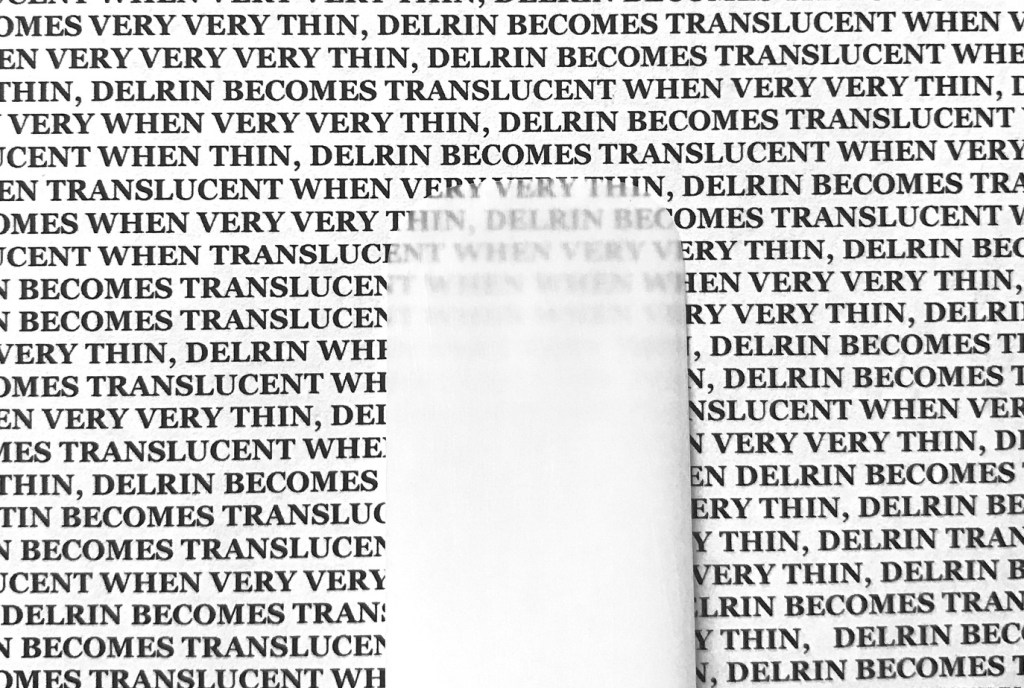
This Deluxe Delrin lifter is designed for the lifting covering materials, backing removal, hinge removal, and tape removal. The cutting edge is flexible and so thin that the white delrin becomes translucent, a feature that could be useful in certain treatments. Delrin has a very low coefficient of friction, close to Teflon. The handle is hand carved out of a bar of Delrin .75 inch thick and an inch wide. The length gradually tapers, and the weight gives this precision tool a solid heft and a tremendous amount of control.

A must for paper, book, photographic, and other conservators and restorers. The length varies between 8 – 10 inches, since it is difficult for me to get a sharp, translucent, and flexible edge. They tend to get shorter and shorter as I work on them! If the overall length is critical to you, send me a note and I will let you know what is in stock.

Between 8 — 10 x 1 x .75 (thickness at the handle) inches. Tapered gradually along the length. The cutting edge is straight with rounded edges, to facilitate twisting and prying. A basic kit for maintaining the edge with instructions is included.

The Deluxe Delrin Lifter $95.00
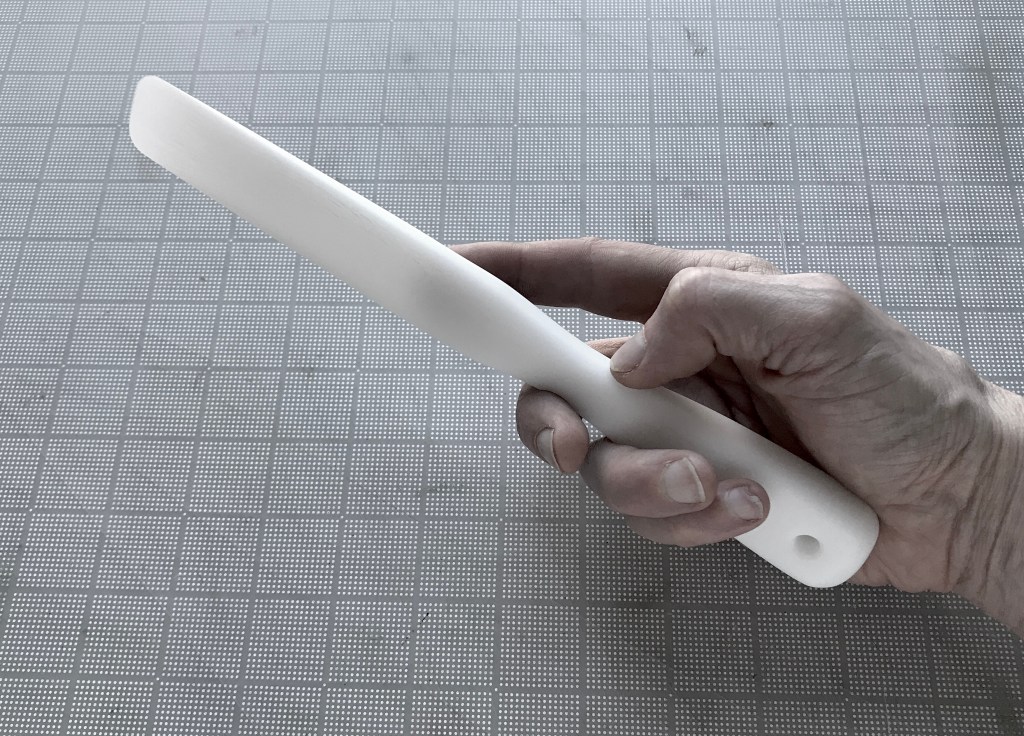
The Deluxe Delrin Lifter.

Timothy Ely’s Five Essential Bookbinding Tools

Timothy C. Ely

Artist in private practice – makes books, prints, drawings and the occasional guitar. Instagram

I had enough warning that I could watch over the course of a few days exactly what was used often. These are tools I grab when I am traveling to teach and they find cross over into other areas. Jeff knows this was a challenge as I have many tools inherited, made and gathered over the years. Next challenge should be the most important twenty five.

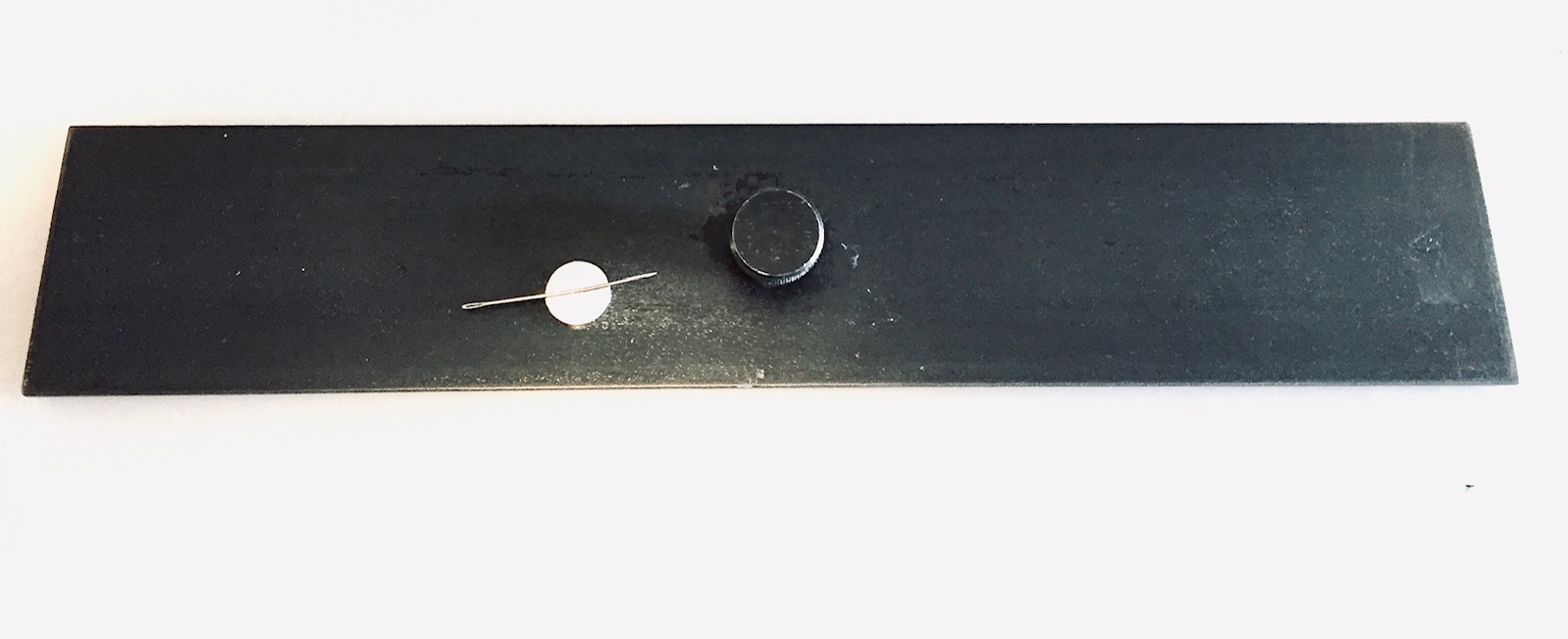
First off, a custom weight made by Randall Hankins of Salt Lake City. I have many weights of Randy’s as well as heavy things found over the years like massive things to hold x-ray machines in place. After making do with essentially the wrong things for decades, Randy and I designed these sixteen inch long weights so that some of the endpapers varieties I make could be selectively weighted or just kept from moving. I have a pair and I could not now work without them. Being steel, magnets can be applied — here is one catching a needle.

I can put you in touch, [contact Tim here] All are custom made.

Cobblers knife from Buck and Ryan [sadly gone] London. Purchased in 1982. Cutting paper and used as a marking knife.


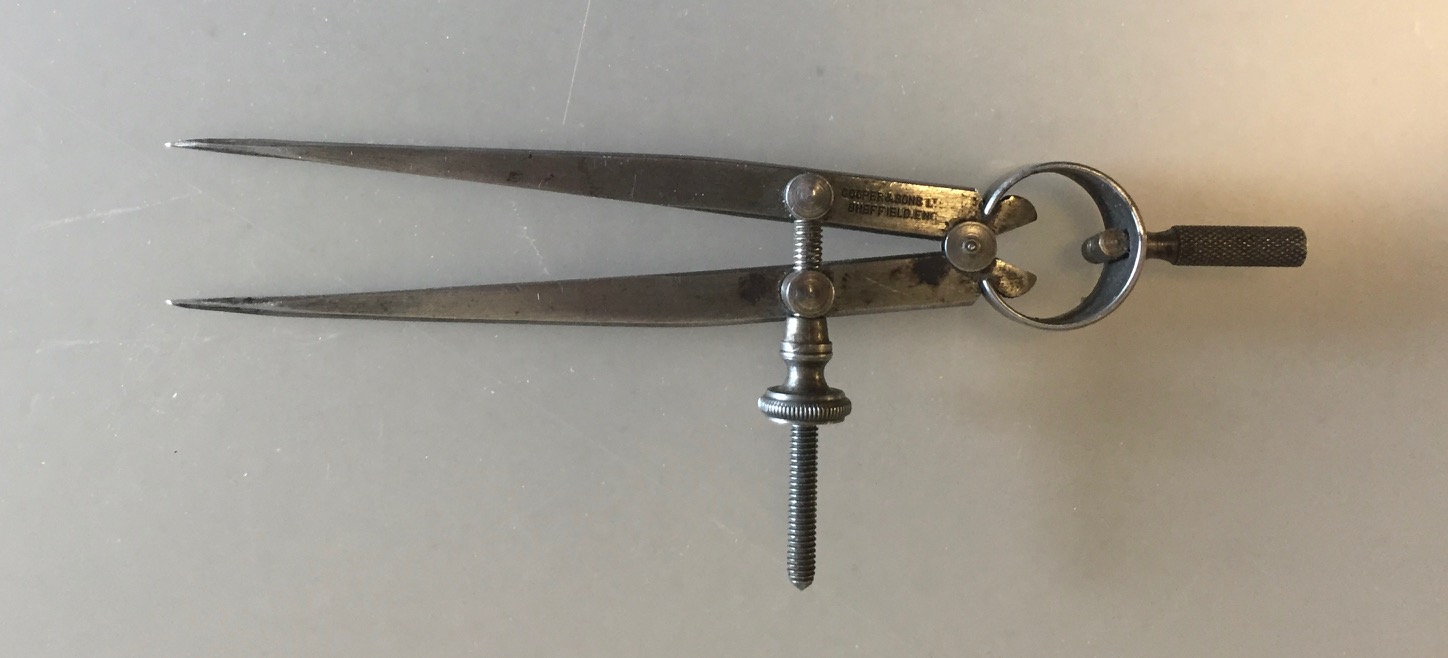
Margaret Smith [d.1982] her dividers, about 6 inches long. She was born while Victoria was still alive and bound books with a Victorian sensibility. Very gracious and knew everyone. Studies a bit with S. Cockerel and was full of stories. She made her stone burnisher from flint found at Brighton. I use this tool more than any. No idea how many dividers of all configurations and lengths that I have found.


Triangle for various squaring and metering jobs. This one allows the worker to dial up the amount of focus required for certain jobs.


My first bone folder. It is sharpened on the lower edge, about 3 inches so that I can fold and then cut folds without needing two tools. I have many bone folders, they are sort of talismans to the discipline and are nice. I have a giant folder made from free range mastodon by Jim Croft. This one is balanced for throwing.

Do Tools Matter When Making Historic Book Structures?

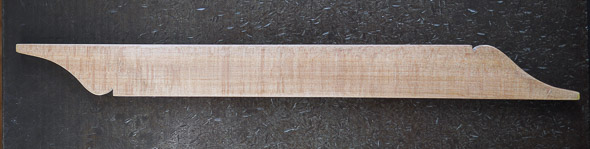
I made this reproduction 18th century French wooden straightedge. Does using it to make a historic bookbinding model *really* affect the process or outcome? Am I heading down the road of wearing a faux French craftsman costume while I do this?

Skillful use of hand tools often depends on their embodiment. They literally become become extensions of our consciousness and body.  We think through them in use, not about them. Don Idhe’s example of driving a car is useful. We don’t have to pay conscious attention to where we are on the road. We just drive. The car is a complex tool that has become embodied. We constantly unconsciously adjust to keeping it on the road. In bookbinding, paring leather is a similar unconscious complex activity. If you are interested in this kind of thing,  Don Idhe’s Technology and The Lifeworld is a exceedingly readable philosophy of technology.

All craft activities have a greater or lesser degree of embodiment, it accounts for some of their joy, relaxation and pleasure. We get out of ourselves for a while.  People often remark on how a tool fits their hand, or is an extension of it, and that it disappears in use. And how time quickly disappears when engaged by using it.

In teaching historic bookbinding structures, however, that these ingrained habits can be counterproductive when trying to recreate, or at least understand in detail, the nuances of earlier techniques.  This is one reason for using historic and reproduction tools. They can help take us out of the familiar, and challange our ingrained craft skills.  They force us to rethink our relationship to a particular tool, and by extension our relationship with the object being crafted. It is all too easy to slip into 21st century work habits when trying to construct a 16th century Gothic binding.

Using historic tools may or may not be the easiest way to do a particular task. When conserving a book there are many other considerations, including the safety of the original artifact, so many historic tools and techniques are not appropriate. And of course, the skill, experience and ability of the conservator is a significant factor. But by in large, the traditional tools of hand bookbinding have not been mechanized because they are an efficient and accurate way of working.

Possibly the most important aspect of using historic tools, or reproductions, is they aid in interpreting historic techniques. Binding a book in an historic style, even inexpertly, helps us understand deeply how older books were made. And isn’t this type of knowledge at the core of any book conservation treatment?