A Few Random Thoughts on 19th Century Books and Machines

Starting in the mid 20th century, many book conservators and proto-conservators rallied around the now common premise that it is the material make-up and structure of books, and not just the surface decoration that needs to be studied and conserved.  So it seems somewhat ironic that most of the recent research/ interest in 19th century cloth case bindings focuses on– you guessed it– surface decoration and famous designers.

For those who think the structure of 19th century cloth case structures are all the same, I urge you to look again. They document the most radical change in book structure during the past 12 centuries.  They dramatically evolve to become the ideal structure for fabrication by machinery.  In fact, the machinery itself is of interest, beginning almost contemporaneously with the Luddite Rebellion of 1811-12.  Interpreting how the machines evolved, were used, were maintained and affected labor is virtually unresearched.  I fear many of these machines gone- sold for scrap.  Similarly, a friend of mine recalled seeing mountains of smashed linotype machines left for trash in the 1970’s along the West Side Highway in NYC.

The structure of cloth cased books, and boarded books, preceded mechanization and was originally done by hand.  Around 1820, the only machine used in cloth binding was a rolling machine to replace hand beaters, but by the 1880’s about the only operation done by hand was the final casing in. I almost always find it interesting to look at machines, speculating about how they functioned and appreciating their aesthetics.

In some respects, the Espresso Book Machine could be considered the quintessence of bookbinding machines. It can print, bind, cover and trim a “library quality paperback” in about 4 minutes, with humans only needed to clear the occasional paper jam in the high speed printer.

Now we just need a reading machine to replace the outdated human interface….

American Book Bindery Building, Part 2

industrial conveying

I posted some photos I took of the exterior of the American Book Bindery Building a while ago. When looking through some of the trade catalogues I’ve collected over the years, I was pleased to find this image from the Lamson Company, which specialized in Industrial Conveying. The catalog is not dated, but looks like it is from the 1920’s. The text states the signatures are moving from the folding machine to the gluing benches without first being sewn, which presumably is a mistake.  Now there is a little information about what the bindery looked like on the inside.

Coincidences like these make the world seem a much smaller place.

.

Grattoir

dudin scraper

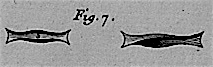
Fig. 1: Two grattoirs from Dudin, Plate 10.

In 18th century French bookbinding, according to both Diderot and Dudin, these grattoirs (usually translated as scrapers) were used to aid in backing and smooth the spine linings. There were also frottoirs (versions with dents– pointed teeth) [*check comments for some discussion of these terms*] to scratch up the spine to get better adhesion, since book structures of this time period often had transverse vellum spine linings.  I made a wood copy of the tool above on the left, but the light weight and friction from the wood made it awkward and ineffective; the friction would tend to tear the spinefolds and dislodge spine linings. There is a contemporary version, available commercially, which is even more useless due to the extreme round on the ends.  I’m a little uncertain about these terms– so far the only reference I’ve found in English is in Diehl, where she refers to a wood frottoir ( burnisher?), that looks a lot like the one still available.

frottoir

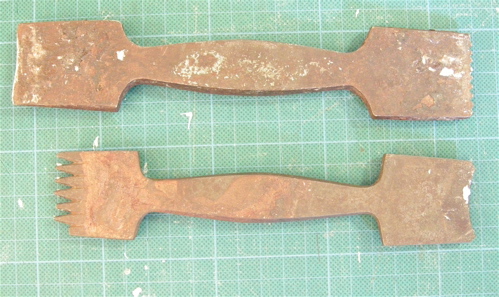
Fig. 2: Two 19th century  frottoir/grattoirs, courtesy Ernst Rietzschel.

This summer,  I had a chance to test drive the combination frottoir/ grattoir tools pictured above. Ernst Rietzschel, from Holland, borrowed them from his bookbinding teacher in Belgium,  so it is likely they come from the French binding tradition.  Their weight, as well as the very slight curve,  made it easy to concentrate pressure on just a signature of two for accurate manipulation of the spine. As an unexpected benefit, it was wildly cathartic to punch and  scratch the spinefolds with the teeth, of course, only in the interests of historical research!

I used the smooth, slightly rounded ends of the original tool to back the book and to align the cords as well as to burnish the spine linings. Even with the damaged edges and paint, I was surprised how easy it was to gently control the backing process and tweak the cords into alignment.   I had much more control compared to using a hammer, and it was quicker (and potentially less damaging) than loading the spine with so much moisture that I could manipulate it with my fingers or a folder.

Originally, I was planning to reproduce the original, but I didn’t want to make it out of iron because it is prone to rust.  I wanted two smooth ends since I only scrape spines on specific historical models.  I considered stainless steel, but didn’t have any on hand, and it is very gummy and difficult to work by stock reduction.  Bronze was a good candidate, but brass is slightly harder.

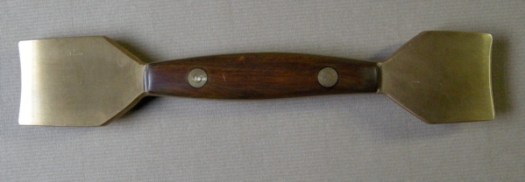
So I made a modern interpretation out of  free machining, type 360 brass with a lignum vitae handles.  The quarter inch thick brass and heavy wood handles give it a weight similar to the original, although the aesthetics are quite different. My version is 1.5 inches wide, 8 inches long and weighs 9.4 oz. ( 4 cm wide, 20 long, and 266 grams) In practice it works just as well, in not better, than the original.  It can be grasped with a fist for extra pressure, or delicately held like a pencil for detailed manipulation.

I wonder why a tool this useful would become virtually extinct?

frottoir2

Fig. 3: A contemporary grattoir I designed and made.