
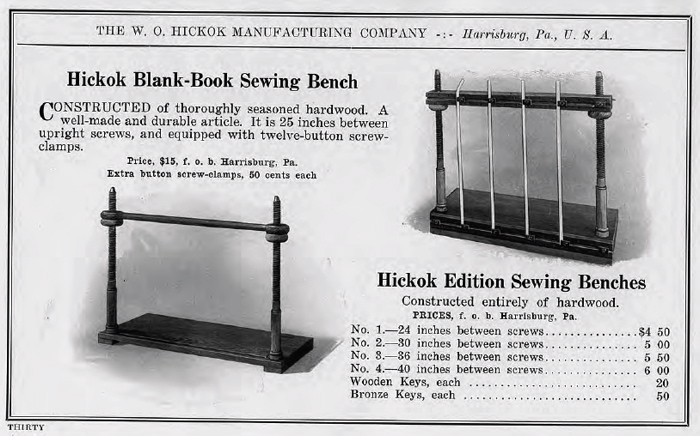
Hickock Bookbinders’ Machinery: Bookbinders’ Tools. Catalogue No. 88. The W. O. Hickock Manufacturing Company, Harrisburg, Pennsylvania, U.S.A. c. 1920. Courtesy of Gary Roberts, who runs the website, toolemera, which has many other fascinating trade catalogs, mainly woodworking, he has scanned.
A while ago, I wrote a post about blank book hammers, rounding hammers and backing hammers. Both Tom Conroy and Gary Robberts felt certain that nomenclature was basically for marketing purposes, and they are most likely correct. However, when looking at sewing frames, in this case from Hickock, it is clear from the function that blank book sewing frames and edition sewing frames are two different animals. The blank book sewing frames only come in one size, 25 inches, and it appears they have something similar to ‘t-slots’ to hold the sewing tapes secure. Edition sewing frames, with keys, can be used for cords, tapes, thongs, etc. But blank books, at least in this time period, were almost always sewn on tapes. The design looks like it would be easy to get the proper tension on the tapes. These frames must be quite rare, and I wonder if the high initial cost–almost 4 times a similar size edition sewing frame– made them an anomaly, if they didn’t work well, if the depression killed the market, if many of them were trashed when the blank book market disappeared or if it is some combination of all of these.
Below is a closeup of the ‘button-screw clamp’. It looks to be an easy way to quickly adjust tension and change tapes. Although I had never seen one of these until reading the above catalog, there was one for sale on the internet, which sold earlier in the same week before I found it. The one that got away.


