New Tool for Sale: The Kaschtoir

If you have never heard of a kaschtoir, you are not alone. The term is a portmanteau coined by Peter Verheyen. The kaschtoir is a backing tool; a combination of a German kaschiereisen and a French frottoir. More about the kaschiereisen here, and more about the frottoir here. This tool combines the most useful aspects of each.

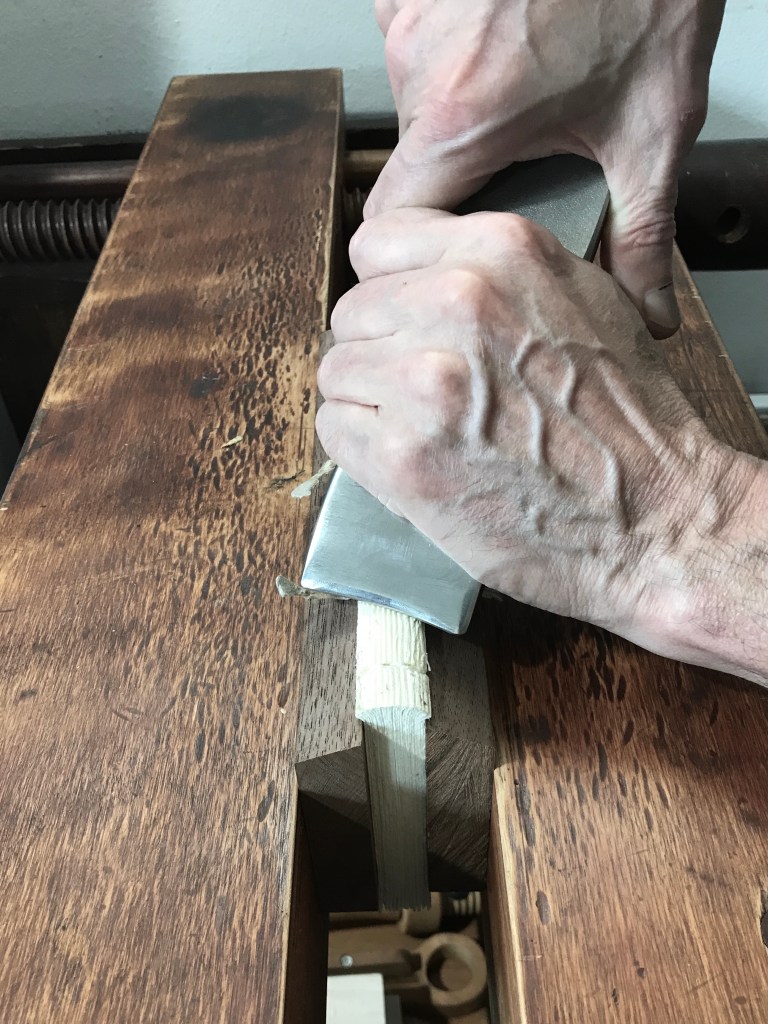
A stainless steel Kashtoir

The kaschiereisen end has small teeth, which help to move the sewn, rounded bookblock into to a backed position. The froittoir end has a gentle smooth curve, which also can help move a bookblock into position, in addition to smoothing out irregularities and trueing raised bands. Two for the price of one!

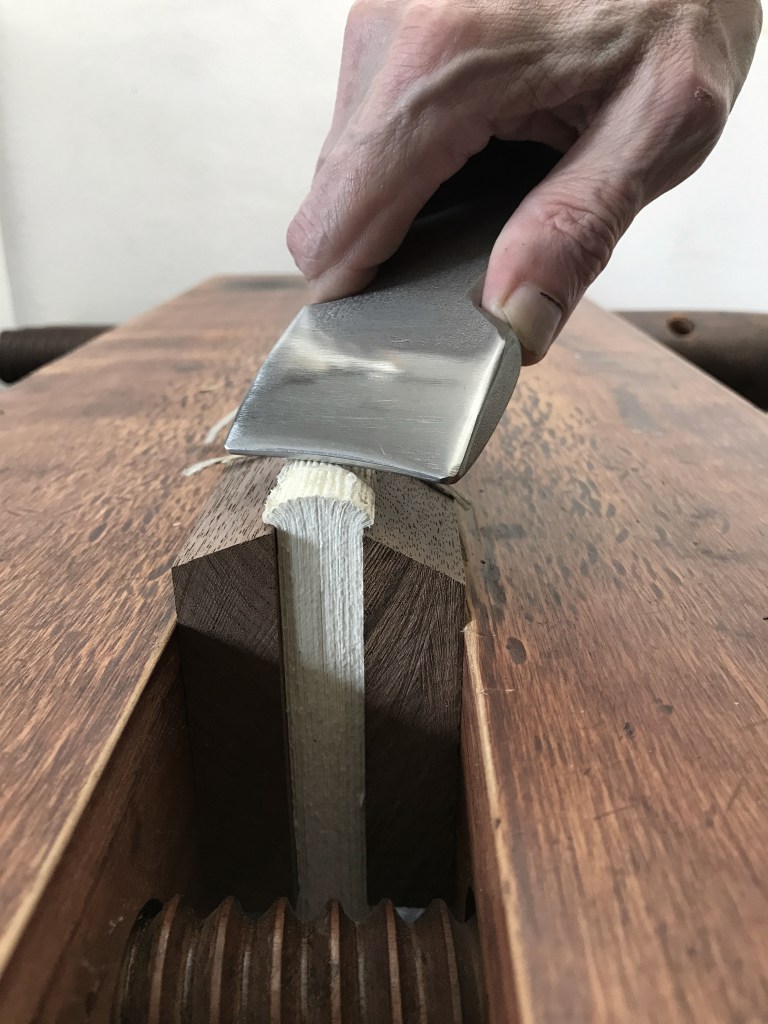
If you are tired of deforming your spine into double folds with a hammer, or deforming your fingers hand manipulating your spine into shape, this may be the tool for you. Fits comfortably in one or two hands. The stainless steel is safe for contact even with historic bookblocks. The edges are very comfortably rounded, and the froittoir end is polished to make clean up easy.

I reproduced the gentle curve on the Frottoir from examples in my historic collection. This tool is not a die meant to exactly shape a spine to its curvature. A gentle curve is much more useful for a range of round spine shapes, smoothing irregularities, smushing sewing threads, etc… . The teeth can be cleaned of adhesive with a stiff brush. This tool is quite heavy, and the weight allows you to easily persuade even hard modern paper into the shape you desire with little effort.

304 stainless steel. Approximately 6 x 2 x .5 inch (15 x 5 x 1.25cm). Weighs about 1 lb. 5 oz (600 grams).

Order your Kaschtoir here!

When did Guillotines for Bookbinding Start?

1834 Patent Model of a “Paper Trimmer”. https://americanhistory.si.edu/collections/object-groups/patent-models-graphic-arts?page=1

Here is another gem from the Smithsonian Graphic Arts Model Collection, a very early — though not the first — guillotine for books or paper. Unfortunately, a fire destroyed the US Patent Office in 1836, so this model is the only remaining record. Visually, it looks much more like the neck cutting variety rather than ones for book or paper cutting. The massive blade operates by gravity rather than a lever or flywheel; again, like the non-book styles. Similar to all the early guillotines is that the blade operates straight up and down.

It’s always a dangerous game to cite the earliest book you have seen that contains this or that evidence, since it often gets superseded. Nevertheless, the earliest book I have seen that contains incontrovertible guillotine marks (thanks to a very damaged blade) is this Harper’s publisher’s cloth binding from 1834 of “The Works of Mrs. Sherwood”. The machine had a clamp and operated straight up and down. The curvature to the marks resulted from tightly clamping and distorting the unbeaten bookblock when cutting, a feature which the patent model above lacks, and when it is released it springs back into its resting shape.

If you have earlier evidence let me know!

Copy Press Mounted on a Safe

Last week, I blogged about a scene from a movie depicting a copy press on top of a safe, and wondered if it was a way they were actually used in offices.  Darryn Schneider of DAS Bookbinding in Australia sent me this wonderful image he found from the State Library of Victoria. Bingo! Well, at least there is one documented example….

Copy press on top of a safe. Interior of  a railway office, ca. 1901-1940.  State Library of Victoria. http://handle.slv.vic.gov.au/10381/38847