

“A joiner’s or cabinet-maker’s apprentice would find some instructive reading in this [The Joiner and Cabinet Maker] little work. It contains, in addition to certain rudimentary information, some hints to apprentices of how to turn their leisure hours to permanently useful account. The book is a good shilling’s worth.”
-The Furniture Gazette, Sept. 29, 1883.
Christopher Schwarz, editor of Popular Woodworking, and Joel Moskowitz, founder of Tools for Working Wood, have teamed up to reprint, expand and annotate the 1839 edition of The Joiner and Cabinet Maker. I also contributed a chapter, “Contextualizing ‘The Joiner and Cabinet Maker'”, so am unapologetically biased about this book!
The first section reproduces the complete 1839 edition, which consists of a fictional boy describing his apprenticeship, accompanied by a large amount of historical information about cabinet making in the mid to late 19th century. The next section consists of Chris following the textual descriptions in the book and builds three projects; a packing box, a schoolbox and a chest of drawers. In a conversational writing style, he adds his own knowledge of woodworking techniques, bits of history and documents building the projects photographically–the overall effect is like having a private tutor guide you through the project.
I examine three editions of this book (1839, 1841, 1883), relate them to the history of book structure, then investigate how their physicality influences our interpretation of the text. I am very interested how craft based information gets transmitted through descriptions and manuals. The hands on explication of historic texts, rather than just reading, is invaluable to a deep understanding, and often opens up new areas of inquiry. Also, I attempt to make a case for the value of primary sources and their conservation, written for the general public, rather than preaching to the usual conservation and rare book choir.
For readers who haven’t attempted any woodworking, this book has enough general information, historical details and how-to information to serve as an wonderful introduction.
The book is available for sale from Tools for Working Wood. 373 pages, tons of photos, acid free paper, sewn signatures, hardcover. One shilling. $28.95
I should be getting copies in sheets later this month, that I will be selling, and well as providing it for students in the historically oriented Cloth Case Binding class I am teaching at North Bennet Street School, Boston, February 19-21, 2010.
I also want to credit Matt Murphy for assisting me with some research, especially concerning Charles Knight & Co. Thanks Matt, librarians rule!
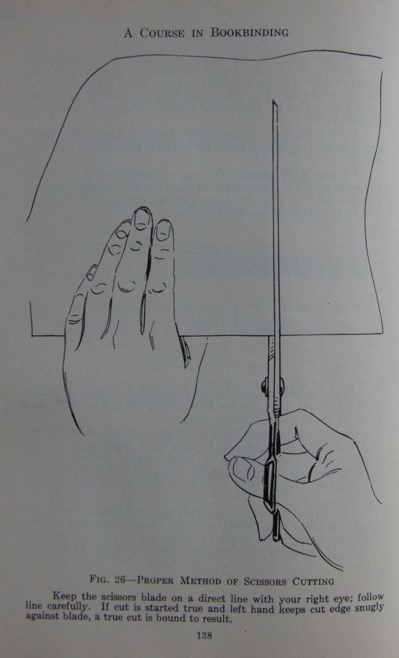 Palmer, E.W. A Course in Bookbinding for Vocational Training. New York: Employing Bookbinders of America, 1927.

 Peachey Conservation