The Shift From Mechanical to Adhesive and Beyond

19th-c

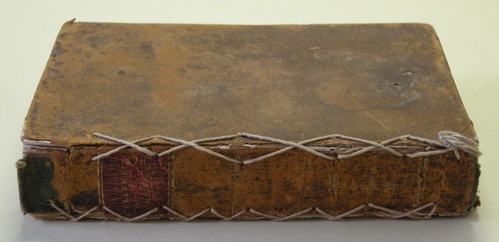
                                          Clark, Adam.  Christian Theology. New York: T. Mason and G. Lane, 1837.

I always enjoy examining these 19th C. (or early 20th C.) book repairs where the board is sewn to the spine.  This example is fairly crude, but some can actually function fairly well.  This book is in my collection– I will preserve it as evidence of the history of book repair.  We might find this repair laughable, but it is fairly easily reversed, there is no glue to remove and it kept the boards from getting lost.  When the holes in the spine are staggered through a number of signatures, these repairs hold up fairly well, and if the paper drapes well and the spine is fairly flat, as in this example, all of the text is easily readable.  


sewn-board


sewn-board-2


This example is missing the title page and first 14 pages, but I think it is some kind of  Catholic devotional book. It is bound in typical early to mid 19th C. style and is quite small– 84 x 57 x 34 mm.   Of course, I am not advocating this as a type of repair a conservator would do today, but to me it represents a 19th C. common sense approach to the most common failure in book structure– detached boards.  This type of repair, fairly common in the US, might have served as impetus for joint tacketing or a literal “sewn-boards” binding. The upper board and lower board are sewn differently, the lower board like the previous example, but in the case of the upper board, the stitch runs into the edge of the board, which results in a decent opening.  The brown thread which matches the calf covering is doubled like sewing thread is.  Could this this have been done by a woman, and the previous “heavy duty” example done by a man?   

board-edge-drilling 

I have hypothesized elsewhere that there might be some kind of connection between early board attachments such as in the Book or Armagh, Romanesque lacing paths, and board slotting. The spine edge of a book board is a very tempting entry point in establishing mechanical attachment.  The strength, and relative noninvasiveness of board edge attachments make it an appealing treatment option, alleviating  the need for disruptive lifting of covering materials.  I have been experimenting with a new jig, pictured above, which holds a foredom drill at a precise angle, and has a depth stop, to accurately drill with wire gage drill bits, in order to drill a hole exactly the size of the thread used to reattach the board.  
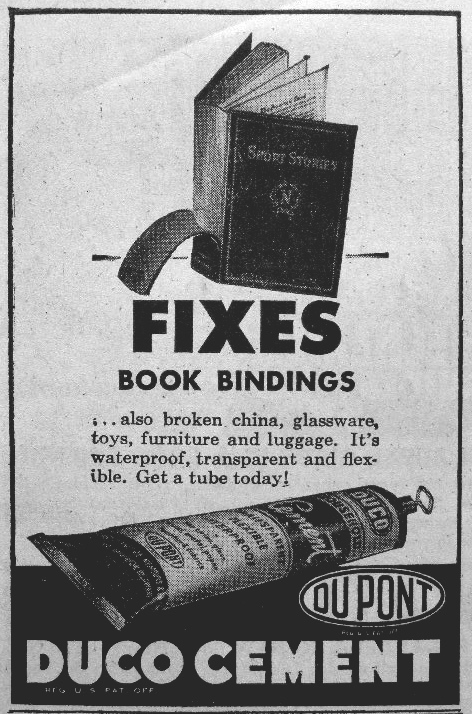
 

                                            Advertisement from  Science and Mechanics, Vol. XVII, No. 6, 1946, p. 38.

By the mid 20th C., detached boards and other types of damage are more commonly fixed by tapes and adhesives, as the advertisement above suggests.   Unfortunately, I think I have seen this used on books. It ends up looking like a thick, completely inflexible amber mass of goop.  I think this glue is the kind I used to use as a kid when assembling plastic or balsa wood models.  The cap of this tube is unusual- it looks like a twisted loop of wire, perhaps used to pierce the top when opening?  Often the spine edge of the detached board is glued to the flyleaf to “fix” a detached board.

By the early 21st C.,in the general public, most ideas of repairing an object mechanically are gone, and most ideas of repairing an object by using adhesives are gone.  In fact, the idea of repair is almost gone.  We simply buy a new one, unless the book has some kind of exceptional value.  

The idea of a world where nothing is worn, nothing is fixed and everything is new frightens me.  How would one conserve an ebook reader? I’m sure books will exist for a very long time, but more as symbolic representations of learning and knowledge, not primarily as a source for  accessing a text.  This is why these primitive, vernacular repairs are so important for understanding a previous culture’s relationship to the books they used, treasured, repaired and read.
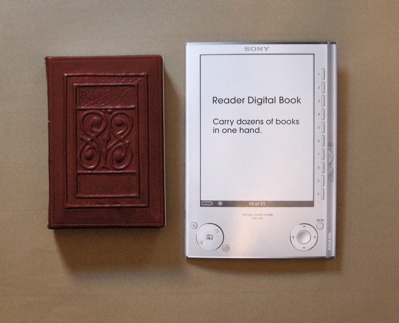
 

Sony and Stony


sony-and-stoney1

I am struck by how closely the dimensions of  the 7th century Stonyhurst Gospel (now renamed as St. Cuthbert’s Gospel of St. John) match the screen size of the Sony Portable Reader System PRS-505.  On the left is a model of the Gospel, which is described in the literature as being 134-138mm high, and 90-95mm wide (1:1.49).  The screen of the Sony Reader is 124mm high and 92mm wide (1:1.35).   Coincidence? Perhaps. But might their dimensions relate to our hand size or comfortable handheld viewing range?  These books are separated by 13 centuries!

I played with the Sony last weekend at the Small Press Fair in NYC. I was impressed by the resolution of the eink at any viewing angle, but page turns were agonizingly slow, and accompanied by an epeliptic inducing flash of background reversal– the text would go white, and the “page” black for a split second.  I also tried out a prototype of the next version, which has a touch screen interface, but doubt this would be a great advantage when reading.There is a promotion on now at Sony—  enter promo code:  10sonyclassic    You can get 10 free ebooks to read on your computer or ebook reader  from the “classics” collection– think 19th C. standard DWM’s.  

I think the Stonyhurst needs a tagline too.  How about “The Stonyhurst: Carry the Gospel of St. John in one hand.”

The Integument is an Integral Part of the Book-Brander Matthews

In 2008 there were two major exhibitions of 19th century publishers’ bindings; The Well Dressed Booat the University of Maryland,  and The Proper Decoration of Book Covers: The Life and Work of Alice C. Morse at the Grolier club in NYC.  One day symposiums accompanied both, and the speakers rallied around the cause of celebrating the presumably unknown, or at least undervalued work of 19th century publishers’ binding designers, often only identified by microscopic initials hidden within the stamping on the front cover.  

Last weekend, I purchased and read Brander Matthews’ book, Bookbindings Old and New, (Strand Bookstore, ex-library copy, $20!) published in 1895, expecting to find the typical remarks of a pedantic 19th century bibliophile, but instead found an opinionated, yet breezily written assessment of mainly French bookbinders from the 16th through the 18th centuries, a chapter on publishers’ bindings and a short history of the Grolier Club.  I found Matthews to be passionate about defending the high quality of work by many book designers of the day– including Margaret N. Armstrong, Mrs. Henry Whitman, Stanford White, Harold B. Sherwin, Hugh Thomson, Edwin A. Abbey, D.S. Maccoll, and more. “The beauty of the modern book is not that of the book of yore” (172), he writes, “Just how excellent some modern commercial bindings are, scarcely any of us have taken time to discover; for we are prone to overlook not a few of the best expressions of contemporary art, natural outgrowths of modern conditions, in our persistent seeking for some great manifestation which we fail to find. ” (174)  He later continues, “It is a fact that commercial bookbinding , often ignorantly looked down on, is now at a most interesting stage of its history; and it seems to me very worth while to consider some of its recent successes.” (175)  

He even is an early advocate for preservation of paper wrappers, “One word of warning, and I have done:  never destroy the paper cover of a book, even of the least important pamphlet.  The integument is an integral part of the book…” (283) The page opposite this quote is an illustration of the Dickens The Mystery of Edwin Drood, which today is worth much, much more if in original wrappers. He obviously recognizes and values the unique physical character of books, and  quotes Hawthorne’s admonishment to collectors who rebind their publishers’ cloth books in leather, those who “strip off the real skin of a book to put it into fine clothes.” (If anyone knows where this quote appears in Hawthorne’s Oeuvre, please let me know, a citation is not included in Matthew’s book)

But at the same time, he complains about the state of hand bookbinding, and is particularly disparaging of the use of the roll in tooling. “The use of the roll, repeating the same motive indefinitely as it is rolled over the leather, is indefensible; it is the negation of art; it destroys the free play of hand which is the very essence of handicraft.” (69)  For Matthews, Cobden-Sanderson is the height of modern bookbinding genius–there are 8 large plates of his bindings– and is critical of the “artistic sterility” of Zaehnsdorf.  “The most original figure among English binders of this century–in fact, the only original figure since Roger Payne–is Mr. Cobden-Sanderson.” (129) “Believing in handicraft as the salvation of humanity, and that a man should labor with his hands, he abandoned the bar, and studied the trade of the binder.” (132)

He ends up adopting a somewhat black and white position:  all hand bookbinding should be done by hand, preferably both the forwarding and the finishing by the same man, but commercial binding is the execution of of design. “So a book-cover stamped by steam may be a thing of beauty if it is designed by Mrs. Whitman or by Mr. Stanford White.” (175)  He ends his essay by claiming the Americans superior to the English in modern book design, and concludes that books are “…one of the most important forms of houshold art–of decorative art.  Properly understood, and intelligently practiced, it is capable of educating the taste even of the thoughtless, and giving keen enjoyment to those love books for their own sake.”(228)  

I am a bit reluctant to include this link to his book online, since it seems somewhat disrespectful to his wonderful phrase “the integument is an integral part of the book.”

_____

Matthews, Brander.  Bookbindings Old and New: Notes of a Book Lover: With an Account of the Grolier Club of New York.  New York: Macmillan, 1895.