Upcoming Workshop. Cloth Case Bindings: Their History and Repair. October 24-28, 2016. Georgia Archives, Morrow, Georgia

CLOTH CASE BINDINGS: THEIR HISTORY AND REPAIR

October 24-28, 2016

Instructor: Jeff Peachey

Georgia Archives, Morrow, Georgia.

For almost 200 years, the cloth case binding has been the standard way publishers issue books. Throughout the nineteenth century, and even into the twentieth, it was often derided by bibliophiles as a temporary structure, not a ‘real’ book. However, it has proved to be a remarkably durable structure, now commonly used by conservators when rebinding books, by fine small press publications, and in library binding.  Quite likely, there are more cloth cased books than any other rigid board book structure on earth. 

This 5-day workshop will investigate the history of the cloth case binding, concentrating on the early years, 1825-1850. We will parse historic texts that describe this structure, while paying close attention to the introduction of four key pieces of machinery: the rolling press, the board shear, the guillotine, and the stamping press. Boards bindings will be considered as an industrial precursor to the cloth case, and we will make a structural model following a technical description from Cowie’s 1828 The Bookbinder’s Manual. By focusing on historic techniques, this workshop will also serve as introduction or refresher to the essential bookbinding hand-skills. Additionally, we will explore options for conserving and repairing cloth cased books by working on actual books provided by participants. Treatment options presented will include recasing, cloth rebacking, tissue repairs, hinge repairs, and boxing. Basic paper repairs, techniques of toning tissue and cloth, spine lining considerations, and the lifting of fragile material will be addressed. Discussions will include treatment decision making in relationship to specific institutional needs or the desires of private clients.

This workshop is open to all levels of experience: pre-program students, technicians, and mid-career conservators who desire a full time week at the bench. Ideally, a variety of participant experience levels will result in an invigorating exchange of information on binding techniques, institutional protocols, and treatment approaches.  Students should bring 5-10 non-valuable cloth cased books that can be sacrificed or repaired, and basic bookbinding tools.

Students should submit a resume and a brief one paragraph application statement, reviewing their background in bookbinding, book conservation, or other crafts, and stating what they hope to learn.

Workshop Fee: $650 which includes materials.

Application deadline: July 15, 2016.

The application, or questions about the facilities/ housing options/ transportation (Morrow is close to Atlanta) should be sent to Kim Norman: Kim <dot> Norman <at> usg <dot> edu

Other questions about the class should be sent to me.

Review of Suave Mechanicals Vols. 1 and 2

Both volumes of Suave Mechanicals received a strongly positive review by David Brock in The Book Club of California Quarterly News-Letter this month. In general, he “…marveled at how unique it [Suave Mechanicals] is. This is not a survey of the history of bookbinding, nor is it a manual, yet it has a foot in each camp.” (p. 19)  In particular, he mentioned my 2013 essay, “Beating, Pressing, and Rolling: The Compression of Signatures in Bookbinding Prior to Sewing”, in a complementary paragraph, reproduced below.

Both volumes are available at The Legacy Press. Get them before they are out of print!


Screen Shot 2016-02-04 at 8.39.33 AM
Source: David Brock “A Review of Suave Mechanicals: Essays in the History of Bookbinding” The Book Club of California Quarterly News-Letter, Vol. LXXXI, No. 1, Winter 2016. (pp.18-21)


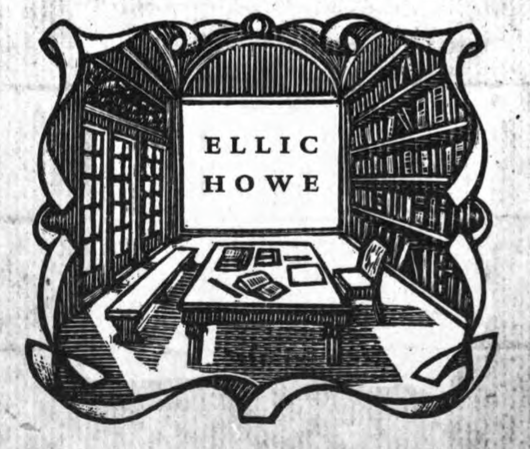
Ellic Howe, Google Books, and a Bookplate

Screen Shot 2015-12-04 at 5.41.34 PM
Ellie Howe’s Bookplate. From the front pastedown of The Book-finishers’ Friendly Circular on Google books: https://books.google.com/books?id=LlwEAAAAQAAJ&pg=PAcontents.

When I worked as a book clerk at the late Gotham Book Mart in 1980’s, provenance, especially on modern books, mattered little to me.  So what if someone famous touched, looked at, owned, or read this particular book, I reasoned. What meaning could possibly be transferred from this?

But recently, while doing some research, I stumbled across the bookplate of Ellic Howe, from the digitized version of The Book-Finishers’ Friendly Circular, 1845-51. (BTW, this copy is much easier to read than the Garland reprint) Howe is a well known book historian and I consider his The Society of London Bookbinders, 1780-1951 the best book yet concerning the London Bookbinding trade.

The Book-Finishers’ Friendly Circular is a wonderful slice-of-life, filled with humor, history, poetry, practical information, and reports on meetings. There is endless arguing about who it making more money, quite similar to what binders often talk about now. The primary evidence in this book informed much of Howe’s publications.

Howe’s stunning bookplate made me realize this book once belonged to him. It illustrates a dramatic one point perspective view a private study. It establishes books as a transactional space between the past and the future: a storehouse of knowledge on the right side of the room, which are being used in this scholars library to create more books, his own writings spread out on the table. Howe’s name is projected on what could be mistaken for a movie screen on one wall, which illuminates the room along with the windows. Is this possibly an allusion to the power of the scholarly interlocutor?

More surprisingly, I felt a bit star-struck: even though I knew I was reading this book virtually, it thrilled me to know I was reading Howe’s copy.