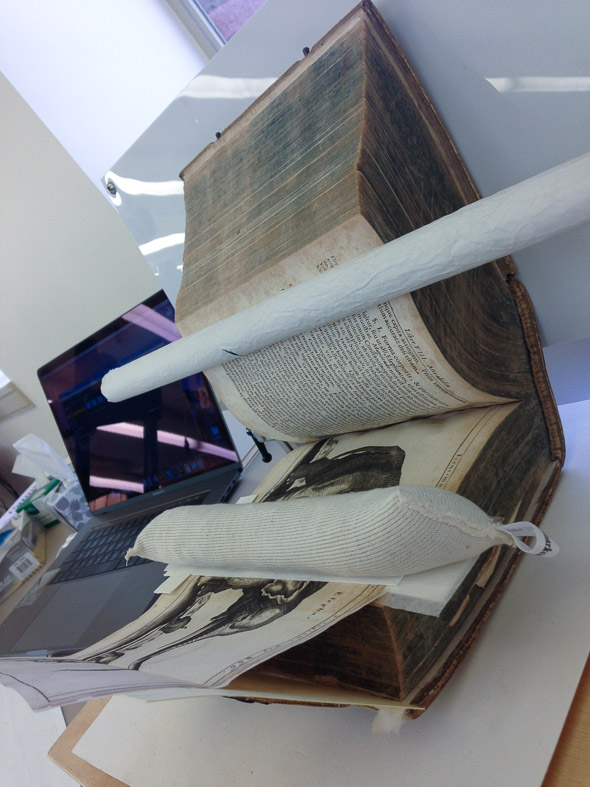
Nice to see my Book Fixture getting a workout at the UCLA Library Conservation Center, battling all 1,389 pages of Gasper Schott’s 1667 Physica Curiosa. Typical of alum tawed books from this time, the spine is now very inflexible; note that the leaves start to drape about 2cm from the folds. These books are a bear trap, err, make that an elephant trap in this case.
Thanks to Chela Metzger, Library Conservator at UCLA, for initial impetus for the fixture. And she is now Tweeting!
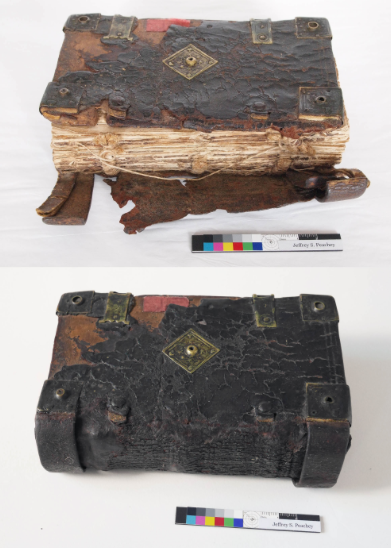
Top: Before, Bottom: After. The only known copy of the first printing of the Ausbund, an Amish Hymnal. Mennonite Historical Library, Goshen College, Goshen, IN.
My recent treatment of the only known copy of the 1564 Ausbund has been getting some press from my hometown area and in Mennonite publications. The Ausbund is one of the earliest Protestant songbooks, still in use by the Old Order Amish.
The treatment is especially interesting since two parts of the book were rejoined after being separated for almost 90 years, and the treatment also involved a textblock infill to deal with the missing leaves, while preserving all the extant spine. The book is a Sammelband, so contains the Ausbund and a number of other texts. The history and provenance of this book are a fascinating story. Reportedly, a dealer tore the book in half in 1928 so that a Goshen College professor H. S. Bender could purchase only the most “valuable” half for $10.00.
If you are interested in a longer, detailed history and description of the treatment, Ervin and I wrote an article: “Ausbund 1564: The History and Conservation of an Anabaptist Icon.” Pennsylvania Mennonite Heritage, October 2016. (pp. 128-135) You can read it here.
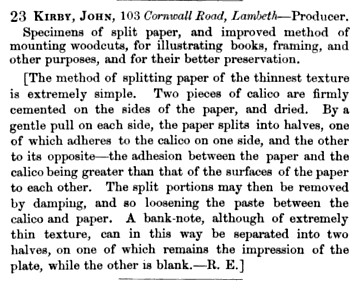
This is the earliest description of paper splitting I’ve seen. It is also the earliest mention of splitting as a means preservation that I have found, though it does not specify why splitting a piece of paper into two might aid in its preservation. It suggests it can double your paper money, though.
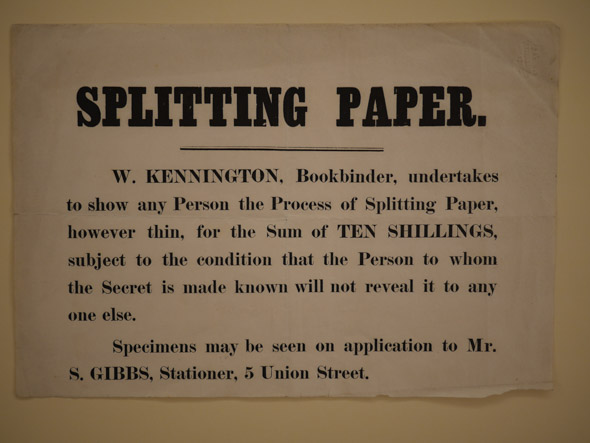
An early attempt to monetize paper splitting comes from a bookbinder in England in the late nineteenth century. Kennington’s secret of paper splitting must have been quite simple since he required a non-disclosure agreement. This broadside is not dated, but looks ca. 1870-1880.
As recently as 15 years ago, machine paper splitting was still being actively researched, practiced, and machines developed. It is quite likely the last mass attempt to preserve brittle paper. Now we digitize.
Splitting Paper Broadside, n.d. Cary Graphic Arts Collection, Bernard C. Middleton Collection, Rochester Institute of Technology.


 Peachey Conservation