
There are some sobering statistics in The FY2014 Preservation Statistics Report, by Annie Peterson, Holly Robertson, and Nick Szydlowski. Eighty-seven cultural institutions responded; primarily academic libraries. Although the authors caution about extrapolating the data since the respondents were self-selecting, I find it difficult not to view the results as roughly indicative of general trends in libraries. The most striking finding is the steady decline in the money spent for bound volumes.
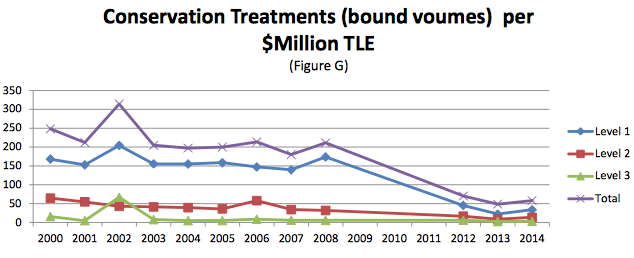
The treatments reported tend to be quite utilitarian, more aimed at circulating rather than special collections. For example, a Level 1 treatment takes less than 15 minutes, a Level 2 between 15 and 120 minutes, a level 3 more than 120 minutes. Most conservation treatments for special collections materials take much longer than 120 minutes.
The authors report that “from 2000 to 2014, total conservation treatment of bound volumes declined faster than commercial binding; treatment declined by 77% in that period, while commercial binding declined by only 69%.” This survey includes in-house and outsourced conservation activities: 92% of respondents had at least some type of in house conservation program, and 70% outsourced at least some treatments. In all, the survey encompasses the treatment of 1.6 million items. The only growth area is a slight—though not dramatic— increase in spending for digitizing and in reformatting of audiovisual materials.
No, the sky is not falling, but as a book conservator, it is worrisome to see these trends. Frankly, I don’t see the situation changing significantly in the coming decades, until we reach the point where the book and the text have become totally individuated. Then, hopefully, the book will experience a reappraisal.
It is well worth reading the full report: The FY2014 Preservation Statistics Report.
 Peachey Conservation