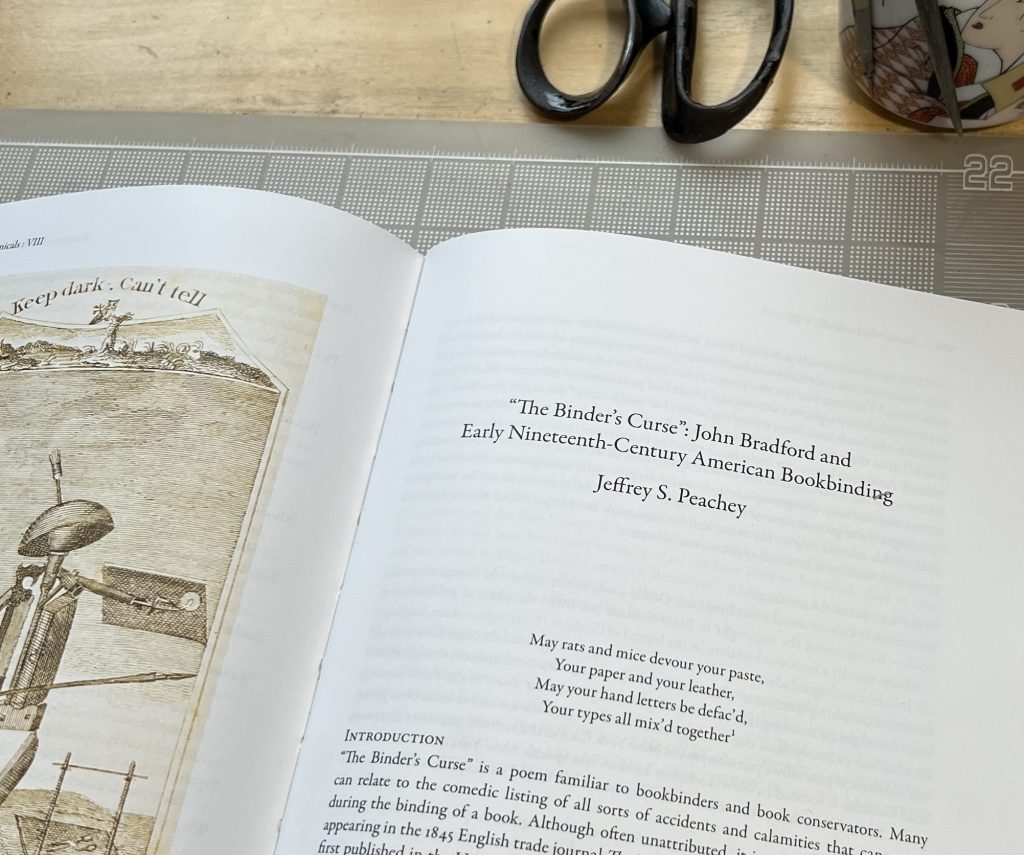
The Binder’s Curse: John Bradford and Early Nineteenth Century American Bookbinding, in Suave Mechanicals 8, The Legacy Press, 2023, 387 – 457.
“Keep Dark. Can’t Tell” With these four words, 19th century NYC bookbinder John Bradford begins an extraordinary book of bookbinding related poetry and imaginative parody. Written records from craftsmen during this time are very uncommon. Writings from bookbinders are very, very uncommon.
Bradford’s well-known poem, The Binder’s Curse, contains an introduction which places it in the context of a trade dispute, which is not so well known. The full title of the book gives a hint at Bradford’s wacky worldview: The Poetical Vagaries of the Knight of the Folding-Stick of Paste-Castle andThe History of the Garrett, &c. &c., Translated from the Hieroglyphics of the Society, by a Member of the Order of the Blue String, Printed for the Author, [New York], 1815. The title is not just poetic exaggeration; part of the text consists of — supposedly — translated and untranslated hieroglyphics.
“This world’s a huge bindery…” Bradford proclaims, decades before Mallarmé’s more famous dictum, that everything in the world exists to end up as a book.1 Bradford constantly reinforces this world-as-bindery cosmology: Did this guy ever think about anything but bookbinding? Yet these poems provides primary documentation of bookbinding techniques and tools: the first mention of a squaring shears, details of which tools the binder owns (Bradford was a journeyman his entire career) and which the master provided, the use of templates, and more. There is a lot of serious bookbinding history buried in his poems.
There are also less serious aspects, like some really cringey love poetry. “Her forehead is like a paste bowl / And smooth as a fine paring stone.” Anyone want to guess what body part is “white as wheat paste”?
Bradford gives us a sense of the working life of an early nineteenth century binder, including day-to-day annoyances, and trade politics, all written with his relentlessly quirky sense of humor. The poem “Receipt for binding a book” consists of the earliest comprehensive listing of the steps in American binding, which is analyzed in depth by comparing it with extant bindings and relevant bookbinding manuals of the day. Bradford’s poems provide a insight into an imaginative bookbinder working on the cusp mechanization, especially dealing with the importance of tool ownership and use.
Thanks to editor Julia Miller and publisher Cathy Baker of the Legacy Press. And congrats to all the other authors below! I can’t wait to read the other essays. Available soon from Oak Knoll Press.
KEEP DARK
Essays in Suave Mechanicals, Vol. 8.
DO NOT attempt this curse at home! Provided for informational purposes only. The beginning of “The Binder’s Curse” from The Poetical Vagaries of the Knight of the Folding-Stick…. 1815.
Malarmé, “Les Livre, Instrument Spirituel,” Quant au livre, 1895. ↩︎
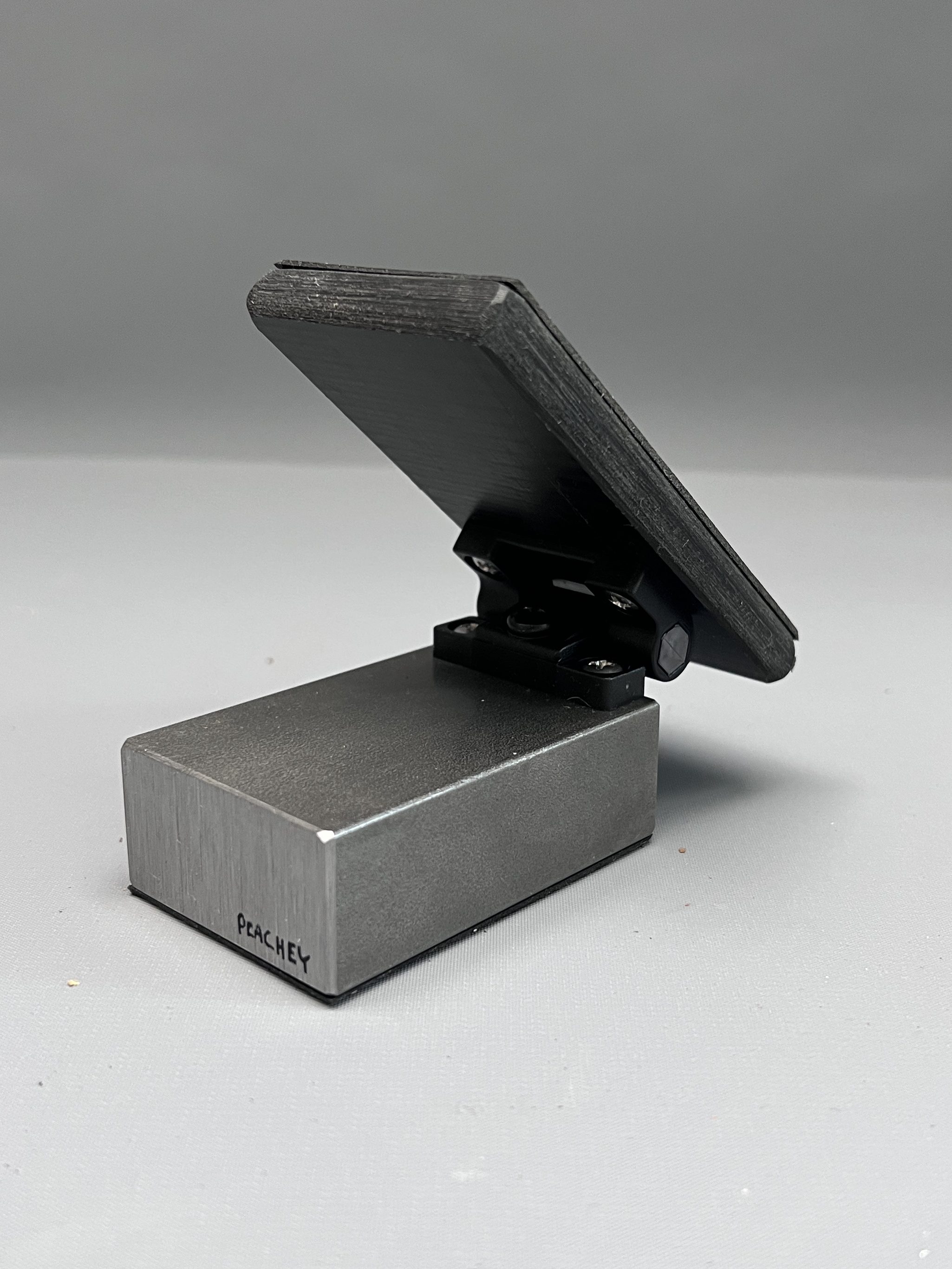
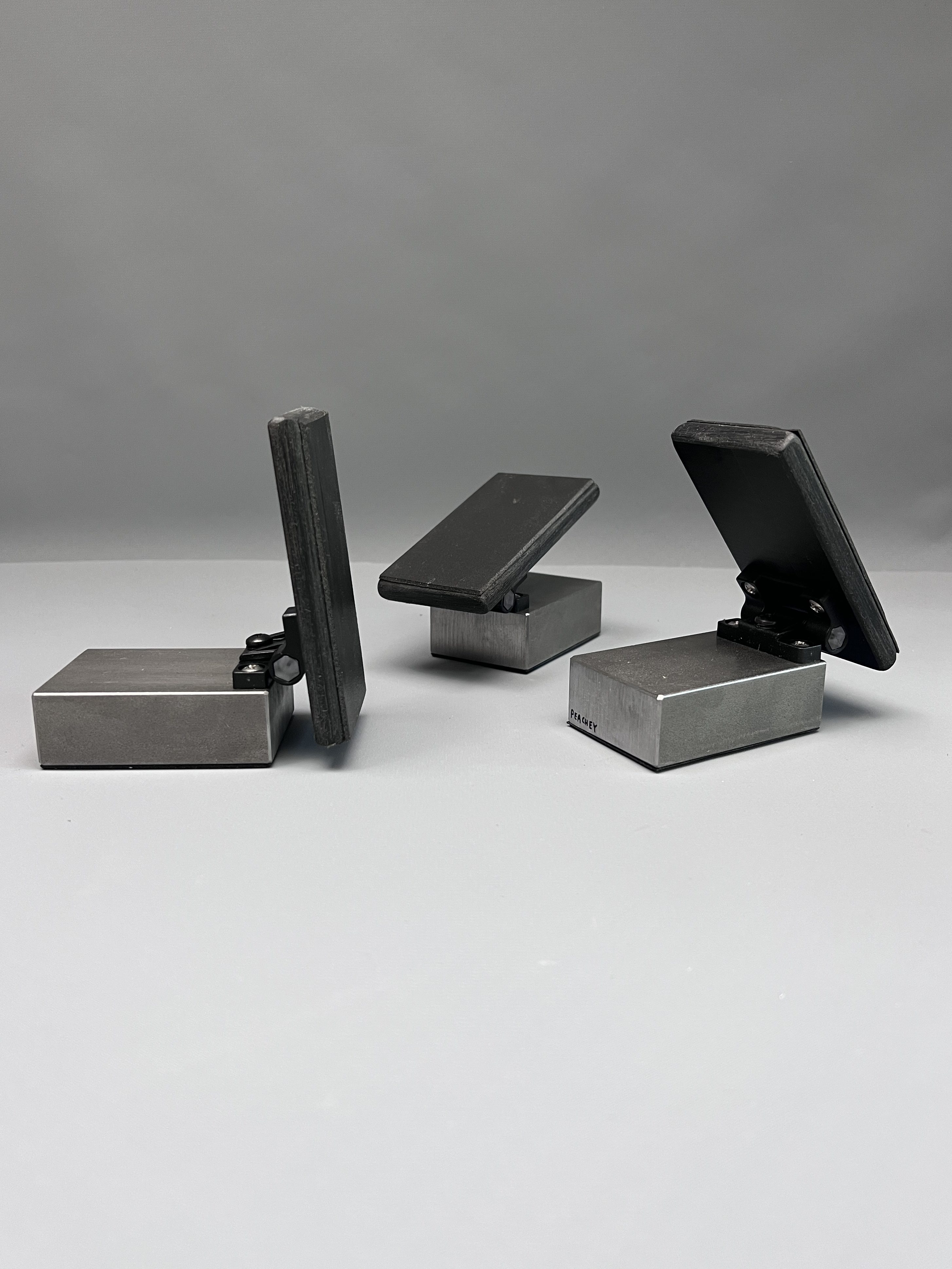
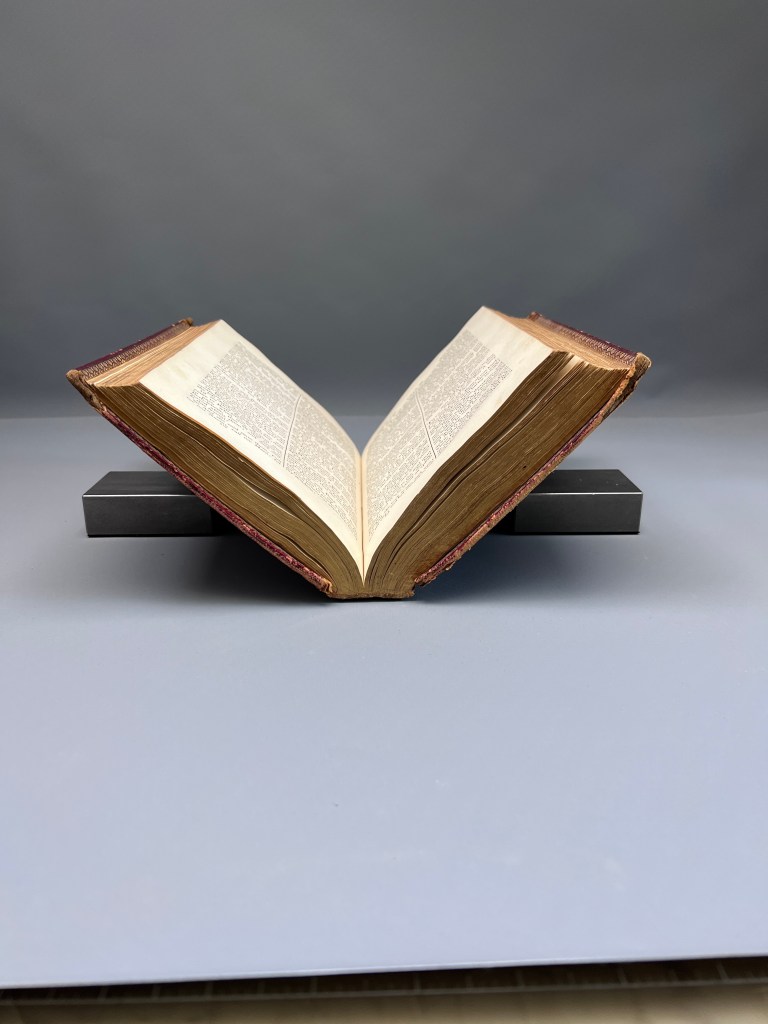
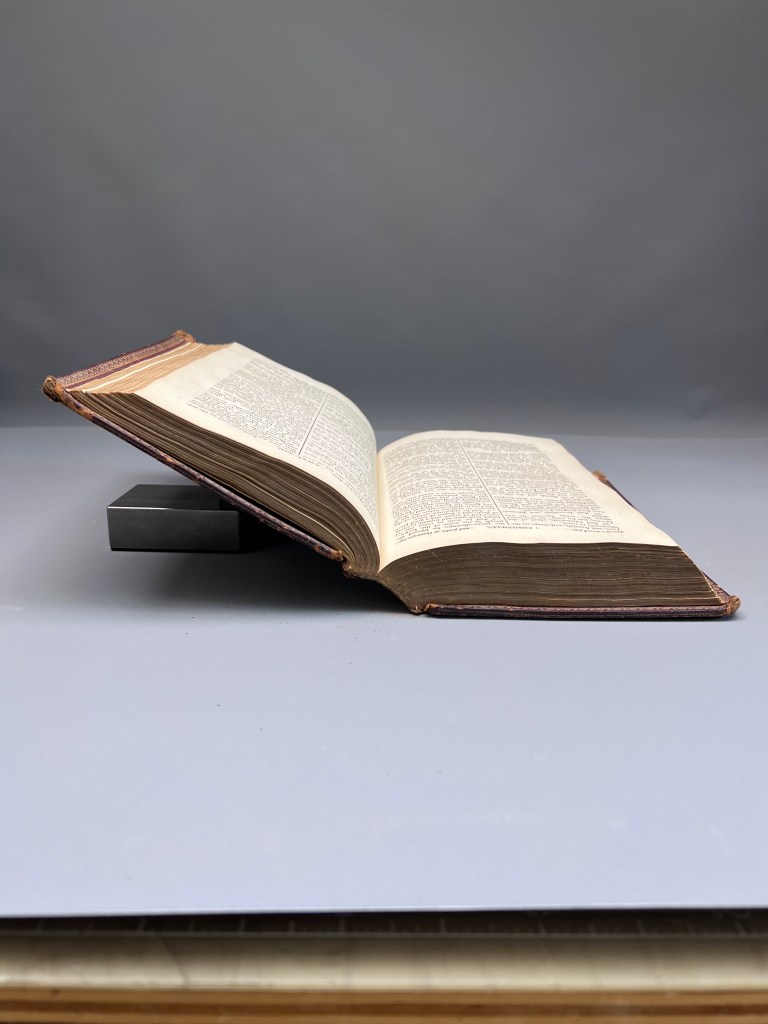
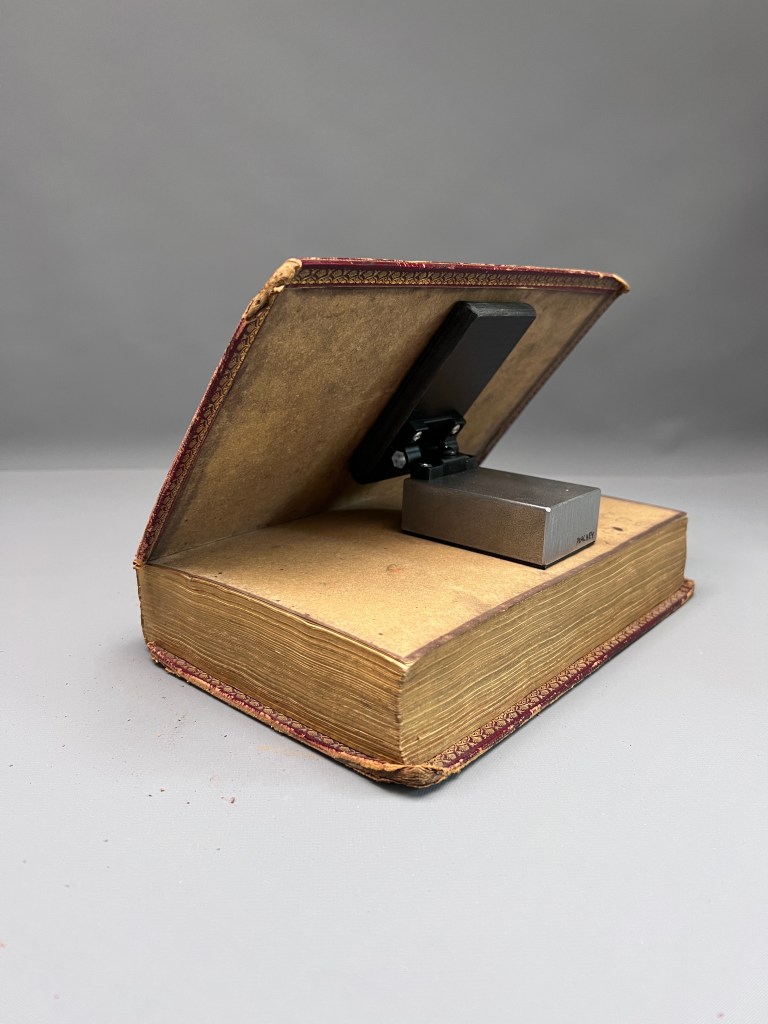
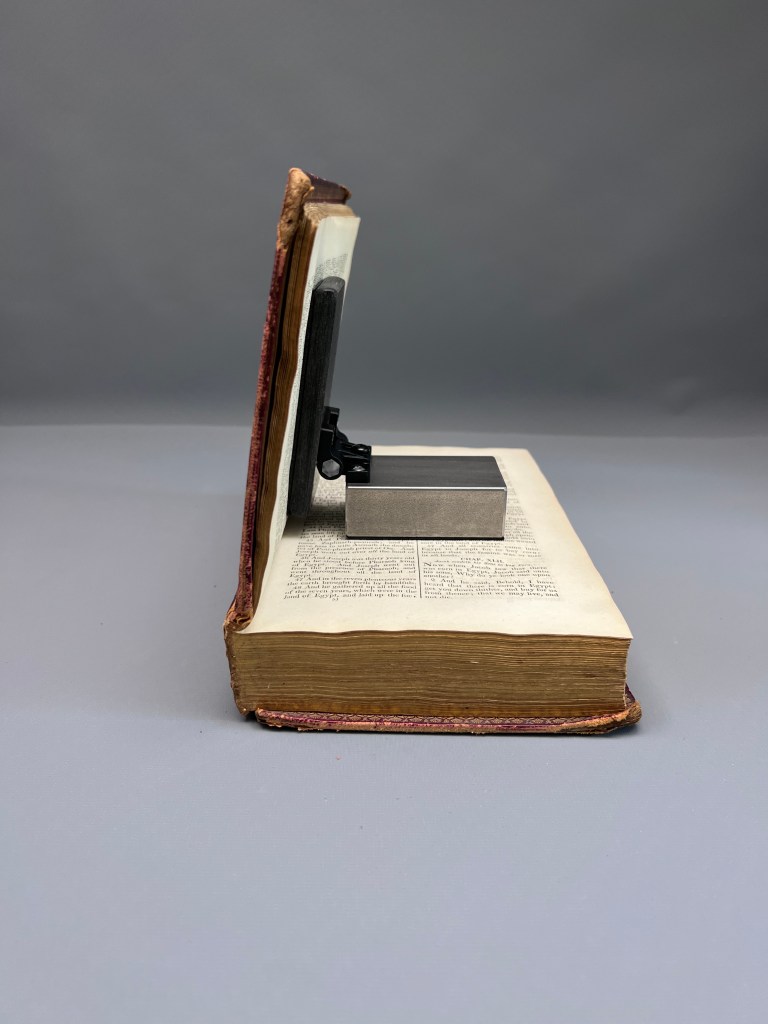
The Weighty WedgeWeighty Wedge is adjustable with a friction hinge
There are dozens of book wedges on the market; the Weighty Wedge is intended for book conservators to use during treatments. It conveniently holds books open in a variety of positions. At 1.9 pounds, or 850 grams, the steel base stays put, and the friction hinge is easily adjustable with one hand from 90 degrees to almost flat. The Volara lined contact surfaces are safe for contact with artifacts and easily replaceable if they become soiled.
These wedges are useful when working on the insides of books for page repair, board edge consolidation and sewing extensions. They can be used to support books open when measuring for display cradles, photography, examination, etc.
Size: Average 4 x 2 x 2 inches. Materials: Steel, Delrin, and Volara. Weight: Average 1.9 pounds or 850 grams. One wedge per order.
I get asked this question quite frequently, and fortunately, Evan Knight gave a great answer on the AIC Membership Forum. He agreed to republish an expanded version of his original post here. Lots of solid advice. Thanks Evan!
I can relate to this question. Been there. It may seem possible to become a conservator based on experiences alone, but I think that route is more expensive, riskier, and more time-consuming than pursuing graduate school. At least that was my calculus when I decided to pursue a career in the field.
Like any craft or trade, it takes years of practice and study to get ‘good’—that is, to consistently perform ethical, effective, and elegant conservation treatment. Although some trades and/or their unions have apprenticeship pathways into their fields, ours does not. So finding paid local opportunities in the field can be challenging (at any level)—especially for entry-level positions. They just don’t come up very often. Granted, on your own, you might be able to study conservation and take occasional workshops, but they can only take you so far. Workshops don’t bestow certain skills—in my opinion, they can provide excellent training, but it is complementary to your bench work. And academic study, while important too, doesn’t adequately prepare you to perform quality craft work either.
About this field more generally, my advice is that all paths into and through conservation will be a constant hustle. Often very rewarding, but a struggle, nonetheless. Money issues will never go away, even in grad school and afterwards. I had to have second jobs for years, before, during, and after grad school, and anecdotally, several colleagues–some extremely experienced and responsible conservators–don’t make six figures. So the road is challenging and the ceiling can be limited for many of us: something to consider if you might eventually intend to live in a high-cost-of-living location, buy a home, raise a family, take vacations, etc. But such is the nature of our field, and it’s not that different from other related professions in the arts and humanities, and even roles in academia. For better and worse, performing high quality work on exceptional objects is often our greatest motivation and results in our greatest fulfillment.
I was given somewhat similar advice: that I’d never make deluxe money — yet I was still compelled to pursue conservation for books, prints, and archives, even though my undergrad focused on humanities and history. So I went about getting conservation experience, knocking down graduate school pre-req’s, and becoming a competitive candidate for graduate schools.
Early in my 20s, I had a day job in a totally different field, and clung to it as longer than reasonable(!), while finding initial volunteering opportunities on the weekends (at a high-end book bindery) and one day a week at a conservation lab (at an art museum library). I read a great deal of art historical / print history books, and took workshops in box making, book binding, even fly-tying, plus a couple intermediate drawing courses. It’s great that you’re in a city like Chicago — opportunities for hands-on experience in conservation or closely related fields tend to be located near great collections. Whatever collection formats you might wish to learn about or work with, Chicago certainly has ’em. Connect via email and phone with any lab you learn about and let them know where you’re at. Try AIC’s “Find a Conservator” tool, or if you’re a member, the professional directory, and of course, your own internet research into museums, special collections repositories, etc. They might not have something for you right away, but then follow up six months or sometime later; or maybe they can only host volunteers on a certain day of the week. Remember that hosting a volunteer or intern can take significant time and effort on their part, and sometimes they can’t swing it. Private conservation studios can ramp up and down based on certain large projects or grants — as a “technician” or intern or what have you. But without any experience, it might not be realistic either (chicken / egg situation)—though still worth a shot in my opinion. In my experience, most everyone I met in my journey was willing to at least talk with me, help me out if they could, or point me to other opportunities.
To be a competitive candidate for conservation grad school you will need significant academic pre-requisites in addition to conservation experience. Each program has different pre-req’s so learn what they are and plan to ‘fill in’ what you don’t yet have because those are non-negotiable. Chemistry is typically the biggest hurdle. I personally went through 2 years of chem after my undergrad (4 courses in total), which went fine, but I took them at rigorous and expensive schools, which in retrospect wasn’t the most cost-effective choice. I thought Ivy League chemistry would be really useful in the long run of my career but in my experience, they weren’t: save your money and find nearby public options. Long story short, it will likely take a couple years until you will be a competitive candidate, so plan accordingly how you might make it all work – financially, academically, and experientially.
I’m sharing my response publicly because the dearth of reasonable opportunities at all levels, but especially those at the entry-level, is a profession-wide issue. It seems, to me at least, that most paths into and within our great field require a great deal of time and money at many career stages (not just pre-program), and a laser focus on the profession from an early age. Healthy industries have pro-active employers and active affiliate organizations that systemically cultivate equitable access for opportunities for their workers at every stage of their careers. I don’t know that we’re so healthy and equitable, but I know that many do care, and have worked hard to improve this in our field.
I’m happy to support your journey and wish you luck: slow and steady is my advice, honestly assessing your career interests and prospects periodically along the way (it’s ok to move on from something; or to specialize in something – it’s all a part of growing personally and professionally), while of course to continue earning income in whatever ways that make sense!
Evan Knight looking quite proud of his innovative double drop spine box!
Evan Knight is the Preservation Specialist with Massachusetts Board of Library Commissioners since Dec 2018 and Proprietor of Knight Art Services LLC since 2021. He is a Peer-reviewed Professional Associate of the American Institute for Conservation (PA-AIC). Previously, he was an Associate Conservator of bound and unbound materials at the Boston Athenaeum, with prior conservation employment at the Northeast Document Conservation Center, the Library of Congress, the Benson Latin American Collection at the University of Texas, and the Municipal Archives of New York City. Additional internships undertaken at the Harry Ransom Humanities Research Center-Book Conservation Lab, Biblioteca Ludwig von Mises (Guatemala), Buffalo Bill Center for the West, and the Metropolitan Museum of Art-Watson Library.