A Book Conservation Treatment Gets Personal

Most books I work, especially the ones that have been around for a while, have a name, bookplate, or other inscriptions in them.  Sometimes I can read these, sometimes I can’t. They are preserved as evidence of how the book circulated, how readers responded to it, which institutions collected it, dispersed it, and so on.  This evidence of use makes many printed books unique objects.

Even among private collectors and dealers, there is much more awareness of the importance of these marks, and a corresponding willingness to leave them in place. A couple of decades ago, many owners would want them to be removed, and I would have to persuade them to keep them.

I’m especially thankful that no previous binder or owner cleaned up the inscriptions in the book below.
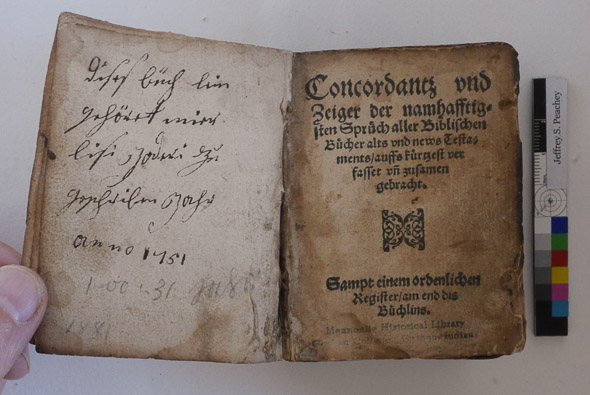
Concordantz, ca. 1550. Inscription and title page. Courtesy Mennonite Historical Library, Goshen, Indiana.

When initially examining this book, the Concordantz, the curator of the Mennonite Historical Library dropped a bombshell on me. He informed me that the inscription on the left in the above image, is from my sixth great-grandmother, written in 1751.  “Wow, this is pretty cool!” was the most coherent professional thought I could express at the time. I wouldn’t have been able to decipher this inscription.

The inscription reads, “This little book belongs to me Lisi Joder, written in the year Anno 1751.”  It is also signed by my fifth great-grandmother in 1787. In 1811, the book went to an older sister of my fourth great-grandmother, thus breaking the direct connection to me. It entered into the Mennonite Historical Library in the 1940’s. I promised the curator not to repatriate it to my family!

I intend to write a longer account of my treatment, the importance of books, and my relationship to this treatment, after some more reflection.
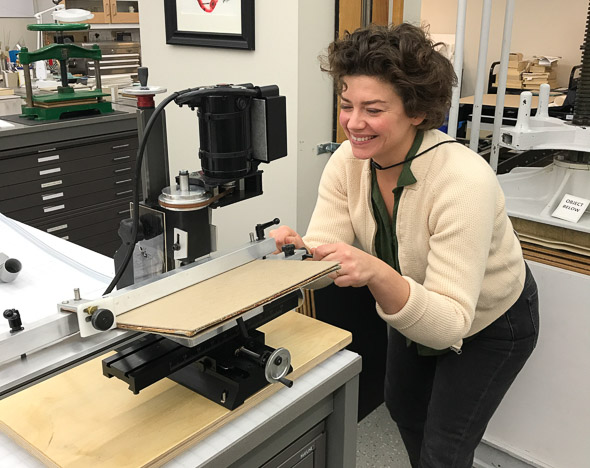
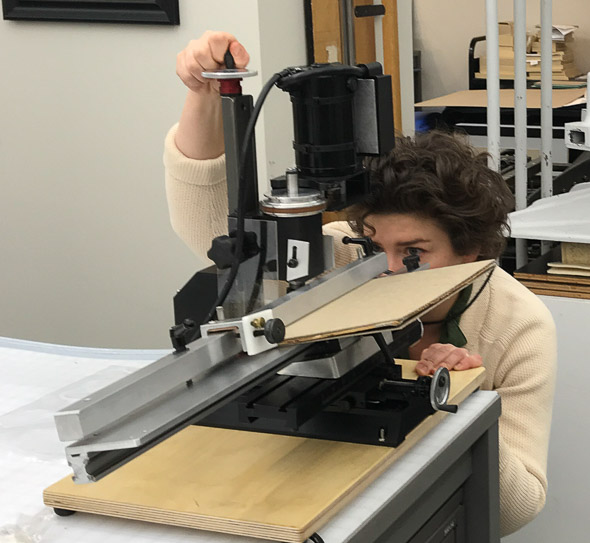
 

Board Slotting at John Hopkins Department of Conservation

Jennifer Jarvis, Conservator in the John Hopkins Department of Conservation and Preservation, demonstrates how fun book conservation is using the Peachey Board Slotting Machine.

John Hopkins Department of Conservation and Preservation recently acquired a Peachey Board Slotting Machine as another technique in their book conservation arsenal to reattach detached boards. Detached boards are likely the most common place books fail. This machine accurately cuts a very small slot, as thin as .015″, to allow a hinge to be inserted without disturbing the covering material or obscuring evidence of lacing, board attachment, etc…. The machine is manually operated, and can accommodate boards up to a 18″ high. The start and stop of the slot is controlled by setting adjustable stops.

No matter which side of the fence you are on regarding the use of leather in book conservation, board slotting with a cotton or linen hinge is a strong and durable base. The fabric can be left alone or colored with acrylics for fast repairs. Or board slotting can be combined with other treatments — such as tissue repairs, cast acrylic repairs, and leather onlays — to achieve a high degree of aesthetic integration. Board slotting is especially suited to nineteenth century leather bindings with a made hollow. More information on different structures for board slotting.

Contact me for a price quote.

Jennifer Jarvis aligning the height of the blade where it will begin making the slot. This is much easier on the new machine, since you can sight the length of the board from the end of the machine.


The Origin of Mohawk Superfine

Quite likely, every bookbinder and book conservator located in North America has used Mohawk Superfine paper.  It’s a wonderful paper for many applications: textblocks for models, endpapers for circulating collections, lining boards and spines, labels, and so on.

Surprisingly, at least to me, the name does not come from 1970s urban slang, or the 1960s Garage Rock band The Superfine Dandelion, but was coined in 1946.

Mohawk originally developed Superfine as the result of a challenge from Yale University Press to produce an attractive, archival text paper for their reprint of The Papers of Benjamin Franklin. A Mohawk representative showed a sample of the new paper to a customer in Boston, who reportedly said, “this is a superfine sheet of paper.