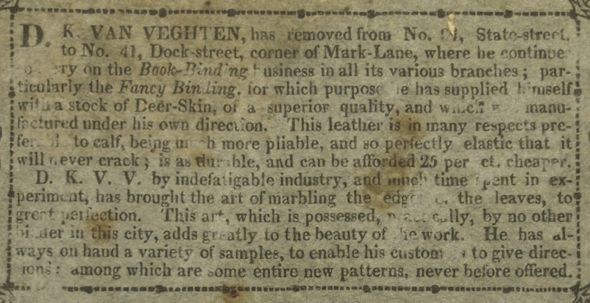
An advertisement on the back cover of “A Treatise on internal navigation.” Ballston Spa [N.Y.]: : Printed by U.F. Doubleday., 1817. Image courtesy The Library Company of Philadelphia.Calf, sheep, goat or pig. It seems 99.9% of leather books are made with one of these these. But other types of leather are always a possibility. For example, deerskin was commercially available for bookbinders in the early 19th century North America. The above advertisement, from D.K. Van Veghten, implies it is a new innovation he is introducing to the market. Given the large numbers of deer — even now — I wonder if this it was all that new. After all, muskrat or beaver are not unheard of in the 18th century. It is best not to become blasé with leather identification.
Below is a vegetable tanned deerskin, with two bullet holes. It was shot by my Grandfather between 1946 – 1954, and he had it vegetable tanned. He also had a couple of heads mounted on the wall of his living room. Deerskin is softer and stretchier than sheepskin, and the grain is more pronounced in this example. Because of the stretch, it is difficult to pare, even with the best paring knife in the world. Possibly different vegetable tanning methods would have made it look more like calf. Most of the examples I’ve seen on books are very similar to calf, and a delaminating grain layer is often a clue that it is in fact sheep. D.K. Van Veghten’s advertisment also mentions it is quite similar to calf, but 25% cheaper.
I don’t think of the deer when I look at the deerskin below, but of my Grandfather. The bond between things and memories is strong. I can’t bring myself to use this partial skin. The familiar curse of a precious material; it’s too nice to use. So it languishes, only to be written about.
Sample of tanned deerskin shot by my Grandfather. Note the two bullet holes.
Nothing quite sums up the Holiday season for me like a poinsettia and hunks of raw blue fin tuna. Stressed? Too much to do before the end of the year? Feeling overwhelmed? Me too. I coped yesterday by playing hooky and indulging in arguably the best chirashi deal in Manhattan at Yuba for $15. Yuba was founded by a couple of ex-Masa employees: $15 there would get you exactly 11 grains of rice.
Other coping mechanisms include buying stuff.
The Peachey Branded Microfiber Towels are in stock! A great stocking stuffer, or you could even make a stocking out of it. I made to logo by having a steel stamp made from my handwriting, then stamped it onto a piece of horsebutt, then had it dye sublimation printed onto the towel. Genuine Horsebutt Strops are always popular.
To be safe, order soon, although the post office estimates December 17 as the deadline.
I suppose most bookbinders are familiar with this depiction of Roger Payne. I first encountered it as Plate 59 in Edith Diehl’s Bookbinding: Its Background and Technique, which was the second book on bookbinding I read in 1988. The scene is often referred to as a “dingy garret”, though to be fair, many slightly later depictions of binderies, ca. 1830’s, are in a similar state, with cracked plaster, dirty looking walls, etc….
There is something appealing about the scene, a locus of honest, if impecunious, craft. His timid, almost mouselike glance conveys an earnestness. He seems weak, leaning on a book in press to support his thin frame. The press tub itself is so dinky I can’t imagine using it to back a book — how would the press itself stay stable on it? The book on the press is also in an odd position. It is difficult to believe a binder would press down on the spine like this, when the book is only supported by the foreedge boards. There are other oddities. Why are there books lying on the floor? Why is he wearing slippers and torn pants? Should we chalk it up to the artistic imagination of the artist who drew him?
And what are in the three pots that have spoons or brush handles sticking out of them? Are they barley broth pots as one theory advances, which he was supposedly fond of? Or are they glue pots? The one in the brightly burning fire would likely be too hot and ruin the glue. The one on the mantle might be a good temperature to actually use. Could the one in the window be kept cool for storage? Or, again, are we back to speculating about an artist’s imagination.
We do have actual evidence of Payne and his work, found in the books he bound, and his invoices, written in his own hand, and very detailed for the time.
Handwritten bill from Roger Payne, The Morgan Library and Museum. # MA 3889.
There is a collection of 35 of them bound together at the Morgan Library and Museum. Accession Number: MA 3889, Unfortunately, they are separated from the books that he bound. What a loss! There are a number of Payne’s bindings in the Morgan’s collection.
While they do not reveal the mystery of his pots, they do reveal a kind and conscientious bookbinder, as in the above bill. He mentions reducing the price by one days work because he wasn’t happy with the quality of the result.
His bindings are beautiful, with his often lauded tooling, carefully handled straight grain morocco, and often exceedingly thin boards that are invariably dead flat even today. He is still a role model!



 Peachey Conservation