Not only a clear illustration of traditional late 19th century pastedown trimming for half leather bindings, but an informative use of binders slang of the day: “cobbs” (for cobb paper, common at this time) and wonderfully descriptive “topper”. I’ll have to use it in class the next time I see this problem! It is still a common impulse for students to want to cover a mistake in a pastedown. This article is part of a series, dealing with pasting down difficult materials, including moire (or watered silks) and leather doublures.
J. Howard Atkins, Tying the Future to a Thread. Medford, Mass: Oversewing Machine Co. of America, Inc., 1968. Front Cover. Middleton Z 269.5 .A8 1968. http://library.rit.edu/cary/
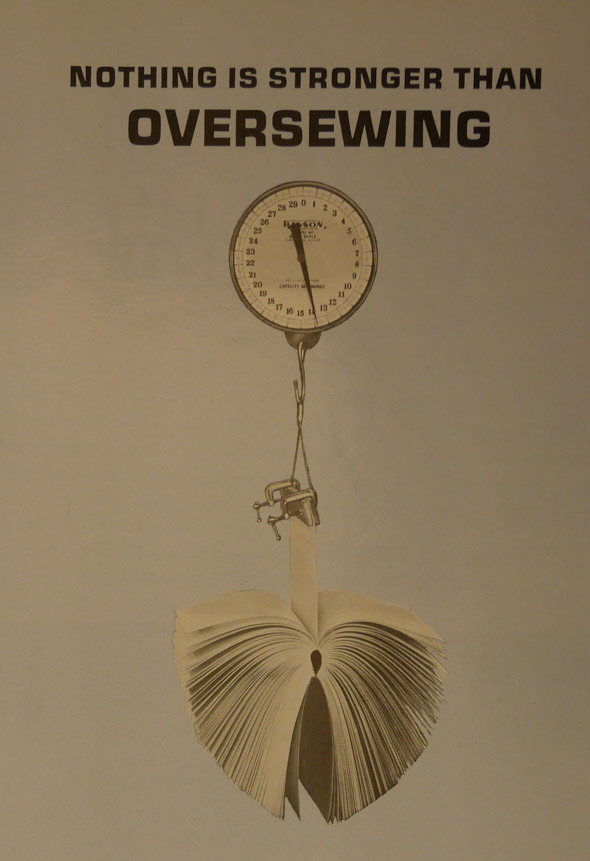
What appears to be a 1970’s post-apocalyptic novel concerning the dangers nuclear stockpiling is actually about a far more dangerous situation. OVERSEWING!
Could pass for an artist book installation. J. Howard Atkins, Tying the Future to a Thread. Medford, Mass: Oversewing Machine Co. of America, Inc., 1968. p. 18. Middleton Z 269.5 .A8 1968. http://library.rit.edu/cary/
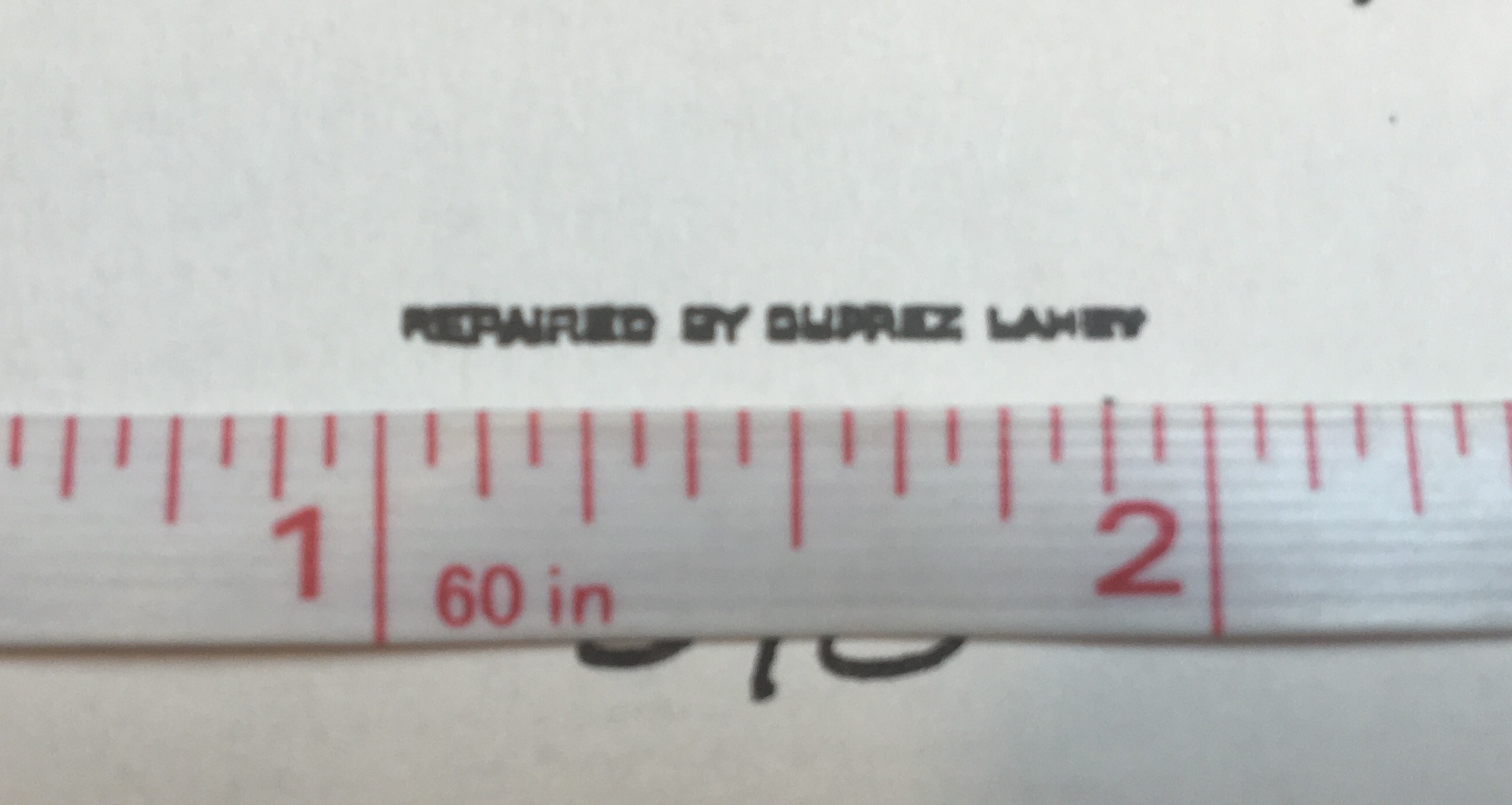
This partially effaced stamp is unusual, in that it says repaired by, rather than bound by. But who repaired this book? “REPAIRED BY DE xxxxxxHSY” or maybe “REPAIRED BY DAVID xxxxHSY”? The letters are .5mm high, and it is positioned in the bottom left corner of the front board pastedown.
retroReveal, which can sometimes aid in legibility of fragmentary marks didn’t help in this case.
Robert Milevski, author of “A Primer on Signed BIndings”, was not familiar with it. He did send a useful overall typology of binders stamps, however:
In research done in Princeton University Library about 15 years ago (before many 19th c books were transferred from the open stacks to offsite storage), my recording methods were necessarily primitive and thumbnail (because I had to get through half a million books rather quickly), lacking in detail, usually, other than a call number, binder’s name, and type of mark. When I went back to these records and books (a couple of years later after their going offsite), I ignored anything not obviously English. Some of the bindings represented by these ignored minimal records probably had some interesting stamped signatures, similar to yours. (A sad thing, however, is that in that interim, some of the books, because of condition, had been rebound, thereby losing their binder’s signature history.)
I did look at my main spreadsheet of English signed bindings (3600 records at present, with more than 1000 yet unrecorded) and found a couple categories of mark other than ‘bound by’ but nothing like your mark. These others include: 1. just the last name of the binder; 2. last name of binder and location; 3. name of binder, address and designation as binder, usually in a two or three-story stamp. Of course, there is 4., the category of ‘bound by x for y’, usually a department store. And 5., ‘bound by x, successor to y.’ And 6., name of binder with a month and year, or more fully, 7., name, address and year. And 8., there is also the rare upside down stamp, usually only the surname, probably from getting the front and rear boards mixed up. That’s all I can say.
Generally, before modern art conservation principals began to be applied to books in the mid-twentieth century, most restorations and repairs attempted to be as invisible as possible. So why try and point it out by stamping the book? And then why did someone else try to crudely scrape it away?
***
Added 8 August 2016
Below is an image of the stamp Maria Fredericks mentions in the comments.