The Importance of Papryus in the Sixth Century

In the sixth century, Cassiodorus wrote this wonderful description of the impact of writing on papyrus on the thought process:

“Before [papyrus was discovered] the sayings of the wise, the thoughts of the ancients were in danger. For how could the writer have been able to write quickly, when, the hardness of the bark resisting him he would scarcely have been able to be ready? The excitement of the mind submits to the unfitting hindrances; when the words are harassed, the mental powers are compelled to grow lukewarm … This was fit only for the beginnings of the world. Then papyrus was discovered, and therewith was eloquence made possible … So smooth and so continuous, the snowy entrails of a green herb, which keeps the sweet harvest of the mind, and resorts it to the reader whenever he chooses to consult it; which is the faithful witness to all human action.”

-Elspeth Whitney, “Paradise Restored: The Mechanical Arts from Antiquity through the Thirteenth Century”, Transactions of the American Philosophical Society 80, Part 1, (1990): 67.
Book Slate

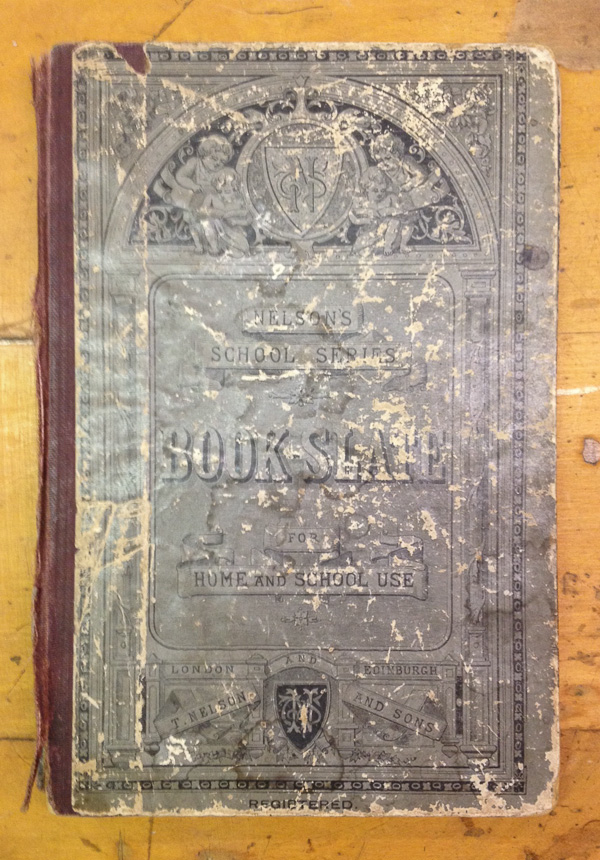
Nelson’s School Series Book Slate for Home and Student Use (London & Edinburgh: T. Nelson and Sons, [1900?]) is an odd structure, a diptych in a case binding. The exterior looks like a standard quarter cloth case binding with printed paper sides. The interior, however, is made from a painted slate-like material. It can be written on and erased. The earliest known diptych is from 14th-century BCE, making the codex seem like a newbie.  Is the laptop a 20th century iteration? Long live the diptych!

book slate
Nelson’s Book Slate. Exterior front board. This is a well used, but largely intact book. My Collection.
book slate 2
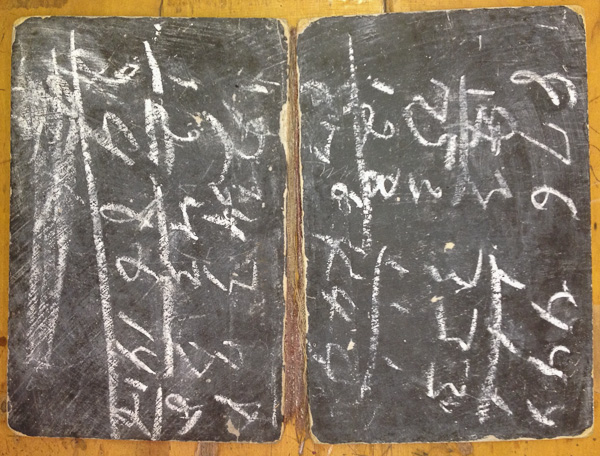
Nelson’s Book Slate. Open. Chalk marks of addition and subtraction. My Collection.

Sobering Statistics Concerning Book Conservation

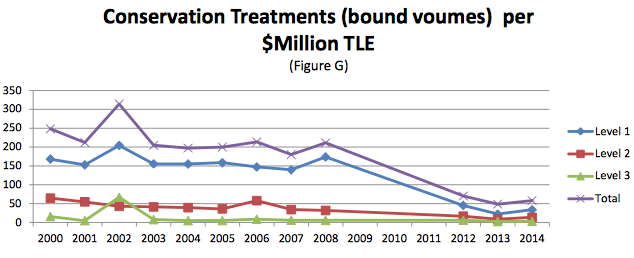
There are some sobering statistics in The FY2014 Preservation Statistics Report, by Annie Peterson, Holly Robertson, and Nick Szydlowski.  Eighty-seven cultural institutions responded; primarily academic libraries. Although the authors caution about extrapolating the data since the respondents were self-selecting, I find it difficult not to view the results as roughly indicative of general trends in libraries. The most striking finding is the steady decline in the money spent for bound volumes.

Screen Shot 2015-08-17 at 8.58.13 AM
Source:http://www.ala.org/alcts/sites/ala.org.alcts/files/content/resources/preserv/presstats/FY2014/FY2014PreservationStatistics.pdf Page 10.

The treatments reported tend to be quite utilitarian, more aimed at circulating rather than special collections. For example, a Level 1 treatment takes less than 15 minutes, a Level 2 between 15 and 120 minutes, a level 3 more than 120 minutes. Most conservation treatments for special collections materials take much longer than 120 minutes.

The authors report that “from 2000 to 2014, total conservation treatment of bound volumes declined faster than commercial binding; treatment declined by 77% in that period, while commercial binding declined by only 69%.”  This survey includes in-house and outsourced conservation activities: 92% of respondents had at least some type of in house conservation program, and 70% outsourced at least some treatments. In all, the survey encompasses the treatment of 1.6 million items.  The only growth area is a slight—though not dramatic— increase in spending for digitizing and in reformatting of audiovisual materials.

No, the sky is not falling, but as a book conservator, it is worrisome to see these trends. Frankly, I don’t see the situation changing significantly in the coming decades, until we reach the point where the book and the text have become totally individuated. Then, hopefully, the book will experience a reappraisal.

It is well worth reading the full report:  The FY2014 Preservation Statistics Report.