Though this is not the first photograph of books, which according to Larry J Schaff of the Talbot Catalogue Raisonne is Talbot’s “Bookcase” in Lacock Abbey, 26 November 1839, or the first photograph in a book, which was Anna Atkins’ Photographs of British Algae from 1843, I’m pretty sure it is the first photograph of books to appear in a book.
The books were from Talbot’s own working library when he was a student at Cambridge University. He arranged them outside, photographing them in the sunlight; even so, the exposure took 10 minutes. Book titles include: The Philosophical Magazine, Miscellanies of Science, Botanische Schriften, Manners and Customs of the Ancient Egyptians, Philological Essays, Poetae Minores Graeci, and Lanzi’s Storia Pittorica dell’Italia and more. Unfortunately, Schaff mentions that this personal library was largely dispersed in the mid-20th century.
I think this is also the first photographic shelfie, a 21st century term for a curated intellectual self-portrait using books or other objects on bookshelves.
Note the co-existence of many binding structures: extra boards bindings (left, top shelf), boards bindings (bottom, middle, spine torn near head and creases along spine) cloth case bindings with a natural hollow and paper labels (inferring from the smooth, uncreased spine), wrappered periodicals(?) with printed titles; and a large number of traditional leather bound books.
This is around the time period we will be examining in detail in my upcoming Early Nineteenth Century Bookbinding workshop. It’s exciting to have contemporary photographic evidence to add to the context of these books. If 19th c. photographs and books interests you, Carol Armstrong’s Scenes in a Library: Reading the Photograph in the Book, 1843 – 1875. Cambridge and London: MIT Press, 1998 is also recommended.
Trindles are used for flattening the spine of in-boards bindings after the boards are laced on, and prior to cutting the foreedge in a plough. This gives a smooth foreedge, without “stepping” of the signatures, which can result when rounding and backing after cutting. I recently designed some modern trindles in stainless steel. Essential for historical models and modern fine binding. 7 x 1.5 inches.
Usually, when a lecture or article begins with a dictionary definition of a particular term, I eye the closest exit or quickly switch tabs. After reading Arthur Green’s historical, technique based article on in-boards edge cutting and trindles in the new Suave Mechanicals 7 I found myself wondering about the origins of this unusual word.
My first stop: Mr. OED! The two volume quarter-scale print version with magnifying glass in a slipcase was one of the few books I brought with me in an overstuffed VW bug when I moved to NYC in 1989. Anyway — according to the dictionary — the word “trindle” has been around for centuries, most of time referring to proper names, or an object that is round or cylindrical.
From a google ngrams search, there is a reference dating from 1695 mentioning “trindle-pins” which may be some sort of fastening device for ships or buildings. This may lend credence to Green’s argument that Dirk DeBray’s use of long needles to flatten the spine are earliest trindles. For me, these two tools, while performing more-or-less the same function, are morphologically too different to be called the same name. Not every tool used to hit a nail is a hammer.
An early reference to trindles in Google Books. Source
Within English bookbinding literature, the earliest reference is found in Parry’s 1818 The Art of Bookbinding. They are simply described as “… two flat pieces of iron made the size and form of a folding -stick, to place between the back and boards of the book, before cutting the fore-edge (pp. 1-2). Folding sticks of this time are usually described as about 6-7 x 1 inches, and made from wood, ivory or horn. Trindles are one of the few tools Parry not only names, but describes how they is used. An implication they were uncommon at this point in time?
A few years earlier, the 1813 Circle of Mechanical Arts describes trindles without using the word, instead simply mentioning the technique as “… introducing 2 pieces of thin iron 4 or 5 inches long near the head and tail of the book, between the paste-board and the back…” (p. 77) Sounds like a trindle to me!
Two button sticks from my collection. The one on the top is roughly 7 x 1.5 x .039″
The top of the image is the quintessential trindle shape, roughly 6.75 x 1.5, and made by the English firm Bodil Parker brass foundry. They are quite thin and deflect when used to flatten the spine of a book, resulting in a foreedge that is less round than the spine when removed. The one on the bottom is more sophisticated, and has an English patent number that I can’t find information on. (Can anyone help?): “Patent No 116972/17” The various curves around the edges fitting around brass buttons of various diameters. The legs of this one would make it very difficult to use in bookbinding.
In the 20th century, museums and manufacturers generally refer trindles as button sticks (or less commonly, button guards). They tend to be associated with military use, dating to around WWI, and made from brass. Brass — as opposed to the thin iron usually mentioned in bookbinding literature — makes sense in that it would not scratch the buttons, since they are made from the same material.
Google ngram for Trindle, which may or may not refer to bookbinding, declines right around the time the guillotine, out-or-boards schoolbook binding styles, and publisher’s cloth case binding becomes predominant, and trindles would have no longer been necessary. Hum. Source
Questions remain. Did bookbinders coin this term in the second quarter of the 19th century? Was it used in the trade commonly earlier? Why would binders create a new term for the more common term “button stick”? Is it workshop slang? Bookbinding does have its own idiosyncratic colloquial terminology. For example, most trades use the term “tommy bar” for a long tightening rod, which bookbinders call a “press-pin”. The search continues. Happy trindeling.
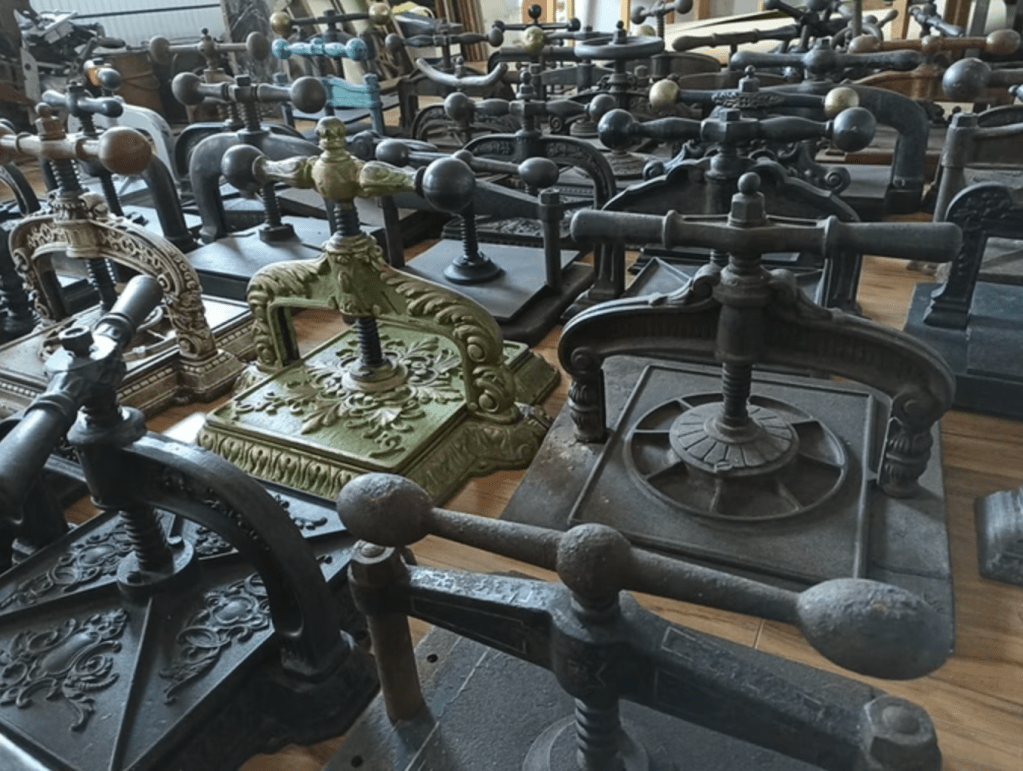
Some of Knyrek’s nipping press collection. Photo from his Kickstarter page.
Leszek Knyrek, a Polish bookbinder for 25 years and currently a student in Book and Paper conservation at West Dean (England), has a kickstarter for his really beautiful calendar featuring some of his 60+ nipping press collection. He calls it his “a bit late” calendar. The photography is really well done, and his collection amazing. I’m mainly familiar with US and UK models, there are some really elaborate European ones in the images. Full disclosure: he sent me a free copy of the calendar. But I’m looking forward to purchasing it for the next four years, maybe more if his collection keeps expanding!
I couldn’t find a number of presses the William Streeter collected for his book on the right. Barbara Rhodes and William Wells Streeter. Before Photocopying: The Art and History of Mechanical Copying 1780 – 1938 (New Castle, DE: Oak Knoll Press and Northampton, Massachusetts: Heraldry Bindery, 1999)



 Peachey Conservation
