A Book Conservator Goes to Hollywood: or, Pretending to be an Actor Playing a Bookbinder

It is pretty unusual—once in a lifetime?— for any craftsman to appear in a Hollywood commercial. I had my chance last week. In many ways it was almost the stereotypical experience: a phone call out of the blue, sending a production company a couple of images of me and my work, a bunch of phone meetings, sending more pictures, then all of the sudden a limo was picking me up at 5:00 am to fly to Los Angles.

The first day was spent meeting the director, producers and wardrobe fitting.  My “costume” was chosen, which was surprisingly similar to the kind of clothes I usually wear.  Loose linen shirt and blue pants, though they did make me wear a kind of silly looking heavy duty leather apron.  Wardrobe went to do a few alterations and I was driven to look at the set.

The set really looked like a bindery, even though much of it was from other trades.  All the small details were wrong, but the overall feel was right.  The director of photography was there with a top of the line DSLR, so I left thinking this was going to be a small, intimate shoot.

The next day my driver picked me up and the scene had changed dramatically. The crew parking lot was filled with over 70 cars.  The caterer had 4 tents set up.  All of these people would be filming me for the next couple days, and I’d never acted before.  I was playing with the big boys.

As my make-up was being applied and my hair cut, I kept thinking that my experience in teaching should help me out, since I’m used to having people watch me work.  Or maybe I should think of this as extreme method acting: I’d practiced bookbinding for 23 years, and now was my chance to perform in front of the camera?

I saw the real camera for the first time; one of those monsters used for film shoots that three people ride on. We shot the various stages of book binding at different times.  Often I had to repeat an action three times, for a wide, medium and tight shot. The raw footage I saw looked amazing; the most professional, seductive looking images of bookbinding I’ve ever seen.

Seductive images of craft are great PR.  I still remember how appealing Bernard Middleton’s hands were on the cover of The Restoration of Leather Bindings.  Quite likely it was a reason I got into bookbinding in the first place. Could the less scientific, and more romantic side of conservation be emphasized a bit more for public appeal and possibly funding? Or does it land us back in the murky world of craft and restoration which conservation strives to differentiate itself from?

Film shoots are pure chaos.  As one crew member recommended “embrace the chaos”.  But the crews were remarkable in the way they worked together, thought creatively and spontaneously, and in the end got the job done.  It was great to get a glimpse at this world.

If you happen to find yourself being filmed using a sewing frame, which is a de-rigor shot, use pre-pierced the inner folios but not the outer one.  This way you can feel the hole on the inside with the tip of the needle, and burst out through an unpierced outer folio with frightening precision, without having to look inside the book. Smooth.

The most difficult thing for me was doing a familiar action differently or at a different speed—either to show it better on camera or because the director wanted it. I spend most of my time thinking about pragmatic realities—reattaching a board to fit the textblock exactly, mending paper fibers to realign or grinding a knife to exactly 13 degrees— so it was a bit difficult for me to get my head around the “prop” mentality, and how much the camera would see, and concentrate on the action, not the object. It was hard work to repeat an action over, and over, and over. “Show the leather more love when you touch it!” In the end I was left with much more respect for “real” actors; it is hard, skilled work.

And how quickly I become accustomed to being treated like a star!  By the end of the second day, it seemed natural to have a driver, someone yelling “talent on the set” and “talent stepping down” when I moved on the set, a hairstylist preening me every 30 minutes of so, food and water brought constantly the minute I sat.

I signed a Non Disclosure Agreement (NDA) so can’t go into any details until December.  Once the commercial is live, I will post links to it on this blog.

Now, back to reality. Finish sewing an endband, then edge paring, spokeshaving, and covering an appealing well used edition of Luther’s Commentarie on the Epistle of Saint Paul, London, 1616. I keep telling myself I’m glad to be back in the real world. But….

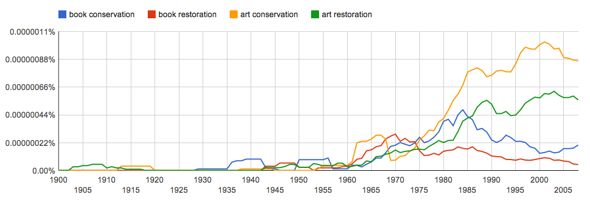
Ngrams: Book Conservation, Art Conservation, Book Restoration, Art Restoration

An N-gram is a continuous series of letters or words. In linguistics, they are useful for gathering information about frequency of use. Google has an Ngram tool that uses more than eight million of the texts it has scanned, which is estimated to be six percent of all books ever published. I thought it might be interesting to compare four terms: book conservation,  art conservation, book restoration, and art restoration. I selected the years 1900-2008 and added some smoothing to make the trends more clear. It is also possible to distinguish between English and American usage, though I didn’t do this.

conservation book

Larger table at Google Ngrams

A couple of things jumped out at me. The use of the term conservation essentially overtook the term restoration in the mid-1970’s, which also roughly correlates with the beginning of professionalism in the field: the founding of the American Institute for Conservation (1972), journals, graduate schools, conferences, etc….

We see a peak in book conservation in the mid-1980’s.  The Columbia University Library and Archives program was in full swing and grant money was plentiful. Microfilming was still the dominant method of reformatting. Book conservation, along with book restoration, has declined precipitously since this time.

The term book conservation gets used roughly 25% as much as art conservation in 2008. It also seems to be on a bit of an upswing.

For a short time in the late 1960’s and early 1970’s, book restoration was even more popular than art conservation. I’m not quite sure what explains this, the Florence Flood? Chance?

It is debatable exactly how the frequency of these terms used in publications reflects the growth, size and public perception of the field. They also likely bear little resemblance to the actual practice of restoration and conservation.  Additionally, I think journal articles are not included, as well as online sources, which might change things dramatically.

My gut feeling, though, is that this graph roughly mirrors the popularity, size and funding for book conservation, which has declined significantly over the past 25 years. Art conservation seems to have declined less, but still significantly since 2000. But the frequency of these terms is still about half of the peak. It has often been noted that creating a written body of literature for book conservation is a necessary step towards professionalism and even some kind of certification in the United States, which currently does not exist.  Are we farther away from that goal now than we were in 1985?

Ngrams can be a pleasant time sink serious tool for the statistical analysis of use frequency patterns. Finally, we can answer such crucial questions as were The Beatles more popular than Jesus Christ?

Cobden-Sanderson’s Workshop

cobden sanderson workshop

Cobden-Sanderson’s Workshop, Illustrated London News, March 1890, p. 323. My Collection.

Updated 25 Nov. 2013. The above attribution was handwritten on the top of the page the image was on; unfortunately it is incorrect. If anyone knows where this is from please let me know.

The quality of Cobden-Sanderson’s work is perhaps only matched by the size of his ego. In true arts and crafts fashion, he raises handwork—especially his handwork— to almost godlike status. His quasi-religious writings are hard to swallow, but his bindings are really beautiful. I’ve had the opportunity to see many of them and to work on a couple of them as well. They are quite refreshing from much of the trade work of the day. Unfortunately, many of the materials he used are often poor quality. The books I’ve been able to see the structure of have common late nineteenth century structural weaknesses: very thin slips, tissue thin leather jointed endsheets, and overly pared covering leather. Ironically, in the article he wrote to accompany the above illustration, he derided “temporary” bindings, like the cloth case, which have often survived in better condition than his bound books.

The studio or workshop of a craftsman often tantalizing in the details of tools and equipment. Cobden-Sanderson and Anne, his wife (he also took her surname, unusual for the time) work in a domestic interior, an English parlor. There are not many tools or much equipment pictured, a chest of drawers on the left, perhaps for storage, a two-rod nipping press with typically English ball ends on the handle. I think this is sitting on a woodworking bench with a leg vice, not a lying press: only one wood screw handle is visible. Reportedly, Cobden-Sanderson was also quite interested in wood carving around this time. Anne sits in the corner next to the fireplace sewing on a frame that is resting on a small table. It appears a paste pot sits on a stool, next to some books stored on their fore edge (!) on a bookshelf. Other tools and tennis (or squash?) rackets hang on the wall. Cobden Sanderson sits on a high workbench, wearing a very long work apron. Just behind him is a freestanding gas finishing stove. On his right is another sewing frame, with a dedicated stool. The central placement of the finishing stove reflects his emphasis on tooling, which was considered the creative aspect of bookbinding at the time.

Cobden-Sanderson, and the arts and crafts movement in general, tried to wrestle bookbinding away from machines, and machine like hand-work as practiced by the large trade binderies of the day. His workshop suggests a smaller, more intimate surrounding is a way to accomplish this, a return to an idealized medieval past. In Cobden-Sanderson’s workshop, craft is integrated into the life of the craftsman, the workshop and the home united.

______________________________________

The  top illustration is after a photograph reproduced in Marianne Tidcombe The Bookbindings of T.J. Cobden-Sanderson: A Study of His Work, 1884-93, London: The British Library, 1984. In the case of this image, there is little doubt that it accurately describes his workplace.