“Intellectual labor tears a man out of human society. A craft, on the other hand, leads him towards men.”
-Franz Kafka
I want to believe this appealing quote. I want to believe that the thousands of hours spent learning, practicing, preparing and performing craft — usually alone — lead back to humanity at some point. I want to believe that the products of craft will also somehow connect with other people. If thinking separates us from society, do reading rooms in libraries and gathering together in coffee shops somehow compensate by letting us be physically together? But Kafka’s conception of intellectual labor in opposition to craft is troubling. Isn’t he separating the hand from the head? Most craftsmen I respect have a tremendously wide curiosity and intellect, encompassing history, technique, tools, materials and many other seemingly unrelated things. Craft is not about just having made something, or even being able to make something. It is consciously participating in the tradition of making something. Is this how it might lead us to others?
___________________________
Gustav Janouch, Conservations with Kafka, trans. Goronwy Rees. 2nd rev. and enlarged ed. (London: Andre Deutsch, 1971) p. 15 in Paul Virilio, Ground Zero (London and New York:Verso, 2002.) p. 7.
In part one of this three part series, I presented an overview of some vintage razor blade planes. In part two, Eric Alstrom gave some tips on using them. Here, I explore some of the issues I grappled with while attempting to come up with a razor blade plane specifically designed for leather.
I have found there are four basic problems with existing razor blade planes when used to pare leather: the blade is usually at too high of an angle, the poor quality metal they are made out of creates excessive friction and threaded parts can strip out, the blade height is difficult to adjust and standard razor blades, because they are so thin and designed for hair, are not ideal.
Bruce Matthews published some plans and images of a plane he designed for model making, primarily dealing with balsa wood. In order to correct some of the limitations of a flexible double edge blade, he used a single edge blade that has a back stiffener.
Bruce Matthew’s Plans for a single edge razor blade block plane
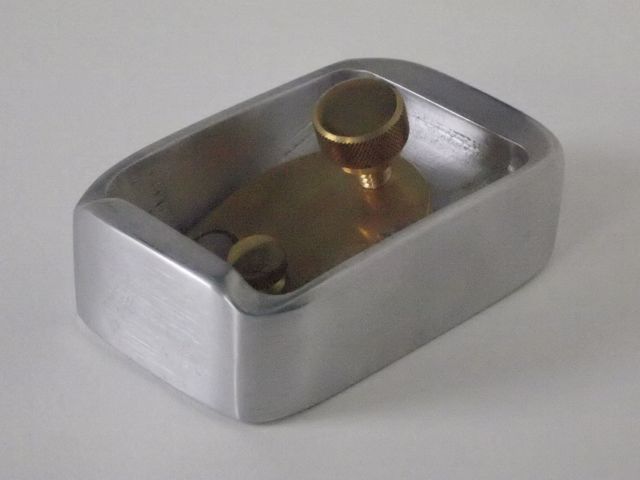
I adopted these plans for a plane specifically designed for leather. First, I lowered the blade angle to about 20 degrees. Secondly, I made the body out of a single piece of milled aluminum, rather than friction generating wood. I also milled the front of the plane a bit more to create space for leather parings and used magnets to hold the razor blade in place before final clamping, to aid in blade adjustment.
The most difficult problem was edge retention of the blades – this problem still needs to be resolved. Other than carbon steel and stainless steel, there are ceramic, ceramic coated,tungsten carbide, and diamond coated carbide blades. Ceramic blades were too brittle, and diamond coated carbide blades were too expensive. So I experimented with two possibilities, ceramic coated blades and carbide blades. The ceramic coated blades reduce the initial cutting performance to an unacceptable degree, but the carbide blades performed reasonably well, although they are not as sharp initially, they have a much longer, more gradual use time, though seeming not as long as the 75 times some suppliers claim. High carbon blades cut great initally, but don’t seem to last as long as one would hope. Or course, this is part of the expense for the convenience of disposable blades.
Three blades, spanning 100 years, all with nearly identical hole spacing. On the top, a circa. 1910 Gillette,in the middle a 1990’s Scharf-fix, and on the bottom a 2011 Tungsten Carbide industrial blade.
Most modern double edge razor blades have some sort of proprietary slit cut through them, but all of the ones I have tried fit into the three hole system pictured above. Note: The Gillette blade is stamped “NOT TO BE RESHARPENED” and “DESIGNED ONLY FOR ORIGINAL USE IN GILLETTE HOLDER”. I hope that the Gillette police are not watching, but perhaps the easiest solution for rapidlly dulling blades is to resharpen them. This can be done by hand or with various antique machines. Carbide blades are too hard to be stropped or resharpened by hand.
Stropping a razor blade. A strong binder clip is a simple way to hold the blade.
A simple holder is to use a one inch wide binder clip on a horsebutt strop prepped with .5 micron chromium oxide, followed by a final strop on undressed calf. The binder clip is lightweight enough to allow a feel for the flexing of these thin blades, making sure to sharpen them on the bevel, although I tend to take a couple of degrees off the angle to make the edge a bit more robust. This can be done a number of times before the angle becomes too obtuse. The blades flex quite a bit, so a slow, gentle touch is necessary.
There are various devices for resharpening double edge razor blades. One common one is the Twinplex Stropper. There are many versions of this device, though all are similar in that both edges of the blade are sharpened on one side, and then the blade is automatically flipped and the other side sharpened. This is much quicker than hand stropping.
.
.
…
.
A razor blade plane designed for leather
This is the result of trying out a number of ideas to develop a better razor blade plane for paring leather. I don’t think it works better than a spokeshave, but it is easier to adjust than a Little Giant or Wilkro. It might be useful for specific circumstances, like paring very thinly, or for those who don’t want to bother having to resharpen their blade. The body is 6061-T6 aluminum, the blade cap and screws brass. Two rare earth magnets hold the razor blades in place for adjustments until they are securely clamped. Either standard double edge razor blades, Scharf-Fix blades, or industrial three hole Tungston Carbide blades fit.
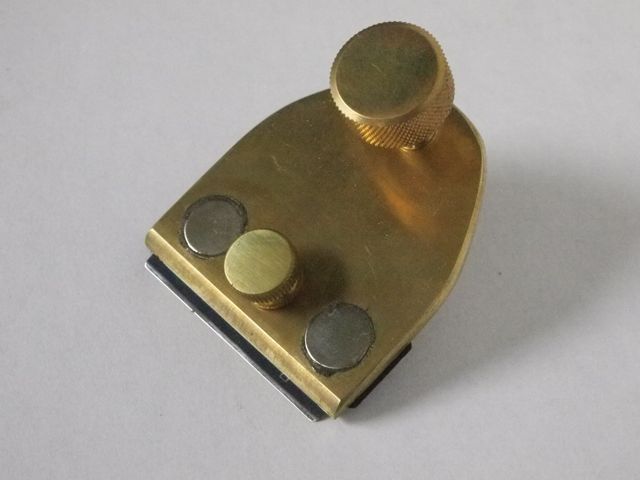
Blade cap with magnets to hold the blade in place for depth adjustment before tightening.
I used magnets to hold the razor blades in place until final clamping, and also used a blade cap more like a normal block plane. Blades can be changed without an additional tool. Since everything on the plane is nonferrous, the magnets only stick the blade to the cap and allow it to be adjusted from the tightening knob. This makes tightening easier, but still takes a little practice, much like a spokeshave.
It cuts quite differently than a a spokeshave or a Scharf-fix. It splits the thickness of the leather more like a paring machine, but allows more immediate depth of cut adjustment by adjusting hand pressure. Like a spokeshave, it it relatively easy to achieve long, gradual bevels. It is also easier to pare larger, flat areas than with a spokeshave.
Below is a video of it in use. I find it easier to use parallel to the edge of the leather. At the beginning I’m taking a fairly aggressive cut, but later taking lighter, quicker ones to even the thickness. I’ll keep tweaking this plane and bring it along to the Guild of Book Workers Standards of Excellence Seminar, October 6-8, 2011 in Boston.
In part one of this blog post, I presented an overview of a variety of razor blade planes. Here, guest blogger Eric Alstrom will share some tips for using these planes to pare bookbinding leather.
Eric Alstrom received his MILS in 1989 at the University of Michigan School of Information and Library Studies. After graduation, he apprenticed under James Craven at the University of Michigan’s Bentley Historical Library for four years. He later became Ohio University Library’s Collections Conservator. In 1998, Eric moved to New England to become Dartmouth College’s first book conservator. Currently, Eric is Head of Conservation at Michigan State University Libraries’ Wallace Conservation Laboratory. Eric also teaches binding and book arts at regional workshops. While at Dartmouth he expanded the popular Book Arts Workshop, which had focused solely on printing, into binding and artists books. He now teaches book arts and binding for the MSU Residential College for the Arts and Humanities. His design bindings and artists books have been exhibited both nationally and internationally. Eric has been a member of the Guild of Book Workers since 1993, has served on the board of directors since 2002. To view some of Eric’s design bindings, artists books and conservation work, please visit http://webalstrom.ftml.net/bookworks.
…
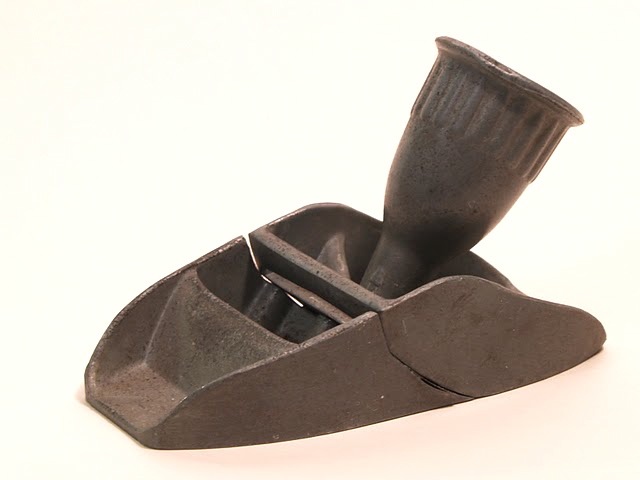
The Wil-Kro razor blade plane.
I was first introduced to the Little Giant when I was serving my apprenticeship with James Craven at the Bentley Historical Library at the University of Michigan. He had a Little Giant and showed me how useful it was for paring leather As I remember (and it has been many years ago), Jim did all his paring with either his paring knife or the Little Giant. In fact, I don’t remember Jim ever using a spokeshave while I was apprenticing with him and the early model Scharfix was rarely used. In the years since my apprenticeship, I have always looked for a Little Giant and garage sales, antique shops and the such. I never was able to find one and adapted my paring technique to include a balsa wood plane (a plane similar to the Little Giant, but made of plastic, rather than metal with a proprietary blade, not a standard razor blade), a spokeshave, and of course my trusty English paring knife.
After a conversation with Jeff Peachey at the Tucson GBW Standards in 2010, he said he ran across these from time to time. I asked him to let me know when he next found one because I would gladly buy it. Fortunately, he found one rather quickly and I have been happily paring away since. What he actually found was a Wil-Kro model, which from what I can tell is pretty much identical to the Little Giant. The Wil-Kro can be assembled with the front base shortened, which may be useful for planing curved wood, but it is not suited for leather paring.
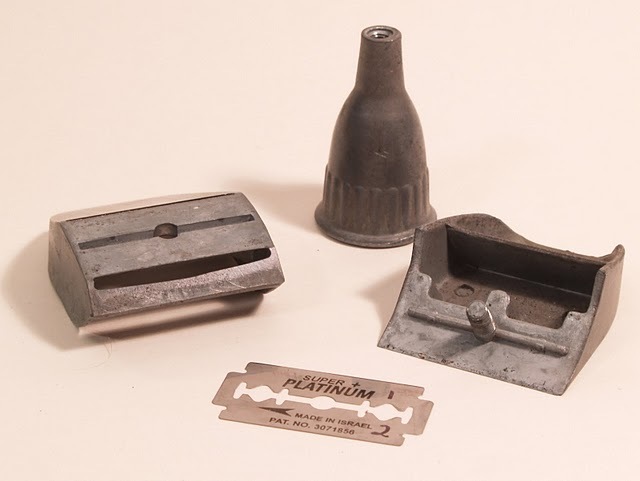
.The Wil-Kro razor blade plane taken apart, showing the blade assembly. Note the curved blade bed.
I immediately started paring with my Wil-Kro as soon as I got it; I have not modified it at all. A razor blade fits over a screw and onto a ridge so it is held exactly in the same place. The front of the plane that clamps the blade is curved so the blade has a very shallow angle. The blade protrudes evenly beyond the base about .008”, or just under the thickness of three pieces of .003” thick mylar.
.
The blade extends about .008″, roughly the thickness of heavyweight paper.
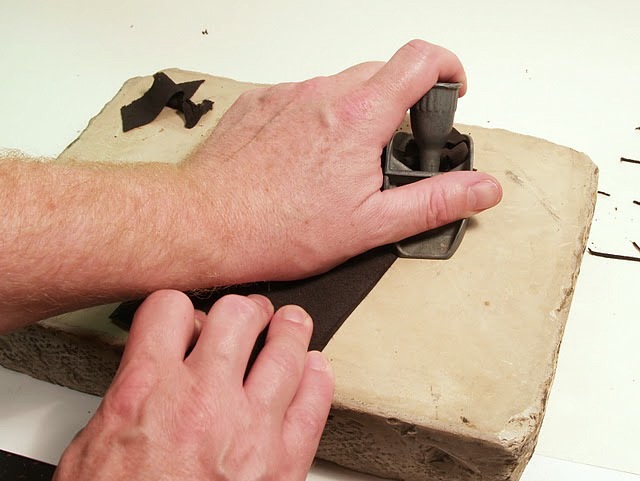
Since double edge razor blades have two edges, I mark mine “1” and “2” so I make sure I don’t use the same edge twice. Just like a paring knife or spokeshave, how long a blade lasts really depends on the leather. When the blade no longer glides easily and shaves off the leather, it is time to change. Another sign to look for is if the leather looks more like dust rather than shavings. To use a razor blade plane, first, prep the leather – pare all edges before using the razor blade plane, same as if using spokeshave or Scharfix. Use a flat surface which is larger than piece of leather, such as paring stone or other surface used to pare leather. You can clamp (or tape) down the leather or hold it with one hand. For smaller pieces (e.g.. spine and corner pieces), I prefer to hold it down with one hand so I can turn the piece around or change angles easily. This is a big advantage over a spokeshave, which takes two hands to operate. I find the razor blade plane best for smaller areas, such as a piece of leather for a spine.
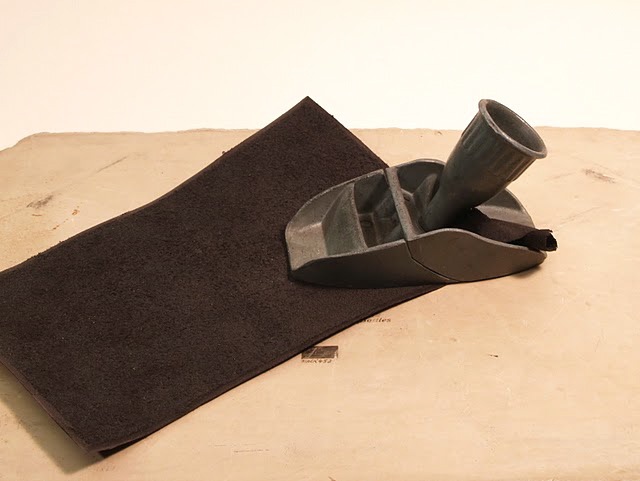
.Paring with the Wil-Kro razor blade plane.
The action is similar to a spokeshave, whereas you hold the plane at approximately 45º to the forward motion, which is called skewing the blade. Don’t apply to much pressure, at least not at first. See how the leather will pare: some leather pares almost by itself, other leathers will need more downward pressure to get the blade to shave anything off. I generally work parallel to the spine, not across the skin (except of course when you are paring the fore edges for a full leather binding).
.Some leather parings made with the Wil-Kro.
Put the plane on the leather a little bit further back than where you want to start the thinning (similar to a spokeshave). Start to move towards the edge and apply pressure as necessary, depending on toughness of leather. All action is done by pushing the plane away from you (same as spokeshave). I start in the center of the edge I am paring and move my plane gradually towards one outside of the piece of leather then back towards the other edge. Don’t always start this process the same place or you are more likely to have uneven thickness in the leather. For example, when paring along the head for a full-leather binding, I might start midway between the spine and the corner of what will be the turn-in on the back cover. As I pare, I move the plane towards the corner a little bit after each stroke. Once I reach the corner, I slowly work my way back to where I started and then all the way to the spine. I’ll clean out the leather shavings and start again. But this time, I’ll start right next to the spine and work towards the corner and back. Then for a third pass (if needed, always check often!), I’d start near the corner. As I move towards the edge, I increase the pressure a bit to thin the leather more along the edge. You have to be careful, though, because you can easily shave through the entire thickness. I find the edges I am working parallel to are more vulnerable to this than in the middle. That said, I will sometimes “tip” the plane as I move towards the parallel edge to thin down that edge. I don’t actually tip the plane, but I put more pressure on the side that is adjacent to the edge.
.
The Wil-Kro in action.
I find the razor blade plane very useful tool in the leather paring arsenal. It won’t replace a spokeshave (for efficiently paring large areas) or the Scharfix (for exact work such as onlays and labels) and definitely not the paring knife (for edge paring), but it has its place. For smaller pieces of leather, such as a spine for a leather reback, I find it better than a spokeshave and easier to use. For larger pieces, it can be useful along side the spokeshave for thinning out the corners or along the headcap area. Care must be taken because it can shave through the leather, but with practice and mindfulness, this shouldn’t happen any more often than with any other leather paring tool. The Little Giant (and other similar razor blade planes) aren’t the easiest to find, but they are worth the search.




 Peachey Conservation