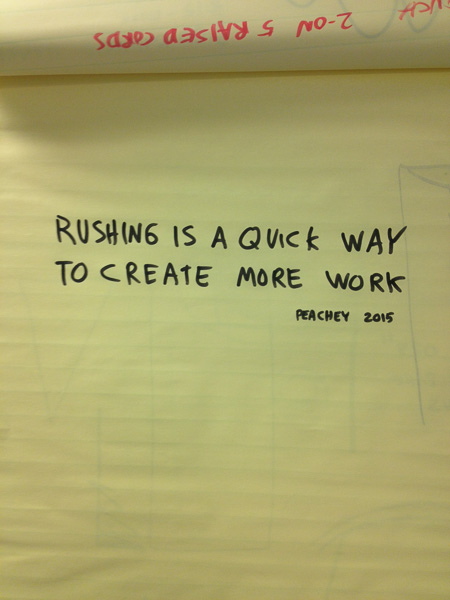
Rushing is an insidious demon in craft work. Its lures are many. It occludes the memory of its last appearence, trapping you once again. Resist with constant vigilance!

Book Conservation
Rushing is an insidious demon in craft work. Its lures are many. It occludes the memory of its last appearence, trapping you once again. Resist with constant vigilance!
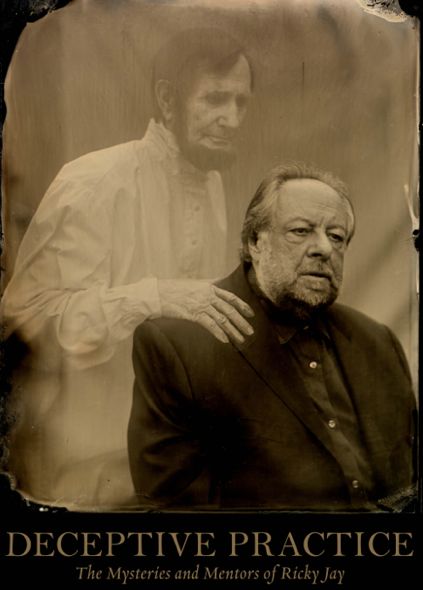
Traditionally craft is learned through close contact with skilled practitioners. Currently most professionals I know have cobbled together an autodiadactic path that often consists of reading, experimenting, practice, formal classes, weekend workshops, and hanging out with others in the field. But what happens when a craft is “mastered”—however you define the term— and how do practitioners keep learning, refining and performing at peak levels? And why do they keep doing it? Both Deceptive Practice and Jiro Dreams of Sushi explore this question.
At an age when most are ready to retire, Jiro cannot stop making sushi. When interviewed, he candidly admits his family and life outside of work have suffered because of his obsession of crafting the most prefect sushi he is capable of. His Tokyo restaurant was awarded three Michelin stars. But he can’t stop, and still doesn’t feel his son, who is 50 years old and who has worked by his side most of his adult life, is ready to take over. The act of crafting is rewarding to him, but it has become such a large part of him, that he can’t let go of it. Jiro’s story bypasses much of his formative experiences, but instead concentrates on a perhaps inevitable paradox: many enter into crafts in order to reestablish some kind of physical/ mental balance in their lives, yet craft at the highest levels becomes singular and obsessive.
Ricky Jay began performing at the age of 4 (there is home movie footage to prove it!), and much of this film discusses his influences and mentors. Most of his education was informal and his skills learned through intensive practice. He mentions he still practices card handling seven hours a day, though I wondered if this might be a bit of magicians patter. Yet Jay is not only one of the most accomplished sleight of hand magicians (he can pierce a watermelon with a playing card), he a scholar of the history of magic, writer, and actor. His books, such as Learned Pigs & Fireproof Women or Jay’s Journal of Anomalies, are facinating and well written. I had the chance to watch him perform a couple of years ago, and left more impressed than ever. I was picked from the audience to play poker with him on stage; for the finale I shuffled, cut and dealt the cards. He didn’t touch them except to turn them over. He had four aces and I had nothing.
Both films feature photography that verges on pornography in their larger than life closeups. An excusite piece of sushi glistening with a brush of shoyu that fills the screen, Jay’s incessant fondling of cards which he watches his hands by using three mirrors. Again the separation of the hand and the head is emphasized. Together these films give an unusually revealing view of the work that craft involves. Attentive practice, trying to improve and trying to maintain one’s skills are never ending. For Jay and Jiro there is no rest. There is only the need to do something very, very well. And do it again, and again, and again. Ars long, vita brevis.
Confession number one: I’m a sucker for reading books about working in craft. I’d read one a month if they were available. Confession number two: I devoured David Esterly’s “The Lost Carving” in two sittings.[1] Likely because of the essentially solitary nature of craft work, I find reading about someone else’s experiences irresistible. Esterly is a wood carver, and the details of his specific craft are fascinating, but not critical to appreciating this book. The commonalities of the craft experience transcend the boundaries of specific disciplines.
In A Theory of Craft, Howard Risatti summarizes two radically different of ways of thinking that Heidegger originally proposed: calculative thinking and meditative thinking.[2] Calculative thinking is the pragmatic, craft-like approach: working for specific purposes, accepting limitations, dealing with the conditions and materials given. Meditative thinking is contemplative, a questioning of meaning and value with no boundries. Craftsmen generally think calculatively, so it is a rare to find one that is able to perform a craft and investigate philosophic concerns. Esterly is a rare, nimble mind that can alternate between both of these modes.
Personal memoirs about craft are not new. David Pye’s, The Nature and Art of Workmanship is a foundational exploration of craft phenomenology and philosophy. [3] It is required reading for anyone interested in craft. His conception of “the workmanship of certainty” and “the workmanship of risk” have percolated into most of craft discussions, which can become heated when methods of mechanical regularity brush up against the boundaries of freer working techniques. Books by Needleman, Krenov and Wilcox have explored what it means to make a craft object.[4] All are deeply curious about the nature of craft, and investigate this in a personal memoir style. Krenov, a woodworker like Pye, profusely illustrates his book with photographs of his work. Needleman, a potter, opts for a more stream of conscious verbal rumination. Wilcox, a bookbinder, details the often arduous modern day apprenticeship she served with Bill Anthony. More recently—and more similar to Esterly’s book—is Crawford’s Shop Class as Soul Craft.[5] Both writers were trainned as academics, then left the academy to live a life in craft. Both are proud of their non-traditional choices for a lifestyle, though Crawford tends to write more about technical education. Also, there is Richard Sennett’s hybrid academic—personal approach in The Craftsman, which I wrote about in a previous blog post. [6]
Esterly’s book is not only a personal record of the meaning of working in craft; it has a strong narrative drive as well. As a self taught carver, he learned from immitating the master carvings he most admired, those of Grinling Gibbons. He considered himself to be his apprentice, the apprentice of a phantom master. This book records an amazing commission he recieved once he was an established carver. After a fire at Hampton Court Palace, London, much of the ceiling carving which was done by Gibbons was damaged and needed to be replaced. Esterly (an American!) was hired to carve a replacement. The book follows his work on the ceiling over the course of a year, what he learned, and relearned. There were also a team of British conservators working on the project and their overlapping boundaries between their work and Esterly’s is briefly covered, though he was hired as a part of the overall conservation plan.
The book moves gently from reflections on the act of carving, back to the story of his learning to carve, to observations on specific techniques. He mentions his carving tools quite a bit, and while he loves owning and using them, he doesn’t fetishize them. Tools are tools. “In the usual way of thinking, you have ideas, and then you learn technical skill so you can express them. In reality it’s often the reverse: skill gives you ides. The hand guides the brain nearly as much as the brain guides the hand.” [7] He carefully describes his favorite medium (lime wood), offers general reflections on the struggles in crafting, and even meditates on the difference between sculpture and ornamentation. Esterly lives in a world where Art and Craft are inseparable; a pre-nineteenth century mentality. Craft, for him, becomes a metaphor and framework for interpreting the world.
Making things—and the escape from the everyday consciousness that craft provides— is a universal human activity, possibly boardering on a need. Esterly is dismissive of CAD carving as lifeless, and I suppose he would be equally offended by even newer forms of making, such as 3D printers like the Makerbot. I see them as a new tools, however. Different tools can produce different results, and tools also influence the maker, which Esterly mentions and I discussed in an article I wrote titled “Conservation and Tools: An Inquiry Into Nature and Meaning“. [8] Craft changes, but the urge to make and shape material objects is constant. Esterly has a poetic, but not romanticized view of craft. The writing is straightforward and honest; similar to the craft objects he makes. Exploring the meaning and essence of craft, like the activity of craft, is an endlessly fascinating pursuit.
_________________
1. David Esterly, The Lost Carving: A Journey to the Heart of Making (New York: Viking, 2012)
2. Howard Risatti. A Theory of Craft: Function and Aesthetic Expression (Chapel Hill: The University of North Caroline Press, 2007) 264-265.
3. David Pye. The Nature and Art of Workmanship (London: Studio Vista, 1971)
4. Carla Needleman. The Work of Craft: An Inquiry into the Nature of Crafts and Craftsmanship (New York: Avon Books, 1981) Krenov, James. A Cabinetmaker’s Notebook (New York: Sterling Publishing Co., 1991) [Reprint, Originally published: New York: Van Nostrand Reinhold Col, 1976.] Annie Tremmel Wilcox. A Degree of Mastery: A Journey Through Book Arts Apprenticeship (Minneapolis, MN: New Rivers Press, 1999)
5. Matthew B. Crawford. Shop Class as Soulcraft: An Inquiry into the Value of Work (New York: Penguin Press, 2009)
6. Sennett, Richard. The Craftsman (New Haven & London: Yale University Press, 2008)
7. Esterly, Lost Carving, 84.
8. Peachey, Jeffrey S. “Conservation and Tools: An Inquiry into Nature and Meaning” in The Bonefolder, Vol. 1 No. 1, 2004, 19-22.
 Peachey Conservation