
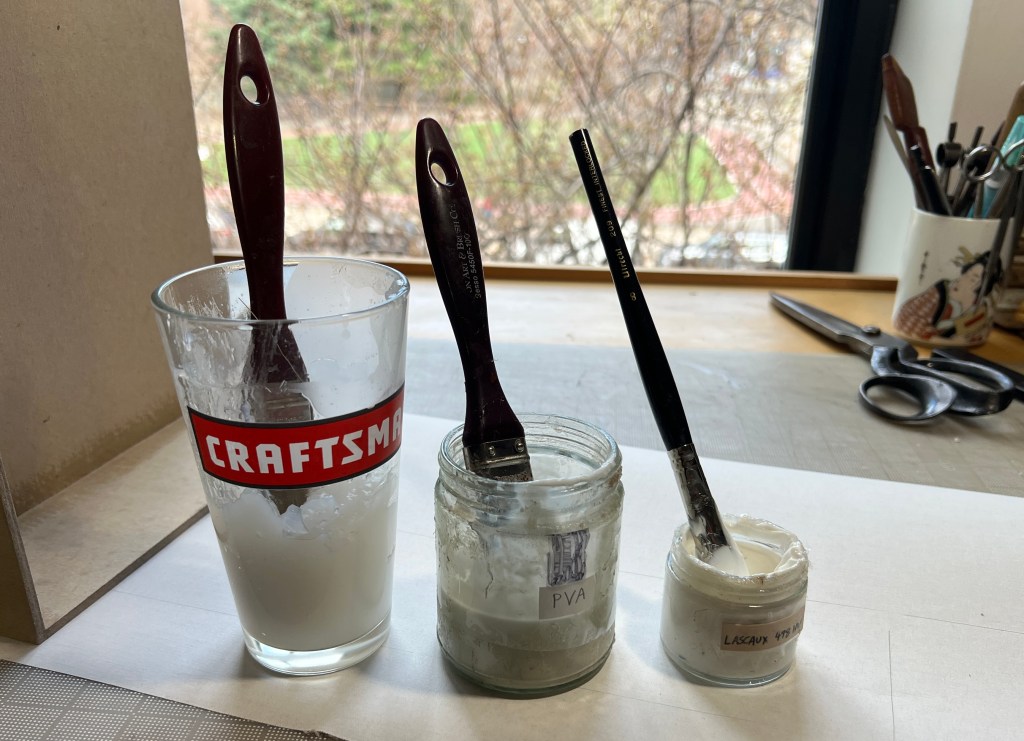
PVA (PVAc, Polyvinyl Acetate) is the adhesive most commonly used in book conservation to make cloth covered drop-spine boxes. Most of my clients prefer these to other types of boxes. For large and heavy books there are few other options.
While PVA is convenient and sometimes necessary for boxmaking, offgassing is a concern. The Library of Congress ( LC poster) found PVA is still offgassing after 6 years! Apart from potential damage to objects, it’s a plastic; most of us are trying to use as little as possible. The offgassing from PVA will not cause instant flaming death for books, it’s not ideal for longterm storage. Books with copper alloy bosses and clasps are especially vulnerable. Box structures like a cradle box, which have many layers of cloth–adhesive–board are most likely offgassing much more than a standard box. The Library of Congress study found that even a box made with 90% paste and 10% PVA still offgasses enough to fail the Oddy test. However, the concentration was much less than straight PVA. As I understand it, testing is ongoing, including other of adhesives like EVA.
There is not a single convenient and cost-effective substitute for PVA. What to do?
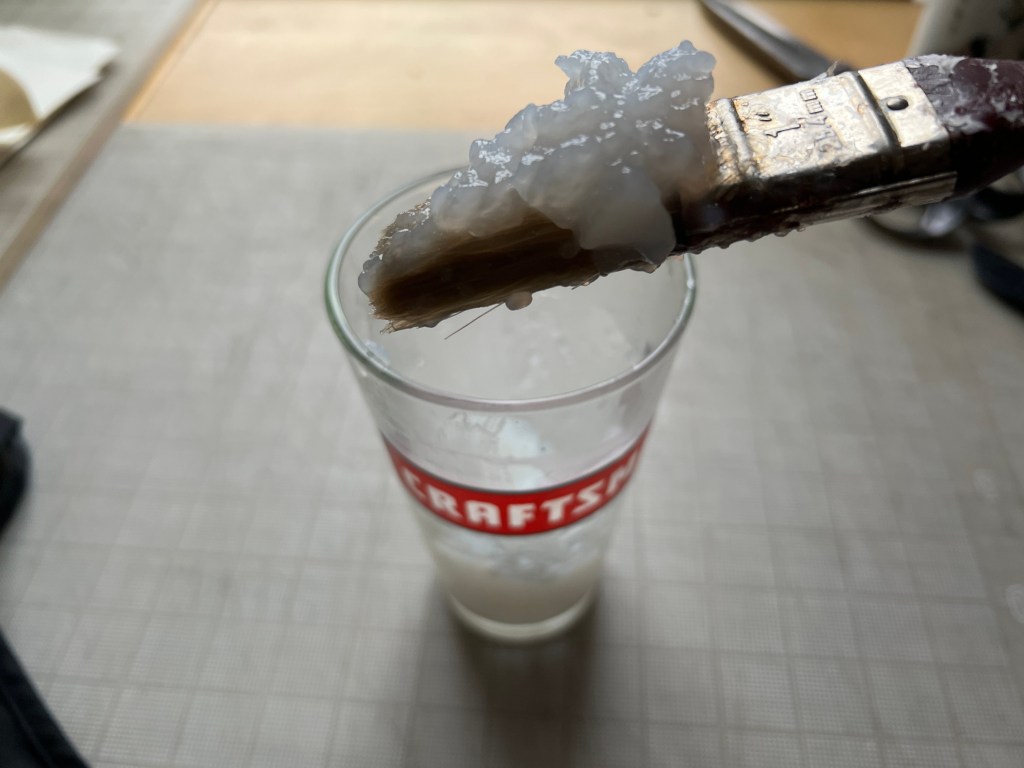
Paste is difficult to work on paper backed bookcloth because of the slowness of drying, problems with adhering edges and turn-ins, bubbling during drying, unpredictable stretching, and weak cloth-to-cloth bonds. An example of cloth-to-cloth bonds are when the trays are attached to the case of a drop spine box, so two outsides of the cloth need to stick together. Lascaux 498HV (an acrylic) is expensive, dries quickly, but also forms a fairly weak exterior face cloth-to-cloth bond. PVA is, well, PVA. I’ve heard of several different approaches, sometimes involving methyl cellulose, but they all pre-mix the adhesives together.
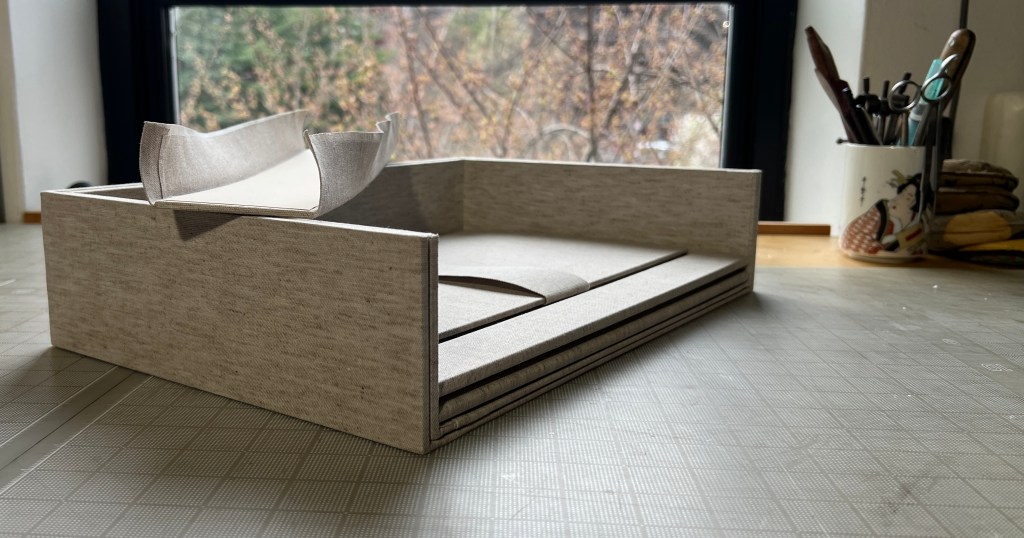
In my Layered Adhesive technique, different brushes are used for each layer directly on the cloth instead of mixing adhesives together before application. It sounds a little like amateur hour — I know — but allow me to explain. Each layer of adhesive performs a different function. I’ve been using this technique on all my boxes since 2023.
PVA use is reduced by about 80%. Paste provides most of the adhesion, small amounts of Lascaux add extra tack to prevent unadhered areas at turnins, corners and board edges. I’ve found PVA is still necessary when attaching the walls to the base of the trays, and when attaching the cloth covered trays to the case. I’ve only used this technique with Halflinnen cloth because I use it all the time. I imagine other paper backed cloths would be suitable, possibly with some modification.
A simpler variation just uses paste and PVA, instead of Lascaux in some areas. Even this cuts down on PVA consumption considerably.
THE TECHNIQUE
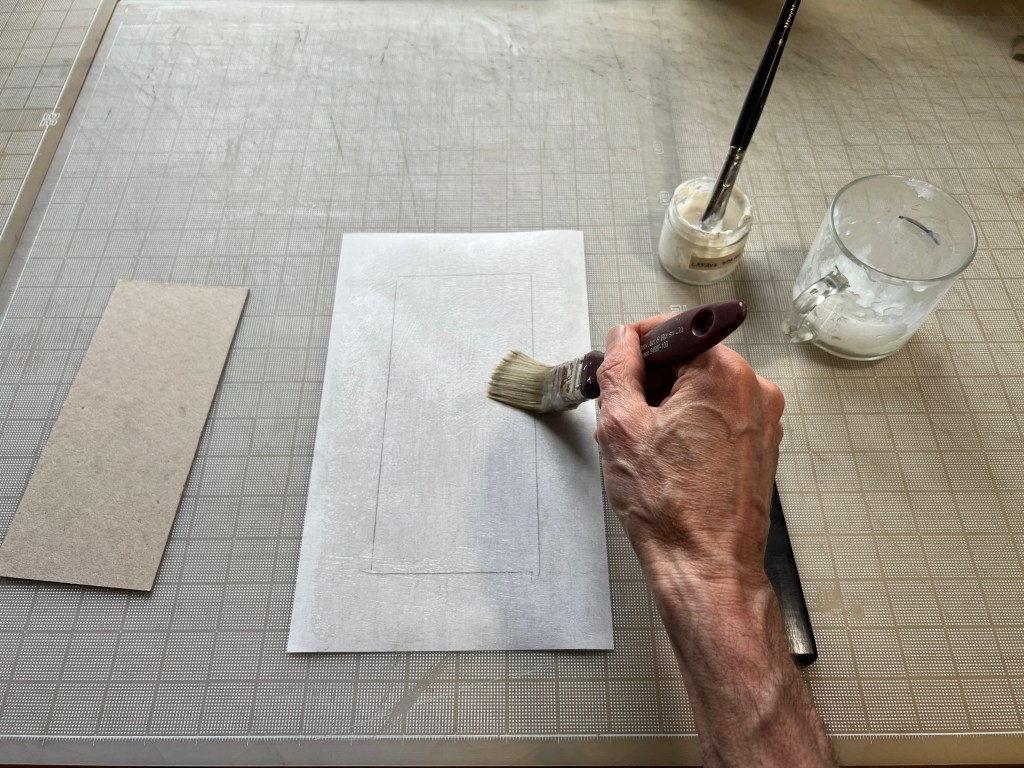
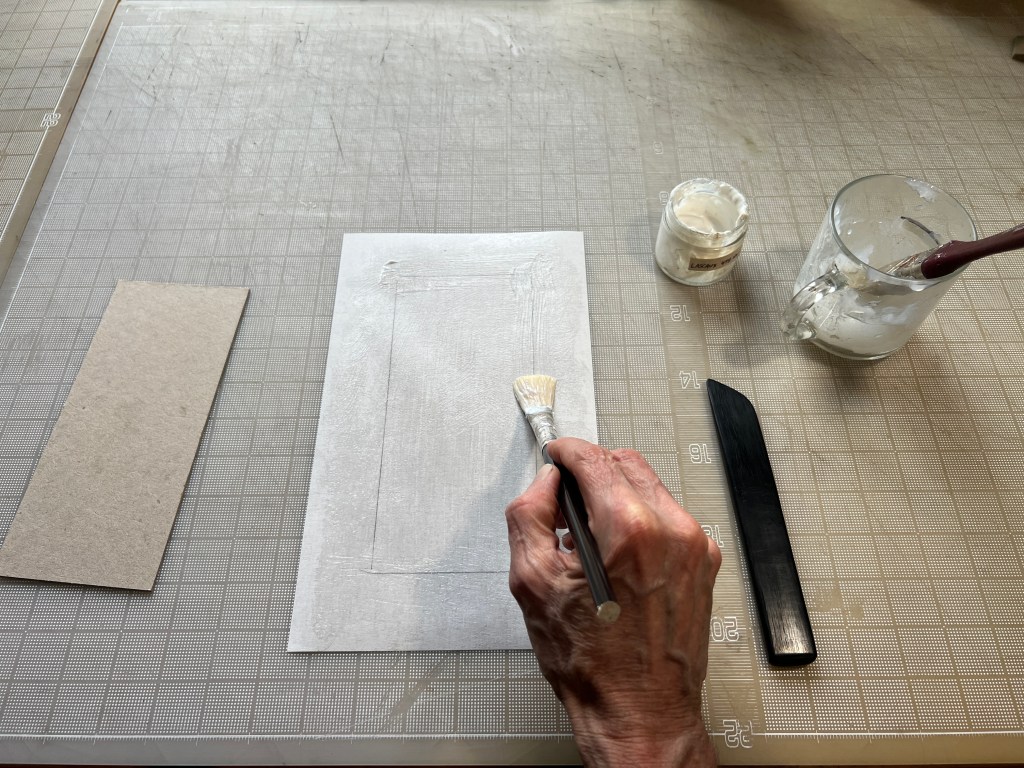
OVERVIEW OF THE LAYERED ADHESIVE TECHNIQUE
- Paste, Lascaux, and PVA all use separate brushes and are kept in separate containers.
- Paper to board, and board to board adhesion uses thick (6g starch per 100ml water) wheat starch paste
- Corners and board edges get a thin coat of Lascaux 498HV on top of the paste. This makes them easier to adhere than paste alone, and I find there are less problems with delamination or bubbling during drying. The Lascaux gets diluted when applied on top of the paste.
- If making a 3 piece case, for example, use paste then put a little Lascaux 498HV on the head, tail and foreedge turn-in areas. Similarly, when casing-in, use paste then add a strip of Lascaux 498HV on the edges of the pastedown, where it overlaps the cloth turn-ins on the case.
- When making drop-spine box trays, I find the strength of PVA necessary to attach the walls to the base.
- When attaching the cloth-covered trays to the case, use paste, with a coat of PVA on top, at the edges, again at the exterior cloth-to-cloth attachments.
ADVANTAGES
- Paste is cheaper than PVA
- Paste is better for the environment
- Less PVA equals less offgassing
- Paste stiffenens the cloth/board much more than PVA; I like the feel. It is also perfect for stiffening the wedges in a cradle box
- The cloth is easier to smoosh together at joins and blends nicer
- Paste flattens the fibers on the cloth so it feels smoother
- Paste works wonderfully for adhering double walls together; a little slip then bam they stick
- There is less waste than premixing paste with other adhesives
- Paste has a long open working time
- Ideal for cradle boxes with many cloth/adhesive layers
DISADVANTAGES
- Paste has a long open working time
- Uses more brushes, longer cleanup
- There is a small learning curve, and it takes more time when working compared to PVA. Then again, if you are charging by the hour….
- May not work for other bookcloths without modification
- Cross contamination with paste of other adhesives, need to use up in a few days
- This technique is likely more suited to making a one-off boxes, rather than production
SUPPLY SOURCES
Halflinnen paper backed book cloth. Colophon Book Arts Supply: https://www.colophonbookarts.com/paperboard/rohhalbleinen With commendable transparency the manufacturer provided information on the paper-to-cloth adhesive, which is a PVA (!) specifically Brand VA518 from Intercol (https://www.intercol.info/pva-glue/) Warning: This PVA can be reversed with an errant blob of paste left to soak in. Just saying.
Jade 403N PVA. Conservation Resources. https://www.conservationresources.com/shop/jade-403n-adhesive/
Lascaux 498HV. New York Pigment Company. Recently formed by former employees of Kremer Pigments, which has closed. They are Kremer’s NY distributer. https://www.newyorkpigmentco.com/products/lascaux%C2%AE-acrylic-glue-498-hv
Aytex P Wheat Starch Paste. Polistini. https://polistini.com/products/wheat-starch-aytex-p
FURTHER RESEARCH
This isn’t perfect, but using less PVA is better than using more, right? I’m curious if others have found different workable techniques to cut down on PVA when used on bookcloth? Have you been able to eliminate it completely?
 Peachey Conservation