
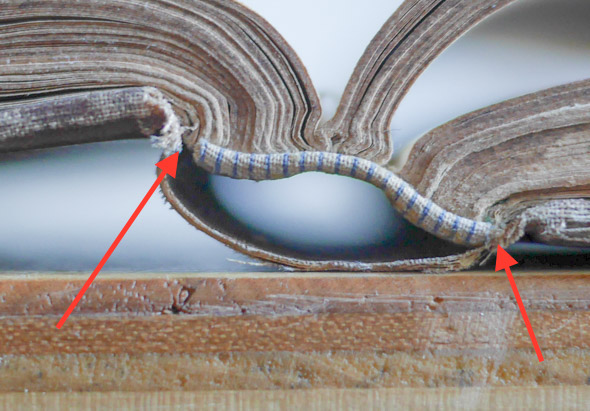
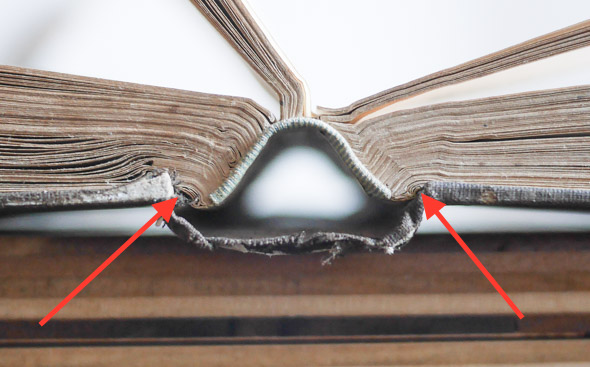
Adding a hollow (aka. Oxford hollow, tube) is often used to repair books that originally had a hollow, which makes sense. What makes less sense is using it on books that originally had a natural hollow, like case bindings. It adds at least three layers of paper, and only adds the strength of one thickness of paper. Admittedly, a strong sheet of handmade paper can be incredibly strong. Adding a hollow can dramatically change the opening, sometimes in unexpected ways. Often other hinging options with airplane cotton, linen or stout tissue are preferable. Adding a hollow is best suited to a quick and fast repair of circulating collections, or on relatively recent bindings with strong covering cloth. There are times when it should not be used.
***
This was one of the complexities we investigated in the recent workshop I taught at the Georgia Archives in Atlanta October 24-28, “Cloth Case Bindings: Their History and Repair.”
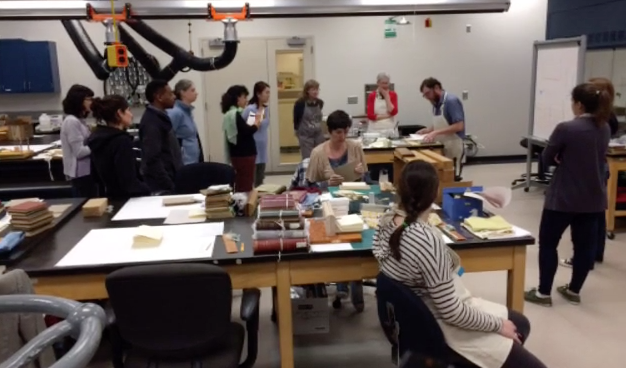
Click on the links to see a slide show of images from each day. Images courtesy Kim Norman, Preservation Manager and Conservator, Georgia Archives. Thanks for hosting, Kim!
Day 1: https://quik.gopro.com/v/PNwC9SDNeW/
Day 2: https://quik.gopro.com/v/5v0ARgYFEo/
Day 3: https://quik.gopro.com/v/0Akz24qveU/
Day 4: https://quik.gopro.com/v/1EWV9WiqcD/
Day 5: https://quik.gopro.com/v/hPB5y1FonH/
There is talk of scheduling a complementary workshop in October 2017 at the same venue, dealing with rebacking, board attachment and repair of 19th century leather bindings. This would include leather paring with English and French knives, spokeshaves and the Scharffix paring machine, as well as methods of consolidating and dying leather. Check this blog for more info as it becomes available.
 Peachey Conservation