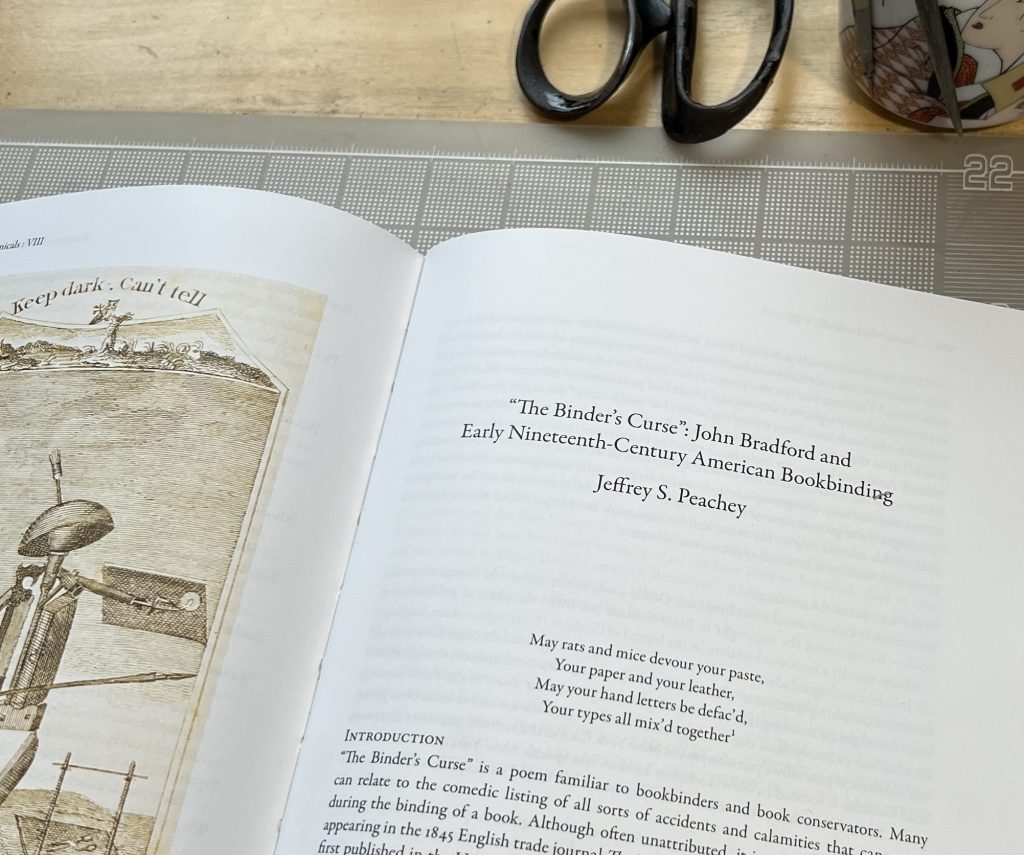
Just Published! “The Binder’s Curse: John Bradford and Early Nineteenth Century American Bookbinding” in Suave Mechanicals Vol. 8, The Legacy Press, 2023.

The Binder’s Curse: John Bradford and Early Nineteenth Century American Bookbinding, in Suave Mechanicals 8, The Legacy Press, 2023, 387 – 457.

“Keep Dark. Can’t Tell” With these four words, 19th century NYC bookbinder John Bradford begins an extraordinary book of bookbinding related poetry and imaginative parody. Written records from craftsmen during this time are very uncommon. Writings from bookbinders are very, very uncommon.

Bradford’s well-known poem, The Binder’s Curse, contains an introduction which places it in the context of a trade dispute, which is not so well known. The full title of the book gives a hint at Bradford’s wacky worldview: The Poetical Vagaries of the Knight of the Folding-Stick of Paste-Castle and The History of the Garrett, &c. &c., Translated from the Hieroglyphics of the Society, by a Member of the Order of the Blue String, Printed for the Author, [New York], 1815. The title is not just poetic exaggeration; part of the text consists of — supposedly — translated and untranslated hieroglyphics.

“This world’s a huge bindery…” Bradford proclaims, decades before Mallarmé’s more famous dictum, that everything in the world exists to end up as a book.1 Bradford constantly reinforces this world-as-bindery cosmology: Did this guy ever think about anything but bookbinding? Yet these poems provides primary documentation of bookbinding techniques and tools: the first mention of a squaring shears, details of which tools the binder owns (Bradford was a journeyman his entire career) and which the master provided, the use of templates, and more. There is a lot of serious bookbinding history buried in his poems.

There are also less serious aspects, like some really cringey love poetry. “Her forehead is like a paste bowl / And smooth as a fine paring stone.” Anyone want to guess what body part is “white as wheat paste”?

Bradford gives us a sense of the working life of an early nineteenth century binder, including day-to-day annoyances, and trade politics, all written with his relentlessly quirky sense of humor. The poem “Receipt for binding a book” consists of the earliest comprehensive listing of the steps in American binding, which is analyzed in depth by comparing it with extant bindings and relevant bookbinding manuals of the day. Bradford’s poems provide a insight into an imaginative bookbinder working on the cusp mechanization, especially dealing with the importance of tool ownership and use.

Thanks to editor Julia Miller and publisher Cathy Baker of the Legacy Press. And congrats to all the other authors below! I can’t wait to read the other essays. Available soon from Oak Knoll Press.

KEEP DARK

Essays in Suave Mechanicals, Vol. 8.
DO NOT attempt this curse at home! Provided for informational purposes only. The beginning of “The Binder’s Curse” from The Poetical Vagaries of the Knight of the Folding-Stick…. 1815.
  1. Malarmé, “Les Livre, Instrument Spirituel,” Quant au livre, 1895. ↩︎
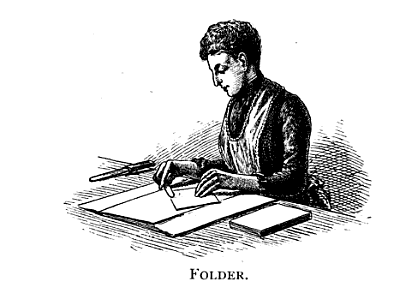
Images from Zaehnsdorf’s “A Short History of Bookbinding”

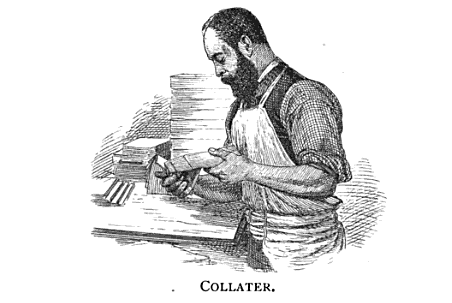
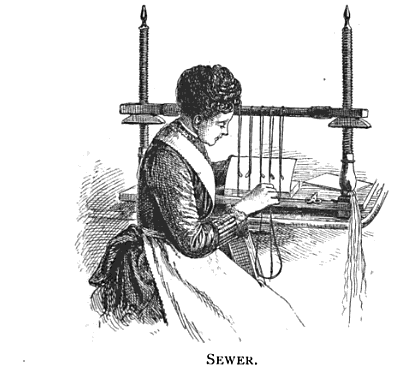
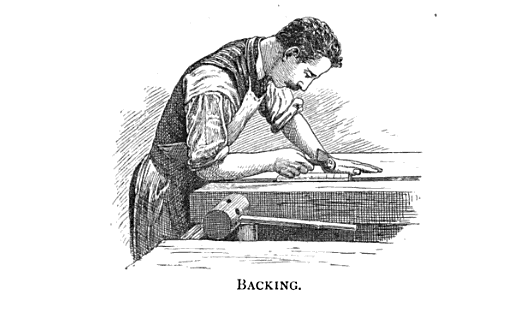
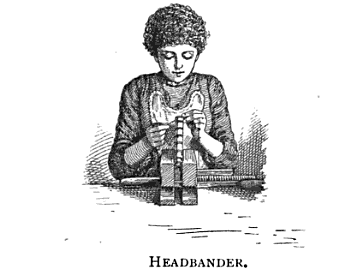
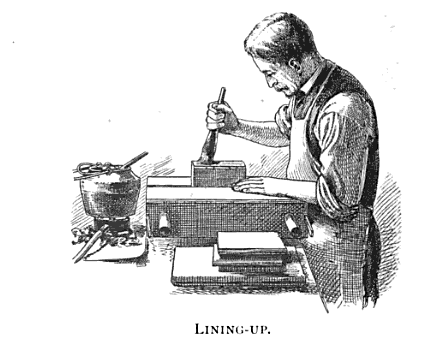
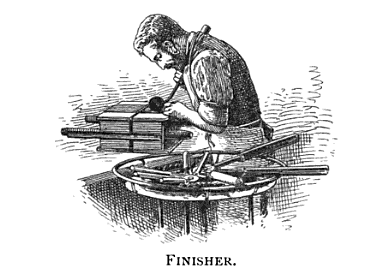
Zaehnsdorf’s A Short History of Bookbinding, originally produced as promotional material, contains some nice images of his premises and details of several steps in binding. Even in these low-res google scans, interesting details can be observed: the headbander using an upside-down plough, the massive finishing press with wood top (replaceable, to protect the press from glue?) used for spine lining and finishing, the sewer working inside the frame, etc….

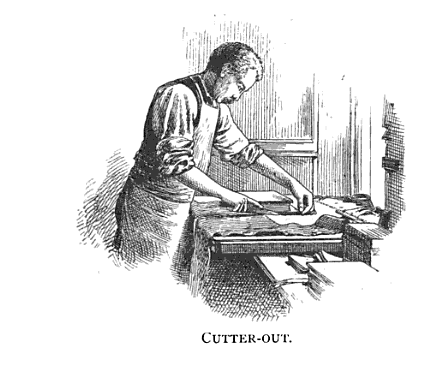
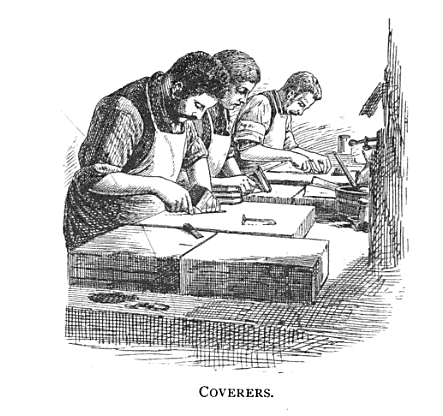
Notably, some of the steps are described as a generic action — “backing” — while some have the specific names for positions — “collater, cutter-out and coverer”. Small clues like this can help to understand the divisions of labor in Zaehnsdorf’s large nineteenth century bindery.


The folder also has a slitting knife to her right.

Interesting a man is doing this, usually I see women doing it. Maybe his great beard got him the job!

Look how long the lay cords are, both to save money on the sewing supports and an indication that only one book at a time was sewn.

Press pin still stuck in the press, indication of the speed of work? It also looks like it either does not go through a hole, or new holes had to be drilled? Usually the holes are drilled completely through at 90 degrees to each other.

Upside down plough. Likely worn out, since the brass holder on many English ploughs would get in the way even if the blade was removed. The women seem to be wearing different aprons, while the mens all look the same.

The rectangular guide rails are on the end of the cheeks of this finishing press, much like Tim Moore does for his modern lying presses. Love the massive cheeks. I want this press! And we know he is using hot animal protein glue, note the pot with a gas line hooked up.

I wonder if he is cutting on a tin, or cutting board. The knife has a handle. In shoemaking, the cutter-out (called the “clicker”) is one of the most skilled and highly paid positions, since they have to decide how to make best use of flaws in the skin. He does have primo bench position, right in front of a window.

I would guess they are covering on litho stones. The man in the foreground is using a sharply angled bone folder to turn in the leather in the cap area, and I suspect supporting the opposite end of the book with his stomach. Are there band nippers also on the stone?

A better view of the same press used earlier. It looks like three sides are covered with extra pieces of wood. I really, really need this press.


***

I also noticed that Zaehnsdorf’s The Art of Bookbinding is available as a 6 hour audio book.  It would be an interesting experiment to listen to his instruction, while following along. I doubt I will do this, but if you do, let me know how it works!

https://www.youtube.com/watch?v=bFMd7UCkfdM