Tool Holder


About three years ago, I got tired of never being able to find the basic tools that I used the most.  I kept them in a couple of cans at my workbench, and they ended up all over the place by the end of the day.  I decided to first analyze which tools I actually used the most, which turned out to be a tiny fraction of the tools I had, and devise some kind of storage so that I could easily reach and immediately put back when I was finished.  Although it took a bit of time to do this, I estimate it saves about 5-10 hours a year in time spent looking for tools, which is significant. I constructed this holder out of two pieces of eight quarter cherry. I also made a travel box for working on-site that has a similar system built in.

In case anyone is interested, below is a list of the tools that I use to accomplish about 90% of my normal tasks, and a few comments.  Not pictured are brushes and larger rulers.

ON THE TOP ROW, LEFT TO RIGHT

-Needle nose pliers

-6″ Mundial embroidery scissors (small, yet the tips can cut through a double layer of aero linen)

-Osborne “E-Z Cut” scissors (these can cut through binders board)

-Medium lifting knife

-Covering knife

-Small lifting knife

-Large lifting knife

-Large teflon folder

-Olfa knife (the ones with a knob are less likely to pull out when cutting something thick)

-Bench Knife

-Two large bone folders

-Two small dividers (less than 4″, leatherworkers ones that operate by friction are easy to adjust)

ON THE BOTTOM ROW, LEFT TO RIGHT

-Starret pin vice (the octagonal plastic handle keeps it from rolling off the bench)

-Four Dumont & Fils tweezers, #2a, #10-00 and 2 #5’s  ( #5 is a sharp point, #2a a wide thin point for tissue, and #10-00 a convex / concave points for gripping)

-Insertion tool

-Small awl

-Japanese  awl

-Rigid scalpel (good for scraping)

-Italian microspatula

-Two plastic handle scalpels,  #11 and #15 blades (plastic is slightly flexible and more comfortable than steel)

-Rigid scalpel 

-Japanese brush pen, 50/50 ethyl alcohol and water

-Two small bones

-Hacksaw english style paring knife

-.5mm mechanical pencil

ON THE BOTTOM

-Four rulers (one thin cork backed for tearing tissue and trimming endsheets, two thicker steel often used as spacers and to tear tissue more ragged, 7/8″ wide aluminum which is turn-in thickness)

BEHIND THE STAND, mounted in a recessed area

-A brass 4 inch triangle
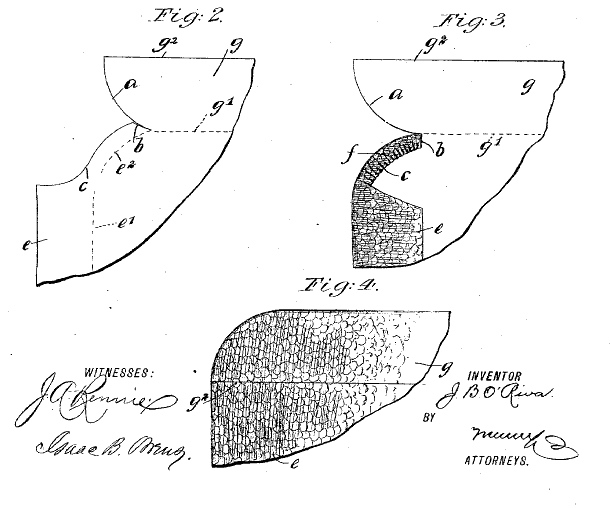


The O’Riva Corner

I found this interesting corner, US Patent # 562,649, issued to John B. O’Riva in 1896.  It is long out of protection, so anyone can make it.  O’Riva states, “The object of this invention is to provide a binding for books which will be strong and durable without necessitating the destruction of the grain in the leather used for the binding.”  It seems intended to be used for bibles with flexible covers. I appreciate O’Rivas sensitivity to preserving the beauty of the grain, which makes me think he came out of an arts and crafts background, rather than from the trade, who favored a very highly polished leather surface which made tooling easier.  

This invention created a very smooth looking corner while preserving the natural grain and covered the puckering of the leather when it was pleated over the rounded edge.  Possibly the leather could be left a bit thicker than a standard rounded corner.  The overlapping layers of flexible board would also add some strength at this critical place.

It would be very interesting to find an example of this corner, I’ve never noticed one. Flexible board bibles like these tended to get carried back and forth to church every Sunday, and even if they were not read a lot, 19th C. ones are not as common as the ubiquitous large, illustrated Victorian Bible, for example. It seems it would be very difficult to enforce this kind of patent, especially if another binder had seen one of these and tried to copy it.  But perhaps the patent was to protect the inventors idea against more large scale publishing house infringement. In this drawing, the grain pattern of the leather makes it seem like some kind of reptile skin, or other exotic such as shagreen.  These types of leather are difficult to turn in neatly, let alone mold around a rounded corner.


Given the 1500 year history of the codex structure, to come up with something new, for something as basic as a corner, is genius.  Except for hand held bibles, rounded corners are rather out of fashion these days, as are large squares, but if someone makes one of these, please send me a photo.  I imagine this could also work with cloth, although I haven’t tried it.  The cut edge of cloth along the curve could be vulnerable to wear, fraying and delamination.  It might work better with paper. Hats off to O’Riva!  

Ligatus

Ligatus was launched last night in the UK, and should grow in the next few months.  The site contains a lot of information on the St. Catherine’s Project, and was put together by Nicholas Pickwoad.  The detail of the recording forms is admirable, and the project important.  If you can understand what XML is, please let me know.