Don’t Wash … Scour!

Last summer I recorded my investigations into replicating early 19th century book cloth  using XSL pigments. One difficulty was achieving an even coloring, and several commenters indicated I should scour the fabric, rather than just wash it. Finally, I had a little time to try this, and although I haven’t had a chance to do more dying, tests with wheat starch paste have been astounding.

Note all the yellowish junk that came out of the muslin: oils, waxes, and pectic substances.

I boiled 1.5 yards of Springs Creative 45″ unbleached muslin (133 x 72 thread count, .007″ thick, $4.00 a yard) for two hours in a stainless steel pot, using 1 tablespoon of soda ash per 6 cups of water. Since it smells a bit, it is advisable to have a externally vented exhaust hood.  A long stirring stick is necessary, as are rubber gloves.

Keep a close eye on the boiling muslin. I used large pieces of cloth, for future use as covering material. As the water boils, hot areas form bubbles under folded and wrinkled areas. Then when you stir, they get released and the pot bubbles over, or worse, spills on you. I stirred the pot every 15 minutes so that all cloth surfaces were exposed to the scouring, and adjusted the temperature as necessary to keep an even boil.

The scouring raised the pH of the cloth from around 5 to 7, though this was measured with testing strips and is likely not super accurate. Soda ash is around 10 or 11 pH. The scouring removed oils, waxes, and pectic substances. The cotton fibers swelled and softened during the process.

Muslin samples pasted onto Mohawk Superfine. Left: Scoured. Middle: Washed. Right: Untreated. Note the superior adhesion of the scoured sample, skinning the paper during a pull test.

The difference in adhesion between the scoured, washed, and untreated samples is remarkable. All were pasted with Aytex P wheat starch paste onto a piece of Mohawk Superfine, with the same weight during drying.  I testing the adhesive strength by pulling the fabric away from the paper at 180 degrees. The scoured sample delaminated the paper, while the washed sample (hot water, a tiny bit of Seventh Generation Free and Clear detergent, industrial washing machine) and untreated sample released without affecting the surface of the paper. I tried this two more times, and the results were the same. In a separate test using EVA all the samples delaminated the paper.  I’d like to get a push-pull gauge to quantify the adhesion a bit more rigorously. Of course, there may be circumstances where a weaker adhesion is desirable.

But for most book conservation applications — spine linings, board slotting flanges, hinges, sewn stuck-on endbands, covering material — strong adhesion is desirable.


Heat Treated Tonkin Bamboo Hera Blanks for Sale

Tonkin Bamboo. Note the large areas of black power fibers. Compare this to the endgrain of a chopstick.

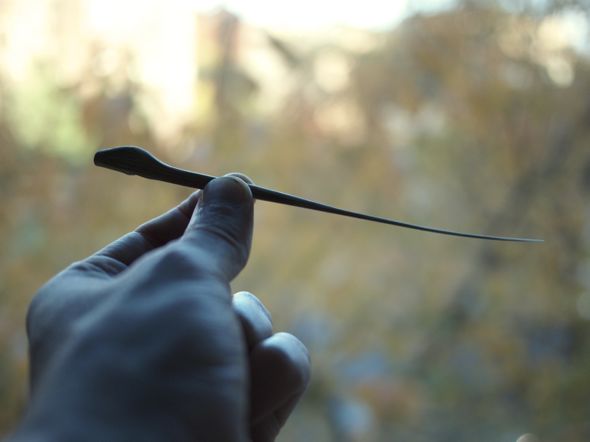
Hera are small Japanese tools useful for a variety of scraping, lifting, and delaminating tasks. They are common in paper conservation. Tonkin is a dense, flexible and strong type of bamboo that handmade fishing rods are made from. More about Tonkin.  Heat treating increases the elasticity of the bamboo.

Even so, hera with very thin and flexible tips can wear and can crack, so they need to be maintained by sanding, carving, reducing the width, or even shortening.  Once you have the skills to make a hera, they are easy to maintain. If you want to keep things simple, shape it with your Olfa knife, sand it with 220 grit, then finish it with 600 grit.  More tips on shaping bamboo.

These blanks are roughly 6 inches long, and 1/4 – 3/8 inch wide.  If you want to make two narrow hera, you could split a wider blank.  Just ask me for the widest one I have. Making your own tools to the exact size and shape you need is rewarding and satisfying.

Purchase heat treated Tonkin hera blanks here, only $10.00/ each!

Top, bottom, and side views of a typical blank.
A finished hera. This is not difficult to do, but takes a bit of time.

An Ornate 17th Century Bookbinding Press

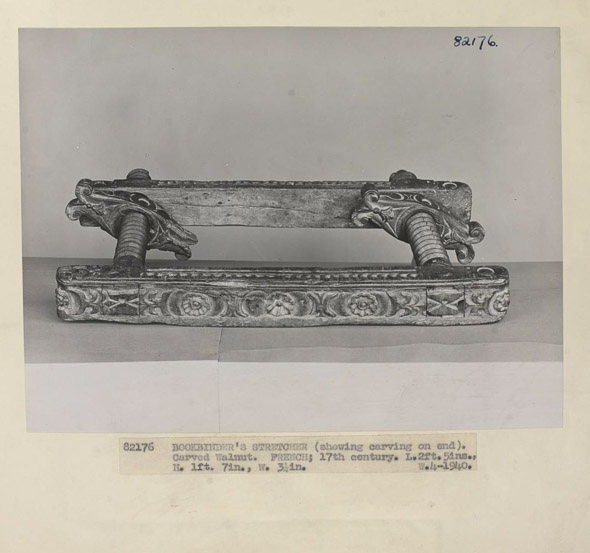
Bookbinder’s Stretcher [sic]. Possibly French, Walnut, 1670-1700. © Victoria and Albert Museum, London
This is the most ornate finishing (?) press I’ve ever seen, as well as being one of the earliest dated ones. It is inaccurately described by the V&A as a book stretcher in the catalog, because in the early images (above and below) the tightening nuts were on the wrong side of the cheek. Usually tightening nuts like these are found on German or Netherlandish presses.

It would be nice to have a book stretcher on occasion, though.  Need to turn an octavo into a quarto?  No problem!  But was this really a book press, or a press intended for some other purpose? The 29 inch long cheeks are very, very thin in profile, and I imagine would deflect quite a bit even with just hand tightening.

Bookbinder’s Stretcher [sic]. Possibly French, Walnut, 1670-1700. © Victoria and Albert Museum, London
A later image shows the press assembled correctly, but it is still described as a book stretcher. Almost every non-functional inch of this remarkable press is covered with relief carvings. The tightening nuts are especially elegant.  It is made from walnut, a wood traditionally used for press boards in 18th century France.

Bookbinder’s Stretcher [sic] assembled correctly. Possibly French, Walnut, 1670-1700. © Victoria and Albert Museum, London
Many 17th century and earlier European woodworking tools, like planes, are encrusted with carving. Hand tools have became minimally decorated since the 20th century, all form deriving from efficient manufacture and use. The decorative deep carving must have taken a lot of extra time. Did the maker or consumer provide the agency? Was this a presentation piece, not intended to be used?  It seems to show very little wear, atypical of most presses. Or did the maker just want to make a beautiful tool? Do beautiful tools inspire binders to make beautiful books?

*****

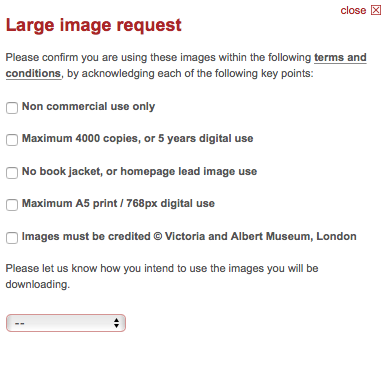
Hats off to the V&A has a very progressive large image use policy.  You can download them instantly, share them widely, and even use them for publication. There are almost 750,000 searchable images on the V&A site. Let’s hope all institutions free their images.

V&A large image use form. © Victoria and Albert Museum, London