W. O. Hickok Box

W.O.Hickock box. My Collection.

How much can we tease out of this nicely made wooden box with a sliding lid? Someone once told me that with enough rigor, knowledge and time, the whole history of the world could be found in any object. Mmmmm.

The Hickok company is still in business, and has made bookbinding and paper ruling tools for over 150 years. On this box, the shipping label also keeps the lid from sliding open in transit. The addressee, “News Bookbindery” must have been associated with the Goshen News, which was the newspaper in Goshen, Indiana. The wood is Southern yellow pine and has finger joints which are machine made using circular cutting heads. The bottom has saw marks from a 12 inch diameter circular saw.

Given the size, and very sturdy packaging, my guess it that it contained fragile Hickock ruling pens. The end of the box not visible in this image has written in pencil “17 point”, which would also support the ruling pen hypothesis, and could indicate the box was also used for storage. There is a Hickok order number, which I haven’t identified yet.

1910 Gane Brothers Catalog. Specific mention of mailing a small package. Apparently this is novel at the time? Source: https://babel.hathitrust.org/cgi/pt?id=nyp.33433057476958;view=1up;seq=44

In a 1910 Hickok catalog, there is special mention that smaller packages can be sent through the mail, and this occurs on the page that lists the styles of ruling pens.  The 3 cent purple Thomas Jefferson 1801-1809 stamp on the outside of the was issued in 1938.  I’m a little suprised a ruling machine was still in use at this late date, even in a small midwestern town. This must have been near the end of ruling machines.

Hickok is still in Harrisburg Pa, and still has lots of spare parts for ruling machines, and they still sell bookbinding equipment, such as my favorite book press, the Hickok 001/2. I visited in 1998 and wrote a short piece, “The W.O. Hickok Mfg. Co.: 150 Years of Bookbinding Equipment” for the Guild of Book Workers Newsletter #121.


Prices of Hickock ruling pens from a 1910 Gane Bros Catalog. They cost .015 cents per point. Source: https://babel.hathitrust.org/cgi/pt?id=nyp.33433057476958;view=1up;seq=44

The history of the world in this little box? Physically, it is evidence of the timber industry and industrial manufacture, as well as transportation and storage. The label is record of printing technology and the postal system. If the box contained ruling pens, these were used to make the pages for record keeping by clerks and accountants. This spins out into record keeping, finance, written marks, memory, foundations of civilization….

Samson Paper Press

The Robert C. Williams Museum of Papermaking in Atlanta has one of the largest — and oldest — papermaking presses I’ve ever seen. Look at the size of the top beam, which is about two feet square!

The entire museum is fantastic. It started at the Massachusetts Institute of Technology in 1939, consisting primarily of Dard Hunter’s papermaking books and artifacts. Then it moved to the Institute of Paper Chemistry in 1954, was added to over the years, and finally landed at Georgia Tech in 2003.

The “Samson Paper Press”, constructed in 1790, was used by Hodgkinson and Co. in Wookey Hole England until the early twentieth century, according to the label. I’m not sure if the name refers to this press in particular, or is a generic term for any massive press.

It has an iron thread which generates much more power than a wooden one, due to the reduction of friction. I’m starting to think that all images of early nineteenth century presses with a ball above the platen also have iron thread.  Samson has a ratchet wheel and pawl mechanism to prevent the platen from backing off when fully tightened.

The tommy bar, or press pin, is lying on the black plinth in front of the press and is about six feet long! Not visible is the iron renforcement on the end of the bar which fits into the four holed iron ball. I imagine Samson securely attached to the ceiling or wall, and three or four men working together to fully tighten it. The daylight is roughly 3.5 feet, which would be about the height of a typical post (a stack of the newly formed sheets and felts). Possibly a century of use might account for the deterioration on the lower wooden platen, or it may have been sunk into the earth under the floor. The uprights are iron faced on the two short sides. A few decades later, by the 1830’s, most presses were made completely or iron or steel, making Samson an interesting transitional press, incorporating both wood and iron.

Around the same time, the French papermaking press depicted in Diderot’s Encyclopédie appears to have wooden threads, but a similar iron ratchet mechanism to prevent it from backing off. I have a hard time believing a small wood pawl could withstand the compression.

Encyclopédie, ou dictionnaire raisonné des sciences, des arts et des métiers, etc., eds. Denis Diderot and Jean le Rond d’Alembert. University of Chicago: ARTFL Encyclopédie Project (Autumn 2017 Edition), Robert Morrissey and Glenn Roe (eds), http://encyclopedie.uchicago.edu/.


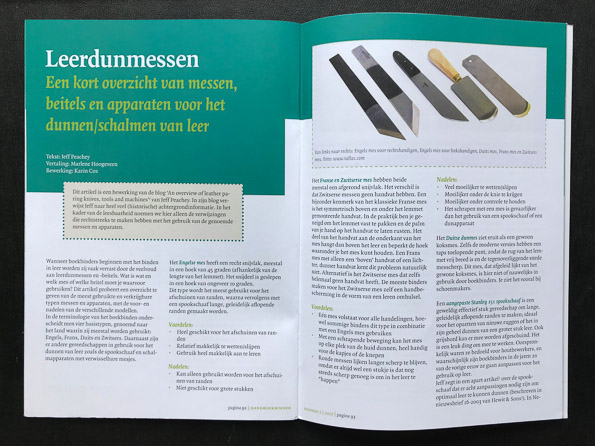
Leerdunmessen

My blog post “An Overview of Leather Paring Knives, Tools and Machines” was translated into Dutch and appears in the current issue of Handboekbinden (Jaargang 10, Nummer 3, 2017): 92-95.  According to Google translate, Leerdunmessen means “Learning Lessons”. Kind of cool!

Added 31 Oct 2017: A dutch friend let me know that Google translation is wrong, and Leerdunmessen actually means “Leather Paring”. Thanks Edith!