Miniature Bookbinding Tool Set

mini
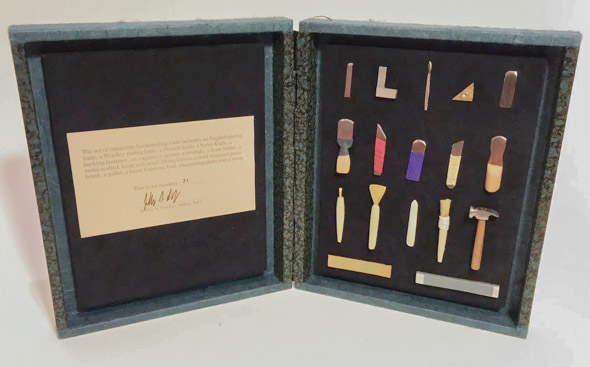
Miniature set of bookbinding tools, 1/6th Scale.

The Miniature Bookbinding Tool set is once again available for sale. I took a couple of years off to rest up my muscles. Ironically, it takes more strength to hold these while grinding and filing, than normal sized ones. The tools are made 1/6th scale, i.e. the Delrin sharpening plate on the left is two inches long, not twelve. They are made from the same materials the larger ones are, but please don’t expect to actually use them, they are much too small to hold comfortably. If you want a knife to use to make miniature books, I recommend my Flexible Mini Knives, and the cutting area can be made narrow if you desire, just let me know. The Miniature Bookbinding Tool Set is for the miniature book enthusiasts (you know who you are) or a gift for the binder who has everything. Seventeen tools are included, l-r: a Delrin sharpening plate, Peachey style French knife, Flexible paring knife, bone folder, small Powell shaped lifting knife, heart shaped finishing tool, brass triangle, engineers square, bookbinder’s hammer, swiss style paring knife, pallet, dissection scalpel, large Powell shaped lifting knife, French paring knife, cord wrapped paste brush, English style paring knife, and a strop. Supplied in a cherry box.

Miniature Bookbinding Tool Set: $800.00

Order here.

***

Elaine Nishizu, a bookbinder in Los Angles California, made this beautiful box to house a set of these tools. It is in the Guild of Book Workers California Chapter Member Exhibition, 2016. Elaine describes it: “The box structure has a reversible spine that folds back on itself like a Jacob’s ladder. It’s covered in Japanese paper and a French printed paper by Claude Braun. The box is lined with black ultra suede and has a magnetic closure.” Note: this box does not come with the tool set.

mini2
Elaine Nishizu’s box to house the miniature tool set.

Suave Mechanicals 3 and Yours Respectfully, William Bewick

Since “retiring”, it appears Cathy Baker, publisher of The Legacy Press, has doubled down on her publishing ventures.  No lounging in the Florida sun for her! Two books will be available very soon and there are five more in the works.   The essays in Suave Mechanicals 3 look spectacular. Congrats to all the authors for contributing to the permanent literature of our field:  It’s a lot of work with few rewards. The distribution website mentions the books are available to ship on October 16,  I’ve pre-ordered mine.
 

suave

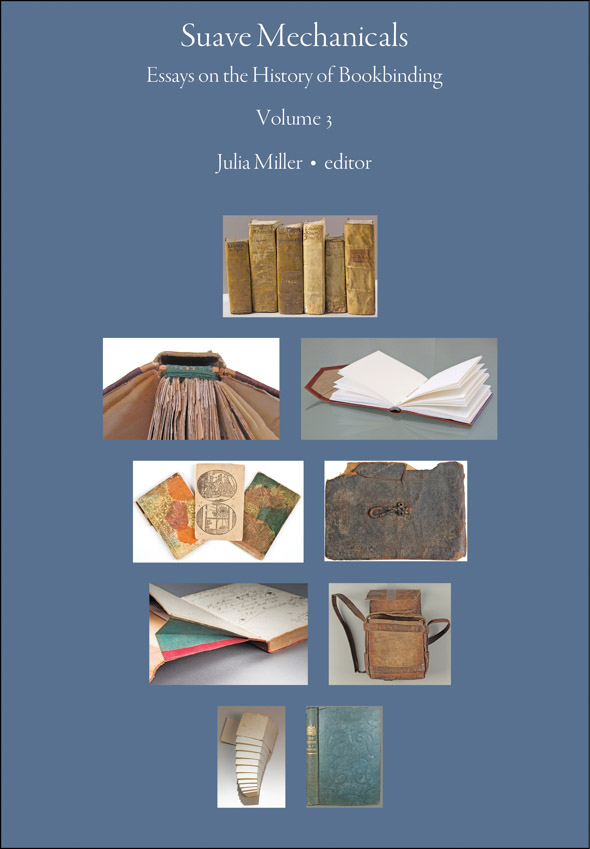
Suave Mechanicals: Essays on the History of Bookbinding, Volume 3. ed. Julia Miller. Ann Arbor, MI: The Legacy Press, 2016.

This is the third volume in the series Suave Mechanicals: Essays on the History of Bookbinding, edited by Julia Miller. Nine essays – many coauthored – are featured and not only are American scholars represented, but also ones from Spain, Ireland, and Italy. One significant connection between a number of the essays is the flap binding, spanning nearly fifteen hundred years of codex history from fourth-century Coptic bindings to nineteenth-century diaries. The eclectic nature of this volume mirrors that of the previous two, in that the authors have taken a look at historical exemplars and archival materials that have always been, if you will, “hidden in plain sight.” Many assumptions and stereotypical descriptions surround some of the structures described in these essays; the authors both add to the scholarly record and refine what is already known or thought about these bindings. 517 pages, 584 illustrations in full color, Cloth, sewn. DVD. ISBN 9781940965024.  $85.00

The essays:

Erin Albritton and Christina Amato, “A Study of Two Semi-Limp Parchment Binding Styles in the Rare Book Collection at The New York Academy of Medicine Library”

Ruth Bardenstein, “Historical Bindings of the Chamberlain-Warren Samaritan Collection”

Ana Beny and Kristine Rose Beers, “An Inspiration for Conservation: An Historic Andalusi Binding Structure”

Ashley Cataldo, “‘A Swarm of Binders’: Isaiah Thomas’s Bookbinding Network, 1782–1818”

Marco di Bella, “From Box Binding to Envelope-Flap Binding: The Missing Link in Transitional Islamic Bookbinding”

Louise L. Foster, “The Nineteenth-Century American Pocket Diary”

Bill Hanscom, “Towards a Morphology of the Ethiopian Book Satchel”

Hedi Kyle, “The Fold: Evolution, Function, and Inspiration”

Arielle Middleman and Todd Pattison, “Benjamin Bradley and the ‘Profitable Stroke’: Binding Six Months in a Convent and the Need for Copy-Specific Cataloging of Nineteenth-Century Publishers’ Bindings”


***
be

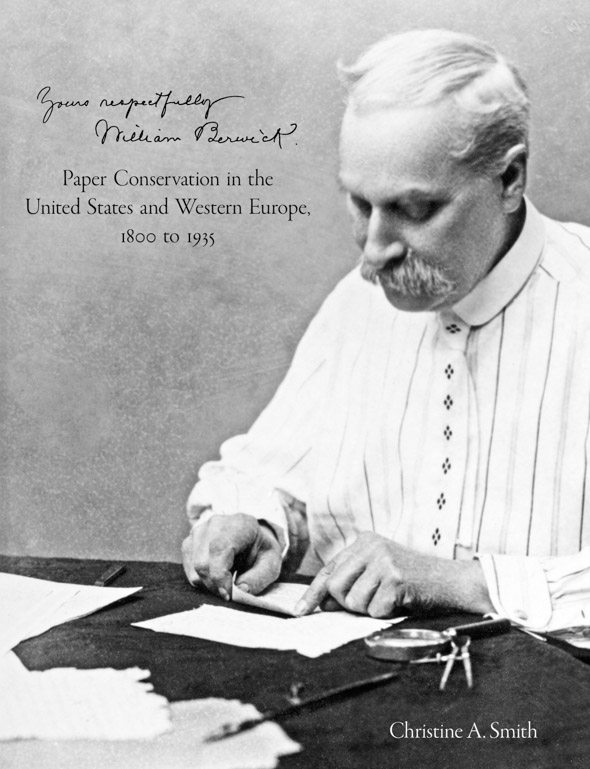
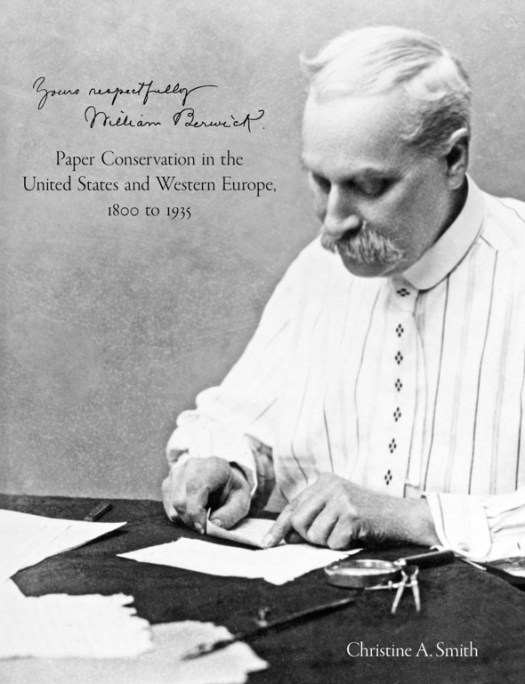
Christine A. Smith.  Yours Respectfully, William Berwick: Paper Conservation in the United States and Western Europe, 1800 to 1935. Ann Arbor, MI: The Legacy Press, 2016.

This book is the first to provide both a broad and detailed exploration of all aspects of paper-conservation activities during the period and is a major reference for those interested in Western paper-based artifacts. The development and character of the profession unfolds in descriptions of materials and processes used in libraries, archives, and fine-arts museums; related scientific advances; differing approaches to treatment; the impact of broad cultural shifts; and sketches of people active in the field. The associated issues of architecture, dirt and pollution, vermin, lighting, temperature and humidity, heating and ventilation, and fire also are explored. In order to contextualize the main focus of the book, practices extending back to the late-18th century and forward to the mid-20th are outlined. Laid into this account is the biography of acclaimed manuscript restorer William Berwick (1848–1920), who was a proponent of silking to preserve severely damaged documents. A glossary, bibliography, appendices, and endnotes accompany the text. Numerous period illustrations – before- and after-treatment photographs, portraits, cartoons, conservation diagrams, advertisements, postcards, and other images – are included. 696 pages, 112 color/black & white images, Hardcover, ISBN: 9781940965017.  $90.00


Order from The Legacy Press

Twelve Ways of Testing Knife Sharpness

1. Visual inspection. When looking directly at the blade edge, with a light source behind you, are there any reflections? If so, these are dull, bent or chipped areas. The cutting edge should be an almost invisibly smooth black line.

2. Visual inspection, with magnification. When looking at the side of the blade, the smoother it is, the sharper it is, and presumably the longer the edge will last. Brent Beach, for example, measures wear in terms of pixels in a microscopic image at 200x. Leonard Lee’s Complete Guide to Sharpening has a number of electron microscope images of blade edges. Take heart, though, even a “sharp” edge will look like the Rocky Mountains if enlarged enough.

3. Shave a few hairs on your arm. If it is sharp enough to shave, it is probably pretty good. WARNING: THIS IS DANGEROUS

4. Rest the blade on a pen held at a 15 degree angle. If the blade, with just the weight of the knife catches the plastic, it is sharp. If it slides off, it is dull. The closer to parallel the pen and the knife are, the sharper the blade is.

5. Do this same test holding the blade and GENTLY and see if it catches on your fingernail.  WARNING: THIS IS DANGEROUS.

6. Tsujigiri. This test likely seems a myth. Supposedly, at one time, samurais tested their swords by the number of torsos they could cut through in one stroke. The sharpest one was a #5. WARNING: THIS IS DANGEROUS, IMMORAL AND ILLEGAL.

7. For kitchen knives, see if they can penetrate a tomato or onion, with no downward pressure and no sawing. There are many variables in the toughness of the skin of a tomato though, I imagine.

8. Longer blades can be tested by slicing paper, even toilet paper. There are many youtube videos of this. Slicing cardboard, because of its consistent and abrasive nature, is often a field test of edge durability.

9. Feel the edge ACROSS THE BLADE with your finger, applying virtually no pressure. The smoother it feels the sharper it is. You should be able to feel any slight irregularities, indicating  a dull area. WARNING: THIS IS DANGEROUS.

10. Test it on a difficult to cut substrate like styrofoam, cork, or balsa wood.

11. Send the knife to CATRA. They will qualitatively test for initial cutting performance, edge durability, and edge geometry. This will, however, dull your knife, so it is designed for production samples.

12. Possibly the best test is just to use it. Providing you are familiar with the material you are using it on, you can often tell instantly if it is sharp depending on how much force you have to apply.