Even More Beating Hammers

A private collector has stepped out of the shadows and agreed to let me post some images of his beating hammers. I hope a few more have the temerity to do so.  While this may raise the prices of hammers that come on to the market (and in your collection), isn’t it better to at least to circulate information about your collection? And isn’t part of the fun of collecting showing off your collection, even if anonmously?

Bookbinder Beating Hammer # 2

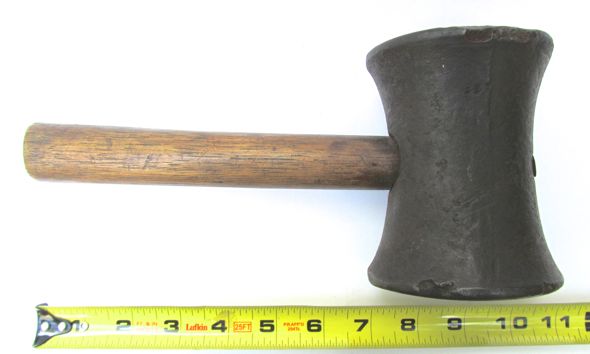
Private Collection Hammer #1. Handle length: 7 1/2”, Length of Head: 4 1/4″, Diameter of Face: 3 3/8”, Overall Length: 10 1/4”, Weight: 7 3/4 Pounds

This hammer looks very much like the early 18th century German beating Hammer as pictured in ZIedler and has almost exactly the same weight, 7 1/2 pounds. [1] The illustration in Ziedler is a very crude woodcut, almost like a line drawing, but it clearly shows this essential hourglass shape. But all the other hammers I have seen with this shape are goldbeaters hammers.  Possibly used for both trades? If it is a bookbinder’s beating hammer, it is one of the earliest ones I have seen. The curved sides also seem to have been used for other purposes, judging from the dings. The handle is a replacement. In any event very intriguing hammer.

Bookbinder BeatingHammer # 1

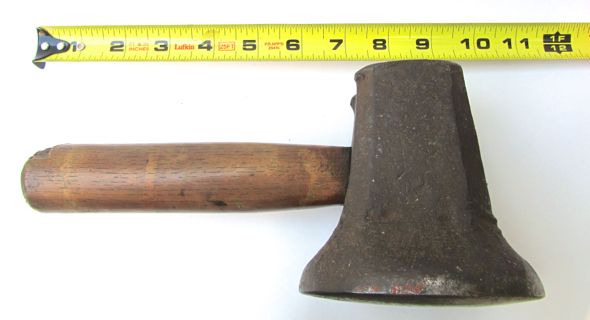
Private Collection Hammer #2. Handle length: 6 1/2” Length of Head: 4 1/2” Diameter of Face: 4 1/4” Overall Length: 9 3/4” Weight: 9 Pounds

This one looks like a 19th c. English beating hammer, but there are many stylistic differences, so I think it is a very crude custom made version for a binder. Of course, custom made tools for a binder are not without interest.  The handle is a replacement and apparently carved down to fit. There are some large casting depressions opposite the face. It also has a very sharp rim and uneven belly.It just doesn’t look right, or have any of the stylistic consistency that other English hammers I have seen have, though it does fit nicely with early nineteenth century textual descriptions which generally refer to a “bell” shape.

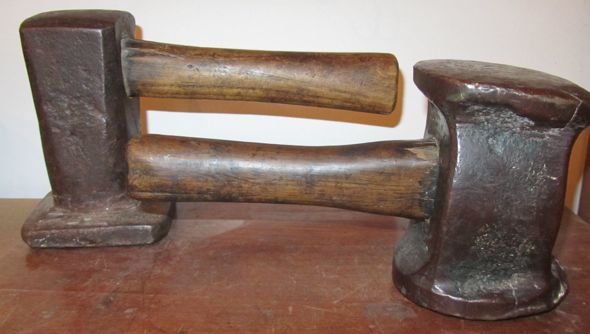
Bookbinding beating hammers at Swiss Museum for Paper, Writing & Printing, Basel

 Basel Paper Mill: The Swiss Museum for Paper, Writing and Printing.

The hammer in back is unlike any one I have ever seen. The lip is so thin and there is no evidence in historic images of an offest handle shape like this. Almost all beating hammers I’ve seen are chipped around the lip.  Is this an altered filemakers hammer? Who knows.

The one in the front is the most beautiful bookbinding beating hammer I have ever seen.  It is great the museum hasn’t overly cleaned the handles or the head: much of the information about how these hammers were held and used must be derived from the dirt, wear and stains.   It has a nicely shaped, older handle. The head appears to have been smashed in a decisive moment, as if it were molten and suddenly frozen upon impact, but with an impact which took place over decades, if not centuries.

***

1. J.G. Zeidler, Buchbinder-Philosophie Hall im Magdeburgschen: Rengerscher, 1708

A Very Brief Account of Beating Textblocks

The compression of signatures before sewing is an interesting, important, and poorly understood aspect of bookbinding.  Many people immediately assume beating flattens the pages. Although this is partially true, the situation is more complex. Below is a brief introduction.

OLYMPUS DIGITAL CAMERA unbeaten page

Both images, page 126 of John Marshall The Life of George Washington  Philadelphia: C. P. Wayne, 1804. On the top: beaten, edges cut and bound in full calf. On the bottom: unbeaten, uncut and boarded. Courtesy The Library Company of Philadelphia.

These two images, shot in raking light with a flashlight, demonstrate some of the effects of beating. The book in the bottom image is from a boards binding and is unbeaten, but has been pressed. The book in the top image has been beaten: it clearly demonstrates increased textblock undulations as compared to the bottom image, where the undulations are much looser. Baxter, in 1809, mentions that beating makes the leaves “smooth and lie close together.”[1]  Beating compresses the pages, smooths their surface texture, decreases the punch from the type, but it does not generally flatten the page overall. It usually does the opposite for the text area.

Pressing complicates all of this, but generally compresses the thickest parts of a textblock composed of handmade paper. Depending on the structure, time period, and nationality, bound books could be pressed up to six times: before sewing, when sawing in, during backing, while ploughing the edges, when applying spine linings, during edge decoration, and after pasting down the end sheets.

Depending on the techniques employed while beating, the margins of the page can get flatter, if beaten more, while the printed portions of the page simultaneously become more undulated. A useful food analogy is is to imagine pounding a veal cutlet.  The meat moves outward in all directions from the blows of a hammer, as well as getting thinner. Careful control can direct the movement, however. Beating hammers usually have some “belly”, so depending on how much force they are used, impact a smaller or larger area of the page.

Beating causes the textblock undulations to become more pronounced, and the pages to lie in closer contact with one another. This has the effect of helping to lock together the leaves, much like inserting egg crates into one another.  Much more information is available in my article, “Beating, Rolling and Pressing: The Compression of Signatures in Bookbinding Prior to Sewing” in Suave Mechanicals: Essays in the History of Bookbinding, Volume 1. Ed. Julia Miller. Ann Arbor: The Legacy Press, 2013. (pp. 316-381)

*****

1. John Baxter The Sister Arts (Lews: Printed and Published by J. Baxter) 95

Thread Bookmark

Thread bookmark

Thomas Nuttall The Genera of North American Plants and a Catalogue of the species to the Year 1817. Philadelphia: Printed for the Author by D. Heartt, 1818.    Courtesy The Library Company of Philadelphia.

There are many kinds of bookmarks, and most often those that are attached to bindings are silk ribbons. This owner made bookmark, which is on a boards binding, almost crosses the line into becoming a kind of oddly knotted end band, which boards bindings never originally had. The fourteen separate threads are sewn into the spine, and were used to mark the pages of this presumably frequently consulted catalogue of plant species. It also seems to have stabilized the binding a bit at the head, where the spine on these  bindings often delaminates.

flowers

Thomas Nuttall The Genera of North American Plants and a Catalogue of the species to the Year 1817. Philadelphia: Printed for the Author by D. Heartt, 1818.    Courtesy The Library Company of Philadelphia.

It is also evidence against once strongly held notions that boards bindings are “temporary”. This binding not only displays considerable use (dirt, stains, flower and leaf storage) but the owner consulted it enough to warrant take the time to install this method keeping track of multiple places at one time, and used the book in the field.