Thread Bookmark

Thread bookmark

Thomas Nuttall The Genera of North American Plants and a Catalogue of the species to the Year 1817. Philadelphia: Printed for the Author by D. Heartt, 1818.    Courtesy The Library Company of Philadelphia.

There are many kinds of bookmarks, and most often those that are attached to bindings are silk ribbons. This owner made bookmark, which is on a boards binding, almost crosses the line into becoming a kind of oddly knotted end band, which boards bindings never originally had. The fourteen separate threads are sewn into the spine, and were used to mark the pages of this presumably frequently consulted catalogue of plant species. It also seems to have stabilized the binding a bit at the head, where the spine on these  bindings often delaminates.
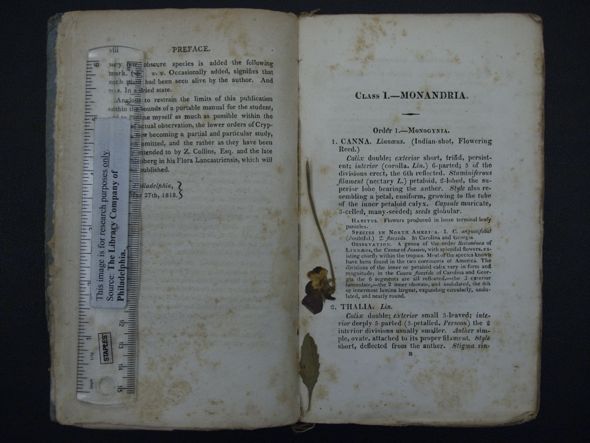
flowers

Thomas Nuttall The Genera of North American Plants and a Catalogue of the species to the Year 1817. Philadelphia: Printed for the Author by D. Heartt, 1818.    Courtesy The Library Company of Philadelphia.

It is also evidence against once strongly held notions that boards bindings are “temporary”. This binding not only displays considerable use (dirt, stains, flower and leaf storage) but the owner consulted it enough to warrant take the time to install this method keeping track of multiple places at one time, and used the book in the field.

Old Style Olfa

Adam’s Practical Bookbinding has an intriguing passage regarding knives to cut binders board:

Instead of sharpening the knife, the tip is broken off, exactly the same as modern Olfa type snap-off blades, except that there were no score lines to make the snap. The description of the knife makes it sound similar to a mill knife. I’m not sure why a broken edge would be sharper or hold the edge better when cutting something as abrasive as boards. Recently on the Book Arts Listserv there was a discussion about resharpening Olfa knives to save a few pennies. Could the original broken edge be superior?

Adam, Paul. Practical Bookbinding. London and New York: Scott, Greenwood and Co. and D. Van Nostrand Co., 1903. (p. 86)

The Ugliest Machine-made Paper?

Franklin

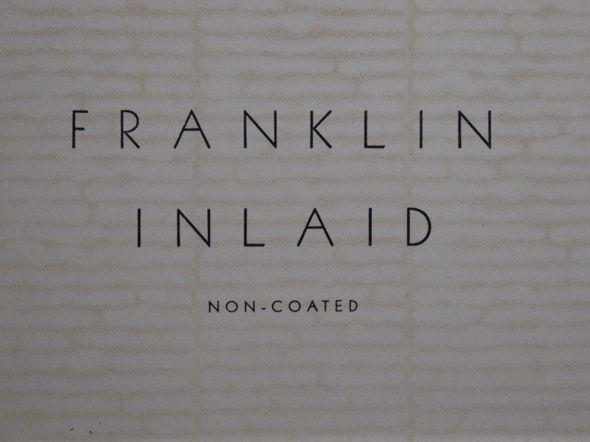
The Franklin Paper Co. Franklin Inlaid Sample book. Early-Mid 20th c.

Handmade paper generally has chain and laid lines. These were originally aspects formed by the making of paper, though are artificially replicated in machine made papers. What is called “fake” chain and laid lines are, in fact, thinner deposits of pulp in the paper, often made by a dandy roll. The chain and laid lines in the Franklin Inlaid paper are beyond fake, however. They are printed on the surface of the paper. The chain and laid lines in this paper were available in four colors.

Franklin Blue Book

The Franklin Paper Co. Franklin Inlaid Sample book. Early-Mid 20th c. Enlarged Detail.

As someone who routinely works with paper, I feel confident in describing this paper as pretty ugly. The chain and laid lines look more like mortar between brickwork than a thinner deposit of pulp.

But in the top image, if I can forget these are supposed to be chain and laid lines, it looks pretty good. With the expansive letterspacing, the chain and laid lines function as a ghostly background image. A faked material aspect of paper becomes part of the image.