The Ugliest Machine-made Paper?

Franklin

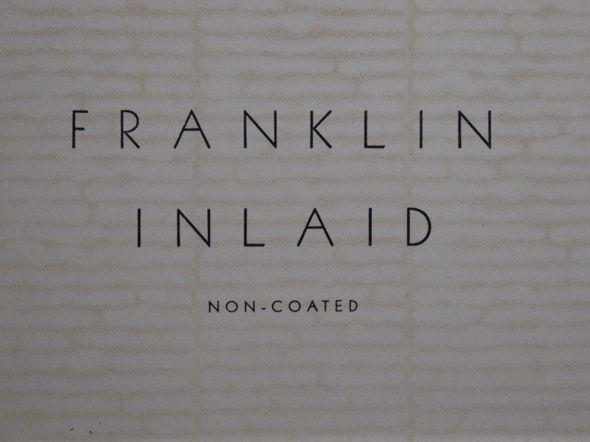
The Franklin Paper Co. Franklin Inlaid Sample book. Early-Mid 20th c.

Handmade paper generally has chain and laid lines. These were originally aspects formed by the making of paper, though are artificially replicated in machine made papers. What is called “fake” chain and laid lines are, in fact, thinner deposits of pulp in the paper, often made by a dandy roll. The chain and laid lines in the Franklin Inlaid paper are beyond fake, however. They are printed on the surface of the paper. The chain and laid lines in this paper were available in four colors.

Franklin Blue Book

The Franklin Paper Co. Franklin Inlaid Sample book. Early-Mid 20th c. Enlarged Detail.

As someone who routinely works with paper, I feel confident in describing this paper as pretty ugly. The chain and laid lines look more like mortar between brickwork than a thinner deposit of pulp.

But in the top image, if I can forget these are supposed to be chain and laid lines, it looks pretty good. With the expansive letterspacing, the chain and laid lines function as a ghostly background image. A faked material aspect of paper becomes part of the image.

Gone Researching. 2013 Brodsky Lecture at Syracuse University. Tool Vending at the Guild of Book Workers in Washington DC.

Some upcoming events this fall.  First, I was awarded the 2013 Reese Fellowship in American Bibliography at the Library Company of Philadelphia for the month of September. This is great news for me, since I will have some time to focus on early nineteenth century American binding structures, especially Boards Bindings. This is not great news if you need conservation services or want to order tools. Although I can respond to emails, I won’t be able to fulfill any orders until September 30th, 2013 or so.

On October 3rd, I will be giving the 2013 Brodsky Lecture for the Advancement of Conservation at Syracuse University Library.  “Reconstructing Diderot: Eighteenth Century French Bookbinding” will take place at 5:00pm in the Peter Graham Scholarly Commons, Bird Library, Syracuse University. This was supposed to have taken place last year, but Hurricane Sandy interrupted. More info from  Syracuse University. I will also be giving a one day workshop on October 4th, 18th Century French Beating and Sewing, from 9:00am – 5:00pm, in the Preservation Bindery of the Bird Library. This workshop full, but to be placed on a waiting list contact Barbara Brooker at bbbrooke [at] syr.edu

From October 24-26, 2013, I will be vending tools at the Guild of Book Workers Standard of Excellence Conference in Washington DC. Although registration is closed, you can still come to shop and examine the tools in person. I will bring my new Manual Board Slotting Machine and hopefully a few other new items. Jim Croft and Shanna Leino will also be there selling handmade bone folders and other tools. Please stop by and chat!

A Cool Press

Luke Herbert. The Engineer’s & Mechanics Encyclopedia, Vol. 2 , 1849 (p. 333)

The above press won a prize for it because it demonstrates the five mechanical powers of a simple machine: the wheel and axle, lever, wedge, inclined plane, and pulley. Sometimes a screw is also considered a sixth basic function, although it is essentially an inclined plane wrapped around a cylinder. Herbert’s article on presses also illustrates a number of high tech screw presses used by bookbinders from this time. The state of the art information contained within this book is reflected by its binding: my 1840 edition is in a caoutchouc binding, which was invented in 1836.