
Text block washing, old school. The binder has a curious expression, a mix of intense concentration, shock and self conscious posing. Courtesy Anonymous Bookbinder
.

The back of the above photo. Courtesy Anonymous Bookbinder

Book Conservation
Text block washing, old school. The binder has a curious expression, a mix of intense concentration, shock and self conscious posing. Courtesy Anonymous Bookbinder
.
The back of the above photo. Courtesy Anonymous Bookbinder
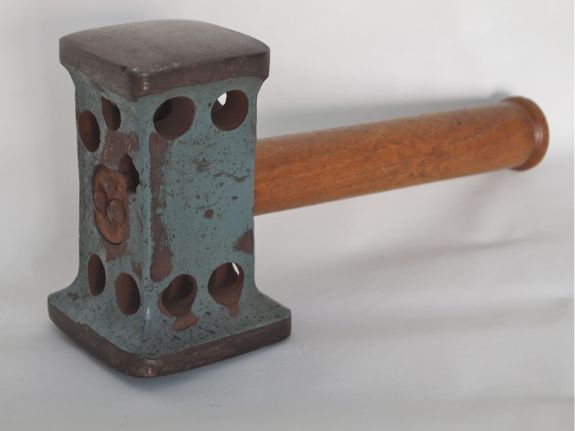
Thanks to a tip from James Tapley, a Florida based bookbinder and winner of the prestigious DeGolyer bookbinding competition, I was able to acquire something I’ve wanted for a long time: a real French beating hammer. Beating hammers were used for pounding signatures before sewing. Early Christmas! But I will wait until Christmas morning to actually smash some paper with it on my beating iron. Seven interminably long days from now….
Anyway, it is typically French with large and small square shaped faces and a cylindrical handle that ends in a bulge. The heads also have a significant amount of ‘belly’, or camber, which I have not seen in images and photographs of other French hammers, though this may or may not be common.
What is not typical about this hammer are the nine holes drilled into it. The only explanation I can think of is that a previous owner wanted to lighten the weight, like I did on the chainrings on my racing bicycle in the 1980’s. Another unusual aspect is a small pin on the side of the hammer that was presumably intended to secure the head, though of course this has loosened. The hammer was used quite—for something— a bit judging from the dings on the faces.
The hammer currently weighs 4.5 lbs with the handle. I’ve calculated that if the nine holes were filled in it would weight about 5.25 lbs. which is the same as my small sized Hickock beating hammer. The large face is roughly 2.5 inches square, the small one 2 inches. Given the relatively small size and (presumably original) green paint, I’d guess a mid-twentieth century date. The handle is 8.5 inches long and 1.25 inches in diameter, and turned on a (copy?) lathe. This is the original length judging from the ends, both marks from a headstock spur center and the tailstock are intact.
Predictably, this hammer arrived a few weeks too late to be included in my forthcoming article about beating hammers, “Beating, Rolling and Pressing: The Compression of Signatures in Bookbinding Prior to Sewing” in Suave Mechanicals: Essays on the History of Bookbinding, which will be published in early 2013 by The Legacy Press. Grrr.

Board slotting is likely the strongest and least invasive method of treating detached boards. Detached boards are the most common point where bookbindings fail. Christopher Clarkson developed the technique in the late 1970’s. The board slotting tab at the top of this page and the board slotting blog offers more information concerning its history, technique and recent advances.
The original Peachey Board Slotting Machine, developed in 2005, is used in conservation labs around the world. It is, however, a somewhat large and expensive machine, and best suited for large institutions. The Manual Peachey Board Slotting Machine is a new affordable alternative for individuals, regional centers, smaller institutional labs and even larger labs with space limitations. This smaller machine can be moved out of the way when not in use, freeing up valuable bench space. It is also simpler to operate.
 The Manual Peachey Board Slotting Machine features stops that automatically guide the positioning of the blade when starting and stopping a cut. In order to make this machine more affordable, three aspects are limited as compared with the original machine: the maximum length that can be slotted is 15″ (rather than 17.75″), the board needs to be manually pulled or cranked using a hand wheel, and the angles for slotting are not infinitely adjustable, but can be set at 11, 13, and 15 degrees. These are the most common angles used. In fact, I use 13 degrees about 90% of the time, 11 for very thin boards, and 15 for thick ones.
 This machine is less intimidating when compared to the original. The orientation makes it easier to sight the height of the blade. The carriage can be quickly pulled back into starting position after the end of a previous cut. This also makes partial (or biscut) slotting of a board very fast and easy. Overall, the slotting operation seems to be quicker. Many bookbinding and conservation students, such as those from North Bennett Street School, have been trained in the fundamentals of board slotting. A one to three day workshop on machine operation, basic slotting technique and structures is recommended, though.

.
SPECIFICATIONS
-Width of the machine -12″, Height- 19″, Length- 22″
-Weight 30 lbs. Easy to move and store when not needed.
-Fast and intuitive operation.
-The sliding board carriage can be quickly moved to the starting position at the end of a slot, or between biscuit slots.
-Maximum height of board that can be slotted: 15″
-Dust collector hooks up to a standard vacuum cleaner.
-Thick and thin solid carbide blades included for long cutting life.
-Automatic blade positioning for starting and stopping a cut.
-Boards can be slotted by pulling or cranking.
-Safety guards (not pictured) keep hands away from the blade in use.
-The motor, and other operations are similar to the original machine.
-No electrical transformer needed for international operation, just plug adaptors.
-This machine can be shipped pre-aligned, but still needs some assembly.
.
I have a machine in operation at my NYC studio if you would like to examine and give it a test drive. Please contact me if you have questions or need a formal price quote including shipping, assembly and training.
Introductory Price: $4,950.00 (Regular price $5,500.00)
 Peachey Conservation