
Has Anyone Else Ever Wondered What the Inside of a Board Shear or Guillotine Blade Looks Like if You Saw Through the Mild Steel, Grind the Cutting Edge and Break the Area Where They Are Joined Together?

Book Conservation

A while ago I made this sketchbook, based on a nineteenth century design, that features a built in pencil holder. It is covered in natural linen and functions well, having a full 360 degree flexibility that landscape format sketchbooks should have, so that they are convenient to hold while sketching. Given the admittedly obsessive amount of attention that bookbinders give to the evenness of the squares, I never was quite satisfied with the size of the top square, to make up for the space of the pencil. Three large squares looked even worse. There are many solutions to this problem, often hiding the pencil in the spine or incorporating it into some kind of catch or tie.
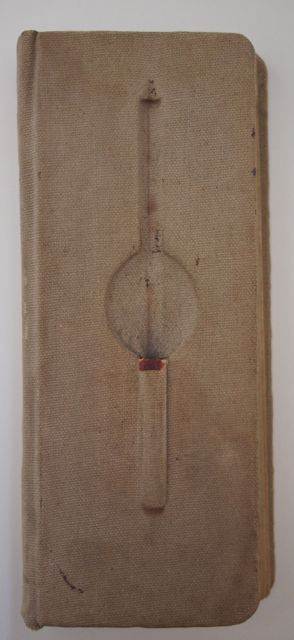
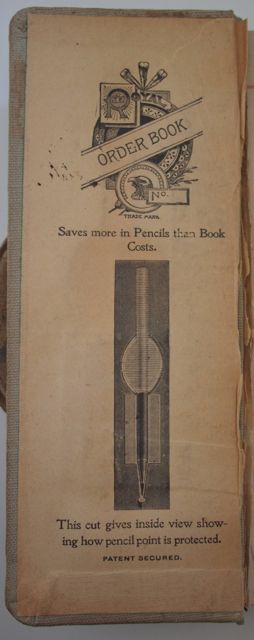
But recently I purchased the account book below, which had a more clever, though much more labor intensive solution—recess the pencil holder into the front cover. The finger space to remove the pencil was similarly recessed. Not unimportantly, the pencil lead is protected when housed. Peeking into the bottom pocket revealed a lot of marks from the pencil being removed and inserted. About a third of the book is filled with pencil notes, primarily lists of food purchases from 1903-1909. The manufacturer of the book is Royal—even the paper has their watermark—and the advertisement on the front flyleaf appears from the turn of the twentieth century.
.

One of the advantages of the Nokey sewing frame is that it is easy to loosen, then retighten the supports to sew a book in the round. Sewing in the round is less invasive than flattening the original backing, then rebacking, and incidenally is quicker. However, thick books such as the one pictured take me a while to sew: I am no where near as quick as an experienced sewer in the mid-nineteenth century who could sew between two and three thousand signatures a day, according to “A Day at the Bookbinder’s” from The Penny Magazine Supplement Vol. XI, December 24, 1842, p. 380.
Three sizes of the Nokey are available here for purchase.
 Peachey Conservation