Knockoff of Amman’s Bookbinder

Der Buchbinder  in Eweloser Schaw-Platz oder Newer Schreib-Kalender Auff das Gnaden-Jahr M.DCC.XXIII. Prognosis Astrologica.... 1723.  Image courtesy Musinsky Rare Books.

Jost Amman’s book of trades is iconic, or perhaps even a bit cliched depending on your point of view, and it is commonly used as a representation of  ‘hand-work’ irrespective of the time period under consideration.  The plates of Diderot are similarly used.  Yet these woodcuts, and an unknown number of copies made throughout the centuries, are important documents of technical aspects of many crafts. The illustration of the bookbinder, above, is from a 1723 calander,  the only edition and only copy located, according to Nina Musinsky. She describes this as “a crudely printed but appealing calendar/ almanac, illustrated with primitive wood-cut scenes of trades and professions. The printer Salomon appears to have conceived his Schreib-Kalender as a vehicle for the lively woodcuts, which may be the work of a single artist (IGS).”

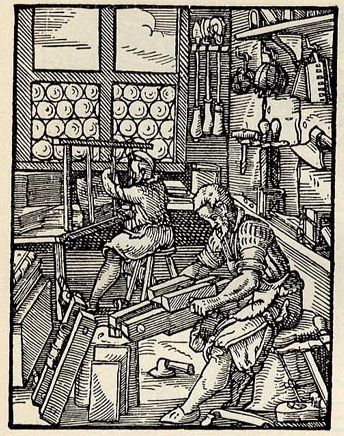
On the top: Der Buchbinder, Jost Amman, 1568. Image courtesy Peter Verheyen.

On the bottom: Der Buchbinder, artist unknown, 1723. Image courtesy Musinsky Rare Books.

Often discrete changes contain valuable information: in this image, for example, the beating hammer looks like it is shaped like a double faced one, rather than the single faced style depicted in Amman’s original. Small details like these can help to help to date changes in tool styles. It also appears the sewing supports are wide tapes or thongs rather than cord?  Is the artist of this woodcut adding details from his own time rather than straightforwardly copying Amman?  It is often debatable if these details are oversights, reflections of contemporary practices and tools, mistakes, or simply crude renderings.

More broadly, the reuse of this image, 150 years after its creation, invites speculation about the long tradition of depicting hand work as archaic. As Tom Conroy mentions in his comments to the original post about this image, about half of the tools are for shaping wood boards, a binding style that was rarely used by the 1720’s.  Likely, this image would have already seemed old fashioned to a early 18th century audience. Yet the appeal — and the reuse —  of Amman’s illustrations continue.

Nina: many thanks for bringing this image to my attention and allowing it to be published.

For more information contact: nina (at) musinskyrarebooks.com.

PS. A calendar such as this would make a wonderful christmas gift for a certain NYC based book conservator with a keen interest in the history of bookbinding tools.
New(ish) Translation of Amman’s Book of Trades

The Bookbinder, 1568


“Both lay and sacred, big and small,

Give me books: I bind them all

In parchment or in boards of wood.

And my clasps and locks look good.

I shape and cut the books for size,

And a stamp that beautifies,

And gild some spines, but just a few.

My income is quite handsome, too.”

________________________________________

Rabb, Theodore K. A Sixteenth-Century Book of Trades: Das Standebuch. (Palo Alto, CA: The Society for the Promotion of Science and Scholarship, 2009) 43.

Rabb’s introduction is fascinating. Jost Amman (1539-1591) was the son of a professor, moved to Nurenburg, and produced thousands of individual prints.   There are ten woodcuts relating to the book trade: the typefounder (the first depiction of one), the draughtsman, the gold beater, the parchment maker,  the tanner, the etcher, the papermaker, the printer, the illuminator, and the bookbinder. This book was groundbreaking in its straightforward description of crafts. The introduction concludes with some observations on German identity, craftsmanship, and Weber’s Protestant Ethic. There are striking similarities between the depiction of the goldbeater’s hammer and the beating hammer that the bookbinder is using — perhaps another early metal working and book making connection?

George Barnsley and Sons lLd. Factory Images

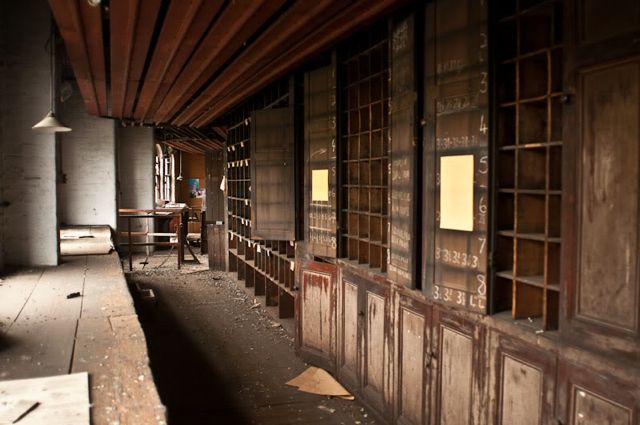
Many, if not most, English trained bookbinders of a certain age cut their teeth using Geo. Barnsley leather paring knives. Barnsley made numerous tools for butchers, saddle makers, shoemakers and others, from the early 19th century until the 1990’s.  Below are great images of how one factory looks now, from the UK UE Urbex Urban Exploration Forums.  There are many more photos on this site from several members. Admittedly, propagating images like these raises some concerns and issues, including trespassing, vandalism, safety, ethics, preservation, conservation, and more.  But these images are already ‘out’, and in this case, I felt the informational value for the people who use and research the history of leather-working tools outweighs these other concerns.  These aren’t just neat photos of a cool old rundown factory, these are valuable documentation.

.

A wonderfully intact painted sign on a gate. Graffiti seems to have been removed or covered over in the grey areas. The piece of unpainted wood, either covering or replacing a hinge, seems to indicate at least someone is repairing or maintaining the premises? Image: The UK UE Urbex Urban Exploration Forums

.

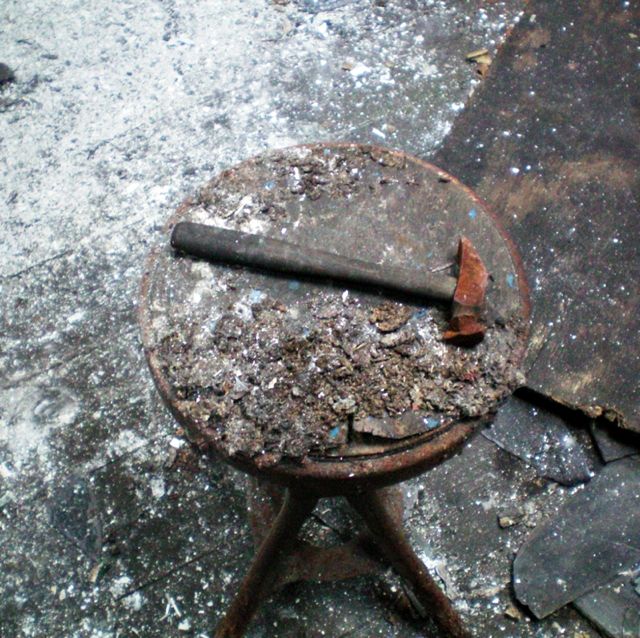
Very rusty cobbler’s hammer with a broken neck. To me this photograph looks staged, although of course all photographs, in a fundamental sense, are staged. The cleaned off area on and around the handle seems inconsistent with the regular deposits of debris on most surfaces. The very rusty and broken hammer head seems incongruous with the essentially intact handle. But it is a nice image of nature overcoming technology. Image: The UK UE Urbex Urban Exploration Forums

.

Storage shelves for knives. Lace knives are used to cut leather laces, and  could be stuck into the bench, and the leather spun around in a circle to cut long lengths from a relatively small piece of leather.  A butt knife is similar to a linoleum knife. Some butt knives have a mysterious nib, or hump,  on the back of the blade, and its purpose is unknown. There are similar nibs on some 19th and 20th century  handsaws for wood and 18th century french saws for sawing in book spines. Image: The UK UE Urbex Urban Exploration Forums
.

Indenture for an apprentice knife or toolmaker. Date: June 4, 1823. Seven years, two hundred seventy one days in length and signed by George Barnsley.   It is hard to believe this is still lying around the factory. Traditionally indentures were cut in irregular patterns on the top edge so that the master and apprentice copies would fit together.  It is a fairly small image and hard to read, but several lines jump out: “Fornication he shall not commit”  and “his [master’s] lawful secrets he shall keep.”  Image: The UK UE Urbex Urban Exploration Forums

.

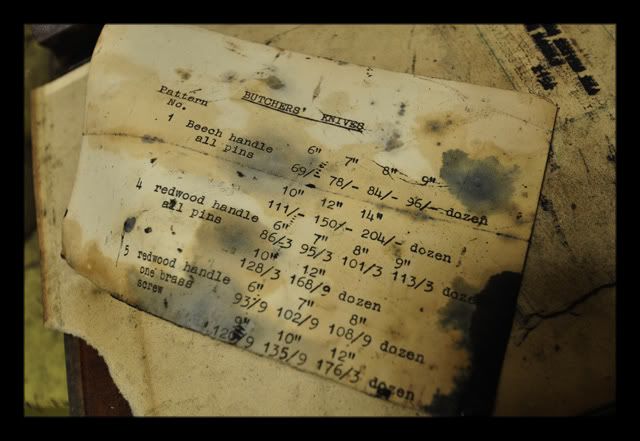
Price list for various pattern Butcher’s knifes.  Note that beech handles were cheaper than redwood and the large variety of sizes availiable. I’m unclear what the bottom style knife with “one brass screw” is. Image: The UK UE Urbex Urban Exploration Forums

.

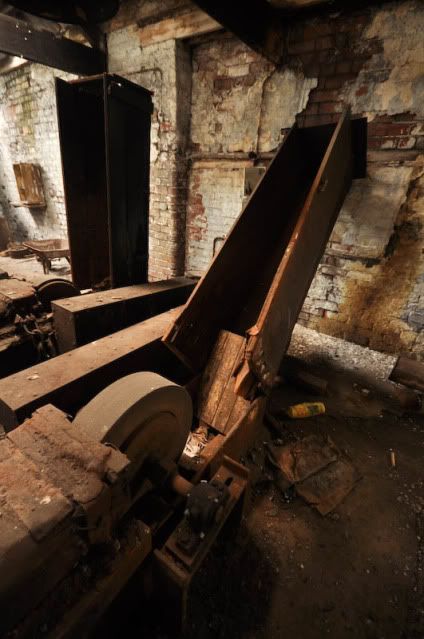
Large grinding wheel.  Ashley Iles reports that in 1950’s Sheffield, most workers only respiratory protection was a pint of ale to wash down the dust. [1]   The hinged wood cover hinges down to protect the stone. Image: The UK UE Urbex Urban Exploration Forums

.

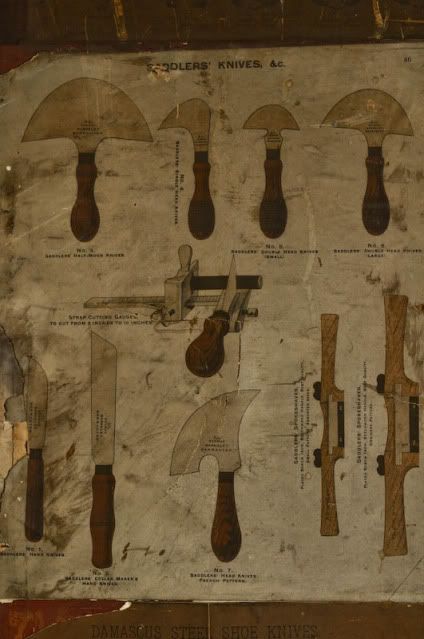
Various knives from a catalog plate?  Small and large wooden body spokeshaves on the right, “Saddlers Spokeshaves”  In the middle is a plough gauge (aka. Strap cutting gauge), which is used to cut long strips of leather to an even width. [2] On the bottom, in the middle is a saddler’s head knife; it is easy to image grasping it with your thumb on the slight curve and forefinger fitting into the severe curve on the left side. Image: The UK UE Urbex Urban Exploration Forums

Notes

______________________

1. Ashley Iles, Memories of a Sheffield Tool Maker. Mendham, N.J.: Astragal Press, 1993. (p. 64)

2.  R. A. Salaman, Dictionary of Leather-Working Tools c. 1700-1950. London: George Allen & Unwin, 1986. (p. 263) Contains a good illustration of how they are used.