Peter Verheyen’s Five Essential Bookbinding Tools

Peter Verheyen’s five essential bookbinding tools.

Peter Verheyen

Bookbinder, Conservator & Librarian, The Book Arts Web & Book_Arts-L Listserv , Pressbengel Project Blog

  1. Ascona Schärfix. This saved my life after falling flat on my face trying hand pare leather strips for hinges on a quarter-leather binding during my apprentice exam.
  2. Ascona Swiss paring knife. This replaced the miserable “German-style” knife I was given as an apprentice.
  3. Peachey Delrin folder. The best for so many tasks.
  4. Shanna Leino folder. Replaces the metal folder/scorer I use for working with vellum.
  5. Bone folder. A small bone one for detail work/headcaps.


Tom Conroy’s Five Essential Bookbinding Tools

Tom Conroy asked me an intriguing question.  What are the five most essential bookbinding tools? And why?

I asked a number of bookbinders and conservators to weigh in, and will roll out their answers, one a day, for the next week or so. It is a deceptively intriguing question, as well as being an engrossing distraction. And possibly contentious!

Spoiler alert, if you want to think about this a bit without prejudice, scroll down no further!

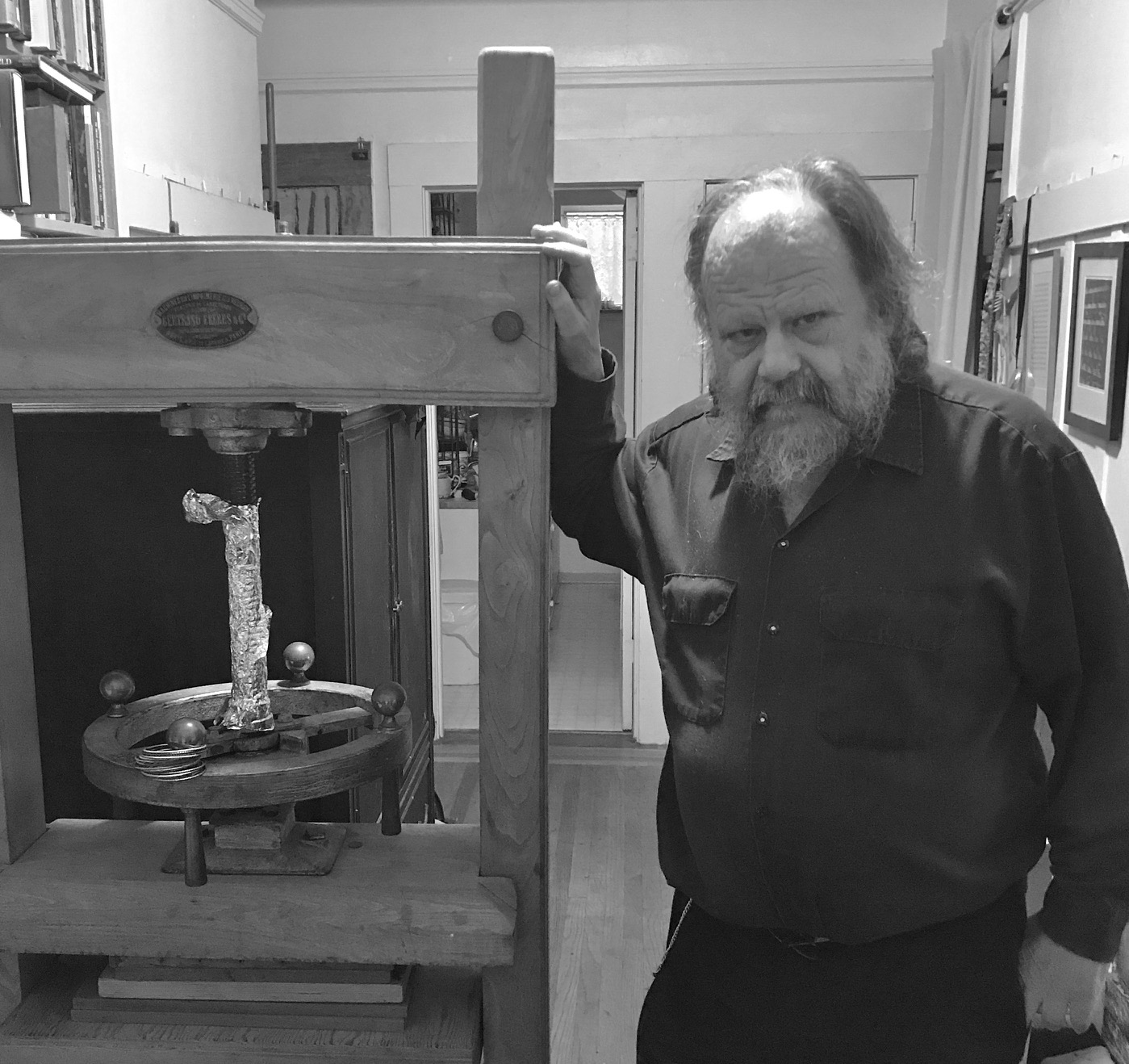
Tom Conroy with his pride and joy: a Bertrand Frères Percussion Press. Note the aluminum foil to protect forearms from getting greased.

Tom Conroy

Bookbinder and Book Historian, Berkely, CA.

Bone folder, of course, first; and then I would say knife and straightedge. Spring dividers. Needle. Its a bit more complex than that, of course. My favorite folder is about six inches long, tapers gradually almost from the butt end, and is strongly curved (when “flat” on the bench the tip is raised by almost 5/8″), and is broadly useful for folding, rubbing down, casemaking, and covering; but it is a bit big for working headcaps, definitely too big or a lot of paper treatment and probing where I like a thin folder, and I avoid creasing with it since creasing wears tips so quickly; so actually, several folders are necessary. Well, the more the better, really. A knife and straightedge normally require a cutting board as well, and a knife requires sharpening equipment (disposable blades are never sharp enough) My preferred bench knife is a “small McKay” used by shoemakers and is perfect for use with a straightedge and for disbinding, generally useful, even for light paring, but it it is too short for slitting paper and too small for serious leather paring. Dividers: almost any will suffice, really bad ones are very rare (though I have seen them), and I can, with a strong grimace, imagine making do with just one pair. My preference, though, is 6″ Starrett “Fay” style, with the screw piercing almost-rectangular legs. Needles: now there’s a essay, good ones haven’t been made for at least half a century now, but some needle is indispensable. It’s hard to stop at five. My first thought, before I remembered needles, I had a paste brush on the list (at least 1-1/8″ diameter, usable for hot glue in desperation, but never for PVA); but then I recalled Bernard Middleton pasting up leather for rebacking by grabbing a handful out of the pot and scrubbing it in with the flat of his hand….I think he did it to shock the young folks, that workshop was full of French-style design binders and newly-minted program conservators, and while Bernard was as gentle and quiet as any man I have ever seen, once in a very great while he would show a touch of teasing, immediately hidden away again. I’d find it hard to do without awls (four main kinds in constant use for binding, and others for leatherworking and woodworking). Long tweezers and needle-nosed pliers would be hard to do without. But, on balance: bone folder, straightedge, knife, dividers, needle.


The Conservation of Leather Bookbindings Workshop Review by Kasie Janssen

One month ago, I was able to attend The Conservation of Leather Bookbindings at the University of Notre Dame. The American Institute for Conservation (AIC) and the Foundation for Advancement in Conservation (FAIC) supported this 5-day workshop that was taught by book conservator and tool-maker Jeff Peachey. Conservation is a field that requires a constant love of learning new skills and techniques, so when I saw this workshop was hosted not too far from Cincinnati, I jumped at the opportunity to increase my knowledge on the conservation of leather bookbindings.

Jeff demonstrating a leather reback.

Leather is an interesting topic in book conservation, as many of the historic books we work on have full or partial leather bindings. Leather, like paper, comes in a variety of qualities, and has inherent issues as it ages over time. And we, as conservators, have many ways to combat these issues to make the books in our collections accessible to all.

This workshop offered an in-depth look at the many ways leather can be conserved, while also discussing the pros and cons of the various types of treatment options. This level of understanding is crucial part for us.  Think of it like taking a test – you can simply have the list of answers, or you can study and understand why the answers are in fact correct (any teacher will tell you they prefer the latter of these two options, and we do too!).

Joint tacketing and sewing extensions.

While the leather on the outside of a book is what most of us see when we look at our books and bookshelves, a large portion of the workshop focused on how those books are put together. If you’ve seen a leather book, you have likely seen a book that has its covers detached or missing. We talked about reattaching covers using techniques such as joint tackets, sewing extensions, slitting and slotting the boards, and tissue repairs. These are techniques that need to be considered before a leather reback, which was the final technique we learned, would take place.

One of the most beneficial aspects of the workshop was that we were able to practice these techniques on our own books. (I’ll take this time to note that these were not collection items! We like to practice on models or personal books first.) Being able to learn about the techniques and then practice them was a great way to use the hand skills needed for these types of treatments. Having our own personal examples that were treated also provides an application of how these techniques work and wear over time.

Detail of sewing extensions that come out under the original sewing supports.

The workshop also covered leather dying, as well as knife sharpening – a crucial tool for working with leather, and leather paring techniques and tools.

I have to say, the workshop happened in the week before Covid-19 began impacting the United States on a massive scale. All of the attendees remained in contact with their home institutions and families throughout the week as news progressed. The workshop, though, provided a sort of conservation utopia where we could turn off the news and focus on the profession that we all love. Jeff Peachey was an incredible instructor, offering vast amounts of knowledge and insight that we can apply to our day-to-day work. And the staff and facilities at the University of Notre Dame provided the perfect environment for our leather conservation deep dive. A sincere thank you to Jeff, the University of Notre Dame, AIC and FAIC for the wonderful workshop.

While I continue my work-from-home, I will be finishing a few of the treatments I had started during the workshop, and also practicing things like leather paring, leather dying, and repair techniques. This will ensure that when we are back in The Preservation Lab, I’ll be able to provide assistance on many of the damaged leather books that are waiting for our tender loving care.

Paring leather for a reback.

In the meantime check out some more photos from the workshop on our @ThePreservationLab Instagram!  And follow us if you don’t already to see what we are up to in our work-from-home spaces.


Kasie Janssen (PLCH) is the Senior Conservation Technician of The Preservation Lab, a collaborative hybrid lab of The Public Library of Cincinnati and Hamilton County and the University of Cincinnati Libraries in Ohio. She works on both special and general collection items for both institutions. She holds an MSLIS from the University of Illinois at Urbana-Champaign, and has been working in the field of conservation since 2014.