
“Armenia!“, now on view at the Met, is one of the largest Armenian art shows ever in North America, containing more than 140 works of art, objects, body parts (in reliquaries), and books. It is not only a great art exhibition, but a great show for bibliophiles: roughly half the items on view are books. The show spreads calmly over seven galleries, with no videos or recorded sounds playing, and ample space between the objects. Even though it was packed with viewers the Sunday afternoon I visited, there weren’t lines in front of any particular object. The minimal gallery introductions and short captions reinforced a direct engagement with the objects, rather than reading about them. Interspersing the books with other objects initiated a dialogue between them.
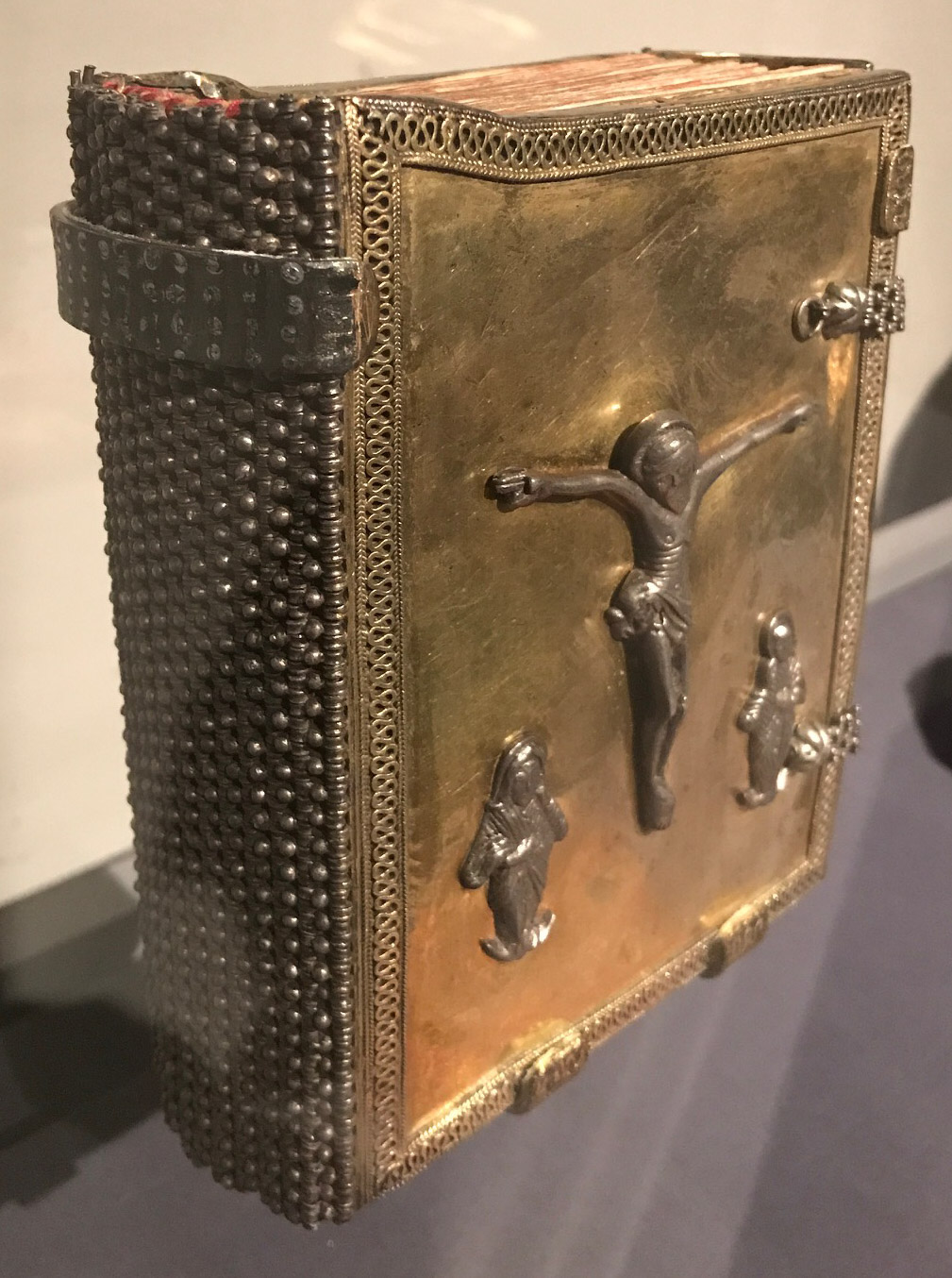
The craft similarities between reliquaries and full-metal books were hard to miss. For example, the 17th century gilded silver covers on the Gospel Book above, and the Hand Reliquary of Saint Abulmuse (L.1988.63) have a very similar construction. The stunning covers of both signal their importance as objects of veneration, and at the same time hide their inner contents. The insides of these objects are deeply personal, and almost at odds with the elaborately decorated exterior. The reliquary houses body parts of someone, the book houses the thoughts of someone. Is there an object that does both?
Expositionitis. n. [ek-spuh-zish-uhn-ahy-tis] : A horrible desease that temporarily blinds museum professionals to the actual objects in an exhibition. Instead, the afflicted spend all their time looking at a crooked frame, an over cut mat, how a particular object was repaired or strapped, prominent shadows, a dust bunny in the corner of a case, etc… “I didn’t even notice the carved ivory elephant in the corner, my expositionitis was so bad!”
I must have had a mild attack, since I am still thinking about a number of books open to a full 180 degrees, which can cause stress to the binding. A more restricted opening is generally better, and it is still relatively easy to view a two page spread. It also sets a poor precedent for the display of books in such a pre-eminant institution.
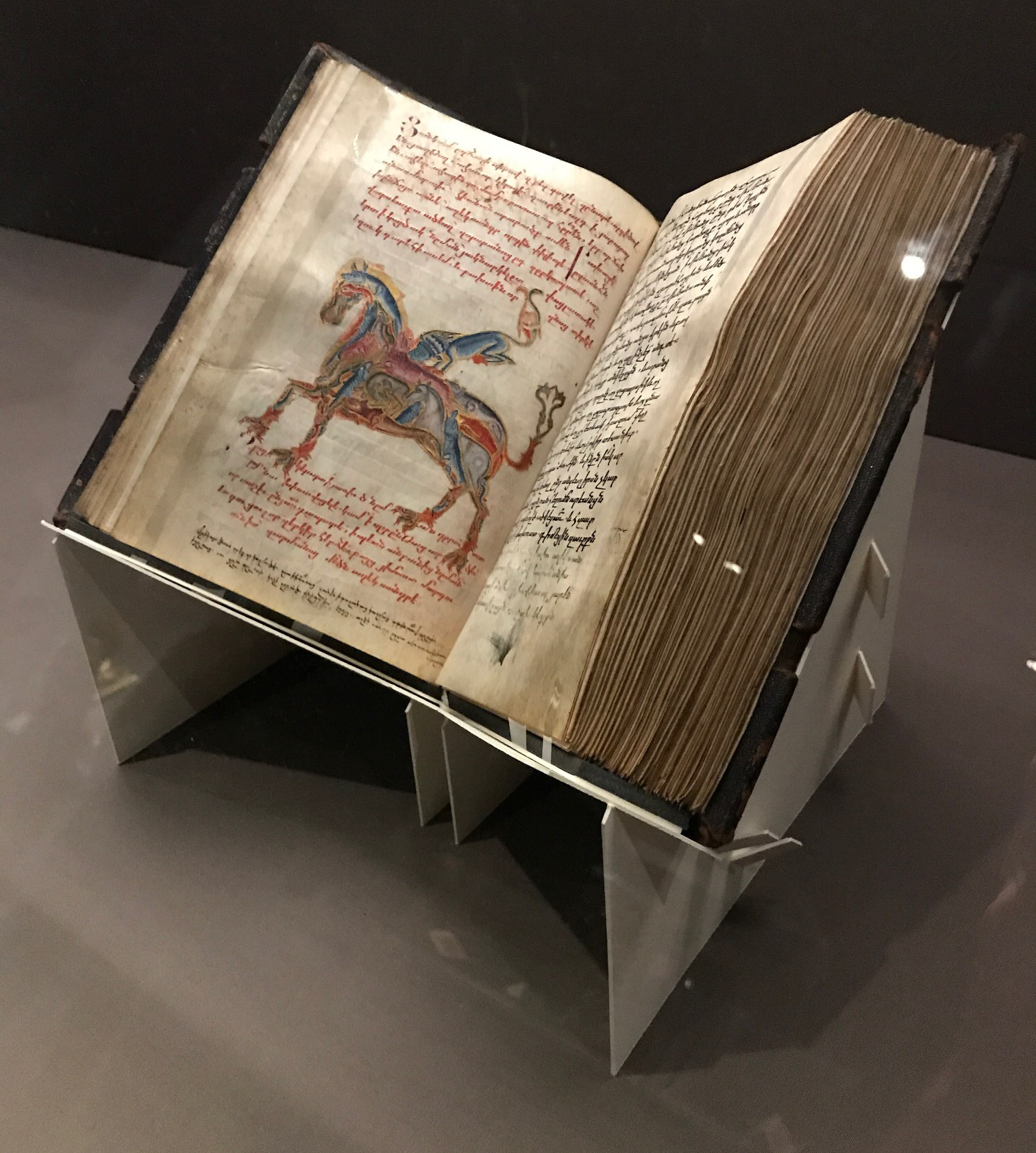
Mark Furness, Senior Conservator at the University of Manchester, designed and made an interesting cradle. He and Elaine Sheldon have been working for a number of years on museum board cradles cut on a Kasemake boxmaking machine. I like the softness of museum board when making contact with leather. Some might find the aesthetics slightly distracting, though I’m sure this is something that is evolving. Mark also did a great job of strapping: note the zero textblock sag. An advantage is it ships completely flat for easy transport, and assembles without any adhesives. This version is quite strong and easily supports a heavy parchment textblook/ wooden board book easily. These cradles are inexpensive and easy to recycle.
I’m glad to see someone experimenting with something other than acrylic. Acrylic is so hard and flat, it rarely conforms closely with the undulations of hand made book boards and hand pared leather, let alone metal furniture. This can result in the weight of a book being concentrated in a few small areas.
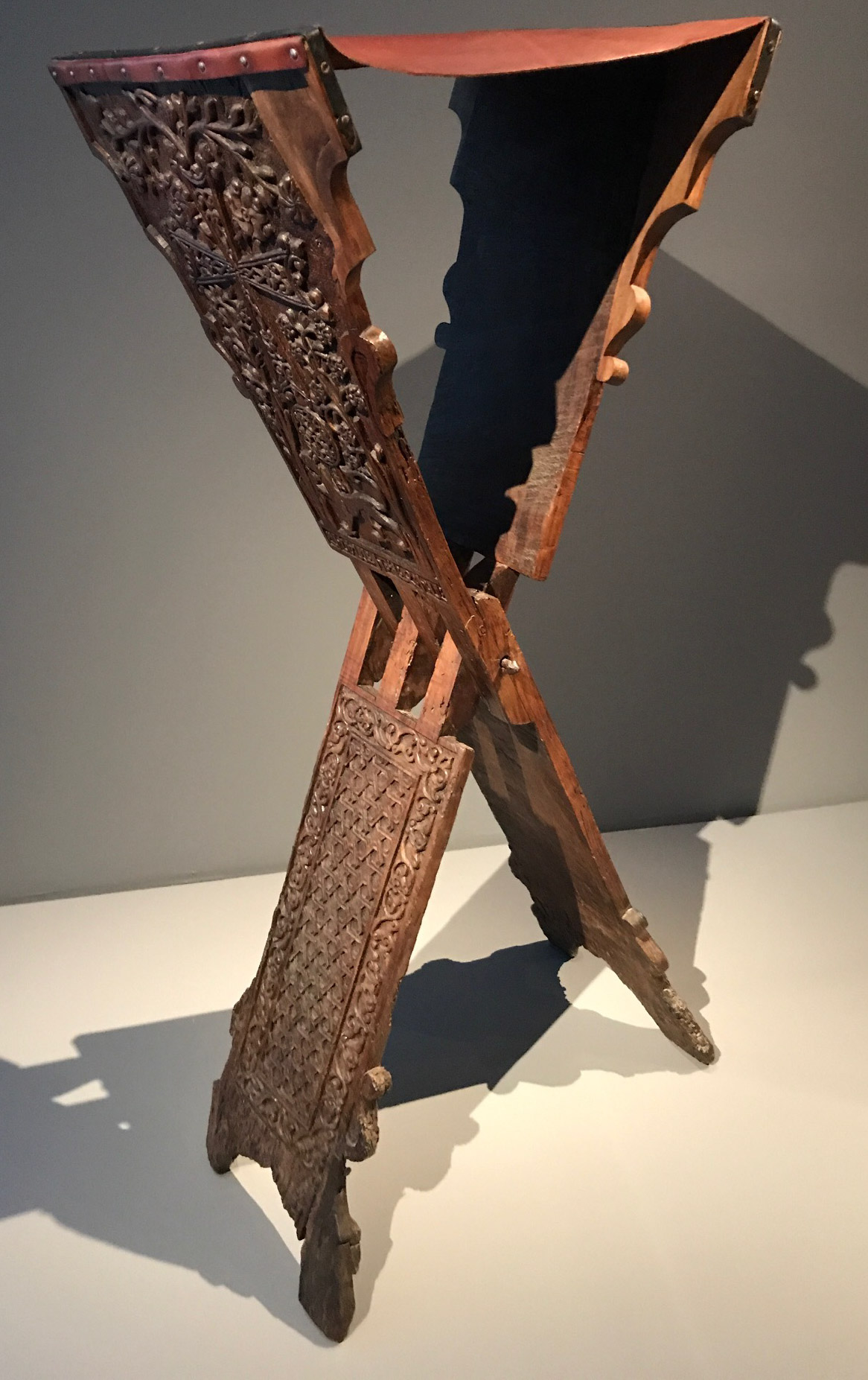
The most interesting cradle, technically a book stand, was this 13th century grakal, a liturgical book stand. Although it is similar to an Islamic rehal, there are important differences. A traditional rehal is cut from a single piece of wood. The grakel was made of two seporate pieces. How they hinge together is also quite different.

To make a rehal, holes are drilled, as you can see in the image below. Then a thin sawblade, like a coping or turning saw, is inserted and the joints cut, and the plank cut in two. The ways a book sits in a rehal or grakal are also quite different. A book in a rehal sits in this cut out hinge, which also flattens out, creating a space for the spine. A book in a grakal sits on top of the leather sling, and has a metal rod that the two sides hinge from. Both, however, are lightweight, collapsable, portable, and support a book in use.

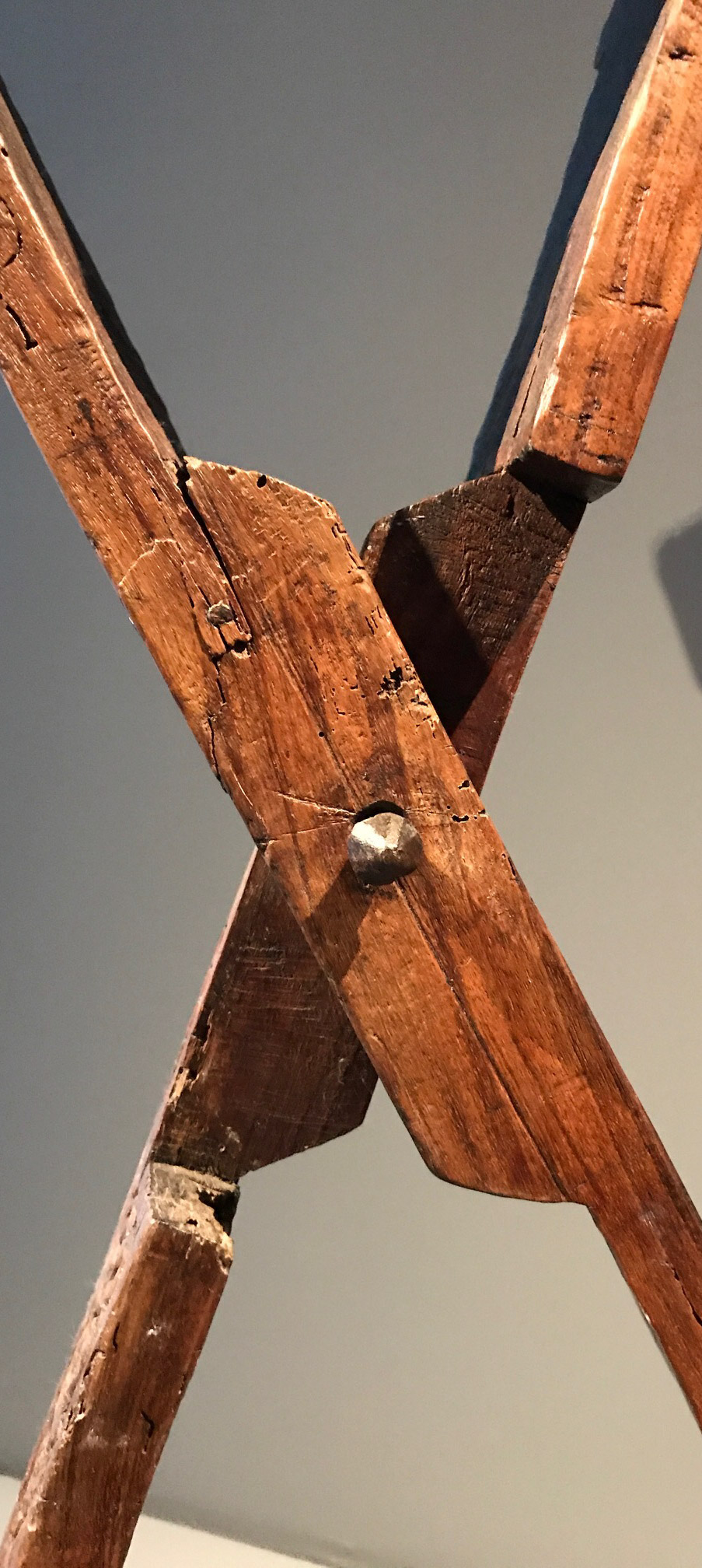
I’m almost certain the top and bottom parts of this grakal are made from separate pieces of wood and glued together. The book rests on a leather top piece which lessens the stress on the hinge. Given the fact it has held up for nine centuries, the construction is more than adequate!

My favorite piece in the show is this page from a Gospel Book, 1386. On the top are two scribes, and under them are two students burnishing the paper in preparation for writing, with extremely tall burnishers. Stylistically, they look quite similar to smaller, one handed Western glass mullers. The scribe mentions, in the text, he wanted to thank the students (“his angels”) for this generally thankless, but important task. Paper was burnished to make it smoother for painting and writing on, and more parchment-like in appearance.
The last gallery of the show included a number of highly skilled manuscripts made in the 17th century. It surprised me to see the skilled transmission of craft skills persisting so late into what we in the West consider print culture. One of the primary takeaways from the show was how Armenia does not fit neatly into the Eastern-Western culture divisions many of us still regularly invoke, as well as challenging our notion of when Medieval culture ended.
If you can’t make it to the show, which closes January 13, 2019, the catalog is very informative, with all 143 objects described in text and photographs, and several longer essays. NY TImes review of Armenia!


 Peachey Conservation