Two Awesome Looking New Books From The Legacy Press. Tim Barrett’s European Papermaking and Pablo Alvarez’s Translation of Paredes’ Printing Manual.

Cathy Baker, owner of The Legacy Press, will drop two new books very soon, Tim Barrett’s European Papermaking, and Pablo Alvarez’s translation of Paredes’ Printing Manual, which is the earliest European printing manual. I can’t wait to get both of them! Pre-order here.

Cover of Tim Barrett’s new book. In the background, at the top, are marbles trapped in a wood groove. It lets the papermakers quickly hang and remove a sheet when it is drying. Clever!

European Hand Papermaking: Traditions, Tools, and Techniques

Timothy D. Barrett

In this important and long-awaited book, Timothy Barrett, internationally known authority in hand papermaking and Director of the University of Iowa Center for the Book, offers the first comprehensive “how-to” book about traditional European hand papermaking since Dard Hunter’s renowned reference, Papermaking: The History and Technique of an Ancient Craft.

This book, which includes an appendix on mould and deckle construction by Timothy Moore, is aimed at a variety of audiences: artisans and craftspeople wishing to make paper or to manufacture papermaking tools and equipment, paper and book conservators seeking detailed information about paper-production techniques, and other readers with a desire to understand the intricacies of the craft. European Hand Papermakingis the companion volume to Barrett’s Japanese Papermaking – Traditions, Tools and Techniques. The first 500 hardcover copies include paper specimens.

352 pages • 394 illustrations • hardcover • paper specimens • 2018

ISBN 9781940965116 • $65.00


Alonso Víctor de Paredes’ Institution, and Origin of the Art of Printing, and General Rules for Compositors [Madrid: ca. 1680]

Edited and translated by Pablo Alvarez

with a foreword by DonW.Cruickshank

Pablo Alvarez offers the first complete English translation of Alonso Víctor de Paredes’ Institucion, y origen del arte de la imprenta, y reglas generales para los componedores [Institution, and Origin of the Art of Printing, and General Rules for Compositors].

This 96-page printing manual – set and printed by Paredes himself – was issued in Madrid around 1680. It opens with an introductory digression on the origin of writing and printing, followed by ten technical chapters on each of the tasks that are necessary to print a book, including a detailed description of the different kinds of type sizes and their use, the rules of orthography and punctuation, the setting of numeric systems, imposition, casting off, the printing of university dissertations, and the correction of proofs. Some of the chapters are of unique relevance for the understanding of early printing in Europe. Chapter 8, for example, is the first recorded, comprehensive account of the practice of printing by forms/formes.

Alvarez’ transcription, translation, and notes greatly facilitate access to this important historical work, which is in fact the earliest known printing manual published in Europe – Joseph Moxon’s Mechanick Exercises was published in 1683 – and an extraordinary rarity: there are only two extant copies in the world. The book also features a foreword by Don W. Cruickshank and full reproductions of the copies held in rare-book collections at the Providence Public Library and at the University of Valencia, Spain.

Dr. Alvarez is Curator at the Special Collections Research Center, University of Michigan Library.

466 pages • 212 color illustrations • cloth, sewn • 2018

ISBN 9781940965109 • $100.00
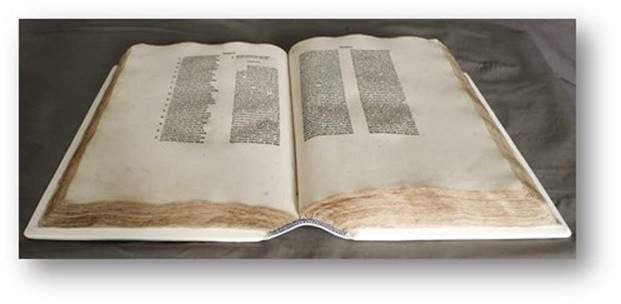
Upcoming Public Lecture at Emory University, Atlanta. The Conservation of Dante’s La Commedia

Please join us at Emory University for this event, free and open to the public—

The Conservation of Dante’s 1477 La Commedia:  an illustrated talk by Jeffrey S. Peachey
Tuesday, November 6, 2018
4:00pm Talk and Q&A
5:00pm Reception

Jones Room
Robert W. Woodruff Library
540 Asbury Circle  Atlanta, GA 30322

Registration available here:  http://emorylib.info/peachey
Please feel free to share this information with others.

Don’t Wash … Scour!

Last summer I recorded my investigations into replicating early 19th century book cloth  using XSL pigments. One difficulty was achieving an even coloring, and several commenters indicated I should scour the fabric, rather than just wash it. Finally, I had a little time to try this, and although I haven’t had a chance to do more dying, tests with wheat starch paste have been astounding.

Note all the yellowish junk that came out of the muslin: oils, waxes, and pectic substances.

I boiled 1.5 yards of Springs Creative 45″ unbleached muslin (133 x 72 thread count, .007″ thick, $4.00 a yard) for two hours in a stainless steel pot, using 1 tablespoon of soda ash per 6 cups of water. Since it smells a bit, it is advisable to have a externally vented exhaust hood.  A long stirring stick is necessary, as are rubber gloves.

Keep a close eye on the boiling muslin. I used large pieces of cloth, for future use as covering material. As the water boils, hot areas form bubbles under folded and wrinkled areas. Then when you stir, they get released and the pot bubbles over, or worse, spills on you. I stirred the pot every 15 minutes so that all cloth surfaces were exposed to the scouring, and adjusted the temperature as necessary to keep an even boil.

The scouring raised the pH of the cloth from around 5 to 7, though this was measured with testing strips and is likely not super accurate. Soda ash is around 10 or 11 pH. The scouring removed oils, waxes, and pectic substances. The cotton fibers swelled and softened during the process.

Muslin samples pasted onto Mohawk Superfine. Left: Scoured. Middle: Washed. Right: Untreated. Note the superior adhesion of the scoured sample, skinning the paper during a pull test.

The difference in adhesion between the scoured, washed, and untreated samples is remarkable. All were pasted with Aytex P wheat starch paste onto a piece of Mohawk Superfine, with the same weight during drying.  I testing the adhesive strength by pulling the fabric away from the paper at 180 degrees. The scoured sample delaminated the paper, while the washed sample (hot water, a tiny bit of Seventh Generation Free and Clear detergent, industrial washing machine) and untreated sample released without affecting the surface of the paper. I tried this two more times, and the results were the same. In a separate test using EVA all the samples delaminated the paper.  I’d like to get a push-pull gauge to quantify the adhesion a bit more rigorously. Of course, there may be circumstances where a weaker adhesion is desirable.

But for most book conservation applications — spine linings, board slotting flanges, hinges, sewn stuck-on endbands, covering material — strong adhesion is desirable.