
Since “retiring”, it appears Cathy Baker, publisher of The Legacy Press, has doubled down on her publishing ventures. No lounging in the Florida sun for her! Two books will be available very soon and there are five more in the works. The essays in Suave Mechanicals 3 look spectacular. Congrats to all the authors for contributing to the permanent literature of our field: It’s a lot of work with few rewards. The distribution website mentions the books are available to ship on October 16, I’ve pre-ordered mine.
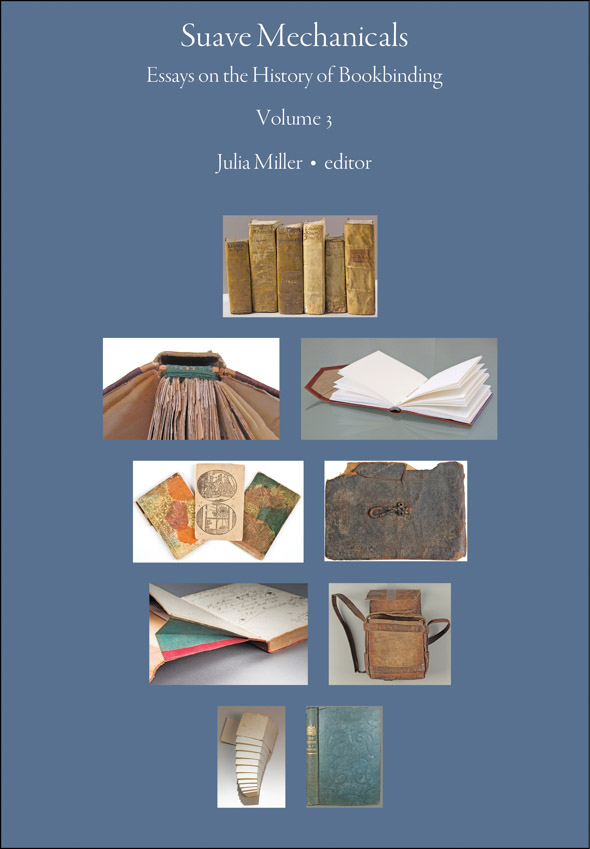
Suave Mechanicals: Essays on the History of Bookbinding, Volume 3. ed. Julia Miller. Ann Arbor, MI: The Legacy Press, 2016.
This is the third volume in the series Suave Mechanicals: Essays on the History of Bookbinding, edited by Julia Miller. Nine essays – many coauthored – are featured and not only are American scholars represented, but also ones from Spain, Ireland, and Italy. One significant connection between a number of the essays is the flap binding, spanning nearly fifteen hundred years of codex history from fourth-century Coptic bindings to nineteenth-century diaries. The eclectic nature of this volume mirrors that of the previous two, in that the authors have taken a look at historical exemplars and archival materials that have always been, if you will, “hidden in plain sight.” Many assumptions and stereotypical descriptions surround some of the structures described in these essays; the authors both add to the scholarly record and refine what is already known or thought about these bindings. 517 pages, 584 illustrations in full color, Cloth, sewn. DVD. ISBN 9781940965024. $85.00
The essays:
Erin Albritton and Christina Amato, “A Study of Two Semi-Limp Parchment Binding Styles in the Rare Book Collection at The New York Academy of Medicine Library”
Ruth Bardenstein, “Historical Bindings of the Chamberlain-Warren Samaritan Collection”
Ana Beny and Kristine Rose Beers, “An Inspiration for Conservation: An Historic Andalusi Binding Structure”
Ashley Cataldo, “‘A Swarm of Binders’: Isaiah Thomas’s Bookbinding Network, 1782–1818”
Marco di Bella, “From Box Binding to Envelope-Flap Binding: The Missing Link in Transitional Islamic Bookbinding”
Louise L. Foster, “The Nineteenth-Century American Pocket Diary”
Bill Hanscom, “Towards a Morphology of the Ethiopian Book Satchel”
Hedi Kyle, “The Fold: Evolution, Function, and Inspiration”
Arielle Middleman and Todd Pattison, “Benjamin Bradley and the ‘Profitable Stroke’: Binding Six Months in a Convent and the Need for Copy-Specific Cataloging of Nineteenth-Century Publishers’ Bindings”
***
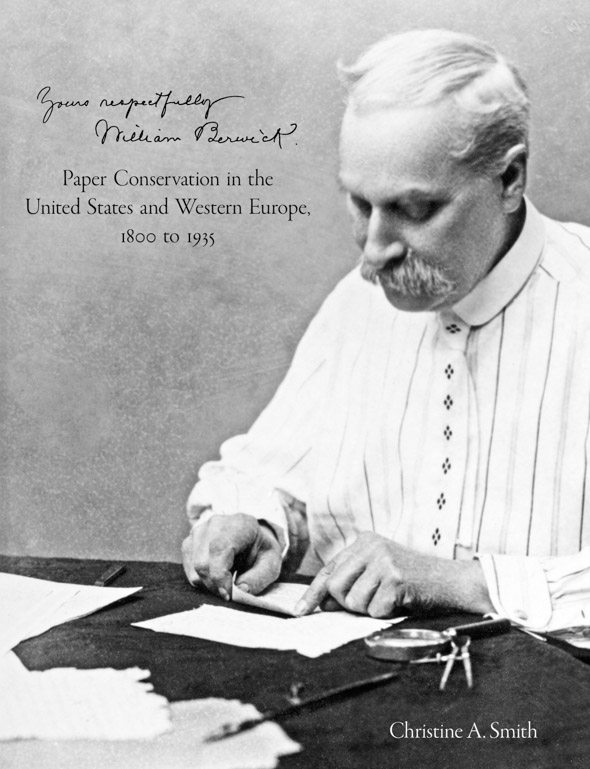
Christine A. Smith. Yours Respectfully, William Berwick: Paper Conservation in the United States and Western Europe, 1800 to 1935. Ann Arbor, MI: The Legacy Press, 2016.
This book is the first to provide both a broad and detailed exploration of all aspects of paper-conservation activities during the period and is a major reference for those interested in Western paper-based artifacts. The development and character of the profession unfolds in descriptions of materials and processes used in libraries, archives, and fine-arts museums; related scientific advances; differing approaches to treatment; the impact of broad cultural shifts; and sketches of people active in the field. The associated issues of architecture, dirt and pollution, vermin, lighting, temperature and humidity, heating and ventilation, and fire also are explored. In order to contextualize the main focus of the book, practices extending back to the late-18th century and forward to the mid-20th are outlined. Laid into this account is the biography of acclaimed manuscript restorer William Berwick (1848–1920), who was a proponent of silking to preserve severely damaged documents. A glossary, bibliography, appendices, and endnotes accompany the text. Numerous period illustrations – before- and after-treatment photographs, portraits, cartoons, conservation diagrams, advertisements, postcards, and other images – are included. 696 pages, 112 color/black & white images, Hardcover, ISBN: 9781940965017. $90.00
Order from The Legacy Press


