Not only a clear illustration of traditional late 19th century pastedown trimming for half leather bindings, but an informative use of binders slang of the day: “cobbs” (for cobb paper, common at this time) and wonderfully descriptive “topper”. I’ll have to use it in class the next time I see this problem! It is still a common impulse for students to want to cover a mistake in a pastedown. This article is part of a series, dealing with pasting down difficult materials, including moire (or watered silks) and leather doublures.
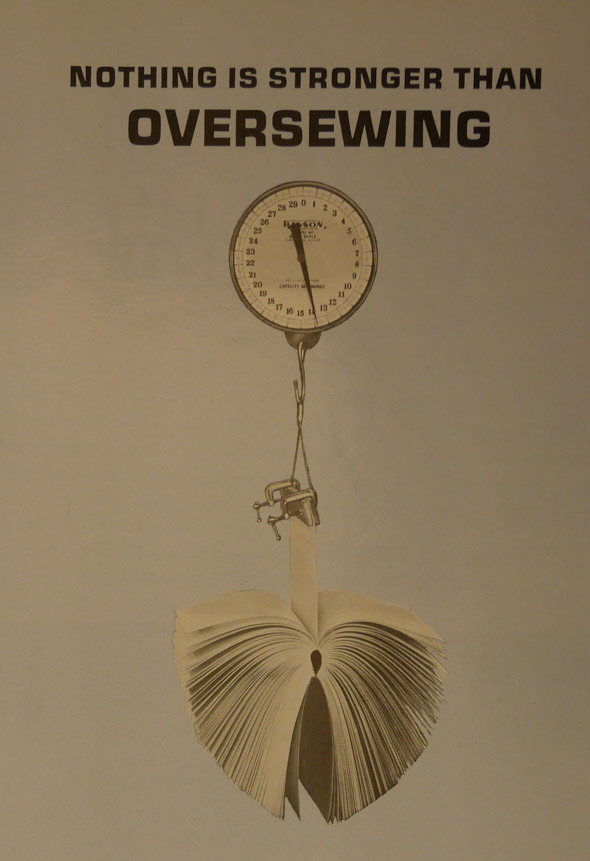
J. Howard Atkins, Tying the Future to a Thread. Medford, Mass: Oversewing Machine Co. of America, Inc., 1968. Front Cover. Middleton Z 269.5 .A8 1968. http://library.rit.edu/cary/
What appears to be a 1970’s post-apocalyptic novel concerning the dangers nuclear stockpiling is actually about a far more dangerous situation. OVERSEWING!
Could pass for an artist book installation. J. Howard Atkins, Tying the Future to a Thread. Medford, Mass: Oversewing Machine Co. of America, Inc., 1968. p. 18. Middleton Z 269.5 .A8 1968. http://library.rit.edu/cary/
My 2013 essay, “Beating, Rolling, and Pressing: The Compression of Book Signatures Before Sewing” in Suave Mechanicals, Vol. 1, ended with many questions concerning when bookbinders generally stopped using the rolling machine. Endings are much messier and imprecise than beginnings. We know that the rolling machine was introduced to the trade in 1827. But when did binders stop using it? Many tools and machines in bookbinding are used for centuries.
Rolling Machine from Joseph W. Zahnsdorf, The Art of Bookbinding, 6th ed., London: George Bell and Sons, 1903. (11) My Collection. Bonus question: what is missing in this illustration?
We know that the use of the rolling machine gradually declined at some point during the nineteenth century. Yet It is still referenced in several 20th century bookbinding manuals, including Zaehnsdorf’s 1903 edition of Bookbinding. Zaehnsdorfhad a deeply personal connection to the machine: his father’s right hand got trapped between the rollers, and even after many months in the hospital, he never regained complete use of it. It had an impact on him, so to speak.
A couple of weeks ago, while looking through the Richard M. Hoe and Company records, 1824-1953 (MS#0599) at Columbia University’s Rare Book and Manuscript Library, I read a fascinating typescript, written by Steven D. Tucker, who began working for Hoe in 1834 as an apprentice mechanic. It is filled with recollections of mechanical details of machines, the evolution of the factory, and the types of machines they were making.
In particular, he writes that in 1856, “There was also brought out (sic) a Book rolling or pressing machine, but few of these were ever built, bookbinders seeming to prefer the large embossing press for that purpose.” (43) To me at least, this seems a good indication of the transition time. Hoe thought the rolling press was still in demand, at least enough to warrant the development and manufacture of one, but he was slightly behind the curve, as many binders moved on to using an embossing press to compress signatures before sewing, ending the era of rolling and beginning the era of smashing.