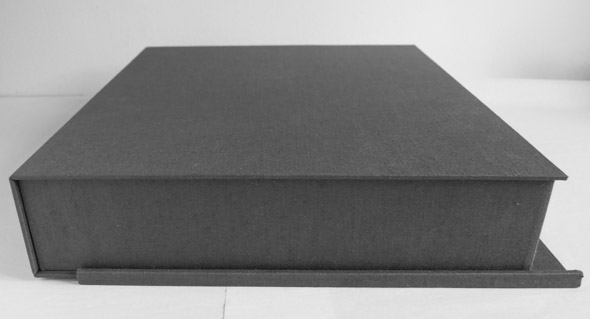
A drop-spine box for heavy and oversize books. The cut out areas on each side of the inner tray allow both hands to lift the book out.
For large, heavy books there are a couple of ways to beef up a regular drop-spine box.
Like most people, I usually make them with double walls.
I also make a modified inner tray, so that both hands can lift the book when removing it. The book this is for is around 19 x 15 inches, and quite heavy.
For even larger books, a lift off lid is a good idea, so the box doesn’t take up so much table space when open.
Since this book will be stored flat, on a metal shelf, and the client intends to read it once a week, there is a a slide off bottom piece to wear out. Even a durable cloth, like this canapetta, can wear quite quickly when slid on and off the shelf, there is an example here. It is adhered by friction, and when it wears through the client can mail it back for a new one, much cheaper than a new box.
The partially removed bottom piece. It slides off, but stays in place by hooking over the edge of the head and tail squares.
I’ve been following the career of Ben Elbel for a while. Originally his onion skin binding structure caught my eye. It has a cleverly elegant design, and is one of the few genuinely new binding structures I have seen in the past 25 years. I met him in Amsterdam earlier this summer, and he was kind enough to write up a review of my large Delrin folder in his current newsletter, which is well worth subscribing to.
Benjamin Elbel
Benjamin (French nationality, 1983) fell in love with bookbinding while studying art in Strasbourg, France. From the beginning his interest has been towards the experimental side of the craft; however, determined to learn the ‘proper’ ways he embarked on a journey that took him to Switzerland (Ascona- Centro del bel libro), Germany (Göttingen- die Buchmanufaktur) and England (London- Shepherds Bookbinders, Book Works). After these years of working in the trade he started his own bindery, Elbel Libro Bookbinding in Amsterdam providing bespoke bookbinding services. Ben is known for his research in bookbinding and over the years has developed a number of innovative book and album structures such as the onion skin binding, which he shares via workshops and printed tutorials.
THE DELRIN FOLDER by Benjamin Elbel
In May, Jeff Peachey gave a workshop in the Netherlands (the workshop was organised by Herre de Vries, Natasha Herman, Wytze Fopma and Restauratoren Nederland, and took place at bindery FopmaWier). Jeff is an American bookbinder, conservator and tool maker, whose work I have long admired so when I heard he was going to be around I jumped on the occasion to invite him to the bindery.
Jeff made me a gift: a special folder that he’d made, called the ‘Delrin’ folder.
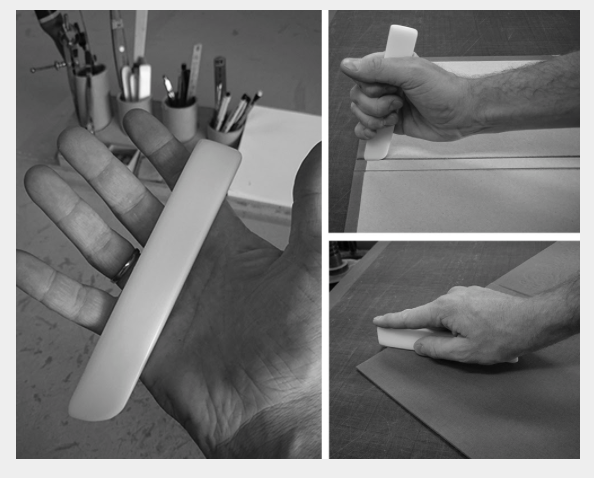
Delrin is a plastic with a very low coefficient of friction, similar to Teflon, which means that it doesn’t leave shiny marks on materials. However, unlike teflon, it is hard.
I wasn’t sure at first, thinking ‘what do I need a new folder for?’ Also, I was suspicious about the low friction qualities. Only after a while did I start trusting it and seeing its qualities:
1. The friction really is very similar to Teflon. I now use it without fear on virtually anything, except perhaps very rough and very dark papers.
2. Its big size is really comfortable for rubbing down. If held like on the picture above, one can really cover large areas very quickly and apply a lot of pressure with less effort than with a small tool.
3. The thin tip is brilliant for rubbing material in grooves without leaving shiny marks and again, the large size means it can be held like a knife and used with maximum pressure.
As one can see on the pictures I have already used it a lot but it shouldn’t be a problem to re-grind it to refine the tip. Thanks a lot, Jeff, for introducing this new tool!
Republished from Elbel Libro Bookbinding, Newsletter, Summer 2016. Sign up for it here.
Miniature books are like cheap crack for many bookbinders and collectors. Once you get a taste, you want more. Miniature books are usually defined as being less than three inches in every dimension, though some accept them up to four. For me, the ultimate miniature book — which is quite likely unattainable — would be one that not only looks like its big brother, but also replicates its function.
There are 14 book dealers who specialize in them, there is a tiny book show tour, they are often displayed together, and they are collected by many major institutions. There is a a Miniature Book Society. There are special tools and equipment scaled for miniature books. There are a number of workshops on how to make miniature books. Miniature books easily cross the line into toys or jewelry. They are fun and social, and addicts seem to find catharsis in hanging with their own, admitting their guilty pleasure.
Gargantuan books often stand alone. Most of us only make one. And swear not to do it again. If you make one, you are not only faced with the expense of materials, difficulty in finding equipment large enough to bind it, but then have to store and exhibit it somewhere. They are proud and boastful; I am the largest, the tallest, heaviest, etc… . Many rare book collections have one special display case for their Audubon, and keep it on more or less permanent exhibition. I’ve never heard of anyone who collects them, or a class devoted to making them.
There isn’t even a standard definition of what a size they should be. So I’ll propose a gargantuan book exceeds 33 inches in any dimension, just slightly larger than the longest side of normal handmade paper.
Many gargantuan books are made with non-traditional materials; some may not have pages, so it is not inappropiate to question if they should be considered books at all. They might be blooks or book shaped objects. Having a sequence of pages, or somehow referencing the idea of a sequence, is a critical difference in my opinion. Of course, it can be argue that any book contains the two basic seeds of a narrative, a before and an after. Eric Kwakkel considers a “real” big book one that is meant to be read, not created as a gimmick. Quality rarely enters the discourse: it’s all about quantity.
Wikipedia and the Guinness World Book of Records offer different accounts of what is the current largest book in the world is; significantly, both are religious texts. Symbolic monuments designed to impress us with their authority and power.
Below are a few gargantuan books I find noteable.
Appearing around 39:12, and again around 1:46:09 is a very well crafted book. It appears to be tooled in gold and blind, with deep type impressions and indentations around the bands on the (leather?) spine. Even the decorative paper sides realistically match the scale of the book. Sensitivity to the scale of details is where the wow factor comes in, both in mini and big books. Thanks to Tom Conroy for bringing this to my attention. The entire opera is spectacular, BTW.
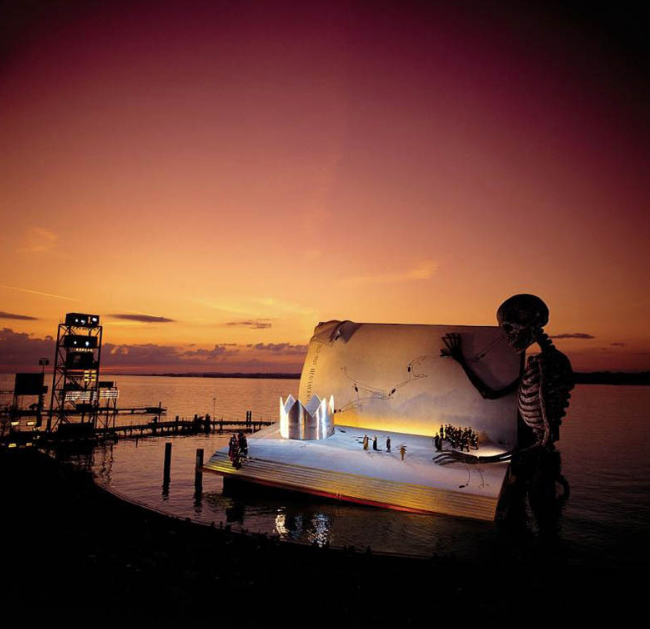
Exhibit two is the The Opera on the Lake of Bregenz. Yes, those are lilliputian actors standing on the open book. The 1999-2000 performance of Verdi’s Masked Ball had the entire stage made up of a book, held open by Death. Thanks to John Townsend for this reference.
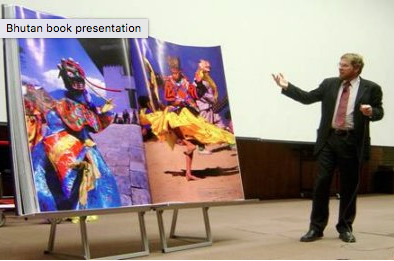
Slightly more prosaic is this edition titled Butan: A Visual Odyssey Across the Himalayan Kingdom, which weighs in at 133 lbs, and open is 7 feet by 5 feet. There are a few copies for sale on ABE books in the $300- $500 range, which must make it one of the cheapest books per square inch available. I imagine the materials alone would have cost more. There is a very nice write-up about it on the University of Washington’s Special Collections site.
The making of this book was well documented a few years ago. It took a crane to install it into the exhibition space. A heroic production.


 Peachey Conservation