

Book Conservation
CLOTH CASE BINDINGS: THEIR HISTORY AND REPAIR
October 24-28, 2016
Instructor: Jeff Peachey
Georgia Archives, Morrow, Georgia.
For almost 200 years, the cloth case binding has been the standard way publishers issue books. Throughout the nineteenth century, and even into the twentieth, it was often derided by bibliophiles as a temporary structure, not a ‘real’ book. However, it has proved to be a remarkably durable structure, now commonly used by conservators when rebinding books, by fine small press publications, and in library binding. Quite likely, there are more cloth cased books than any other rigid board book structure on earth.
This 5-day workshop will investigate the history of the cloth case binding, concentrating on the early years, 1825-1850. We will parse historic texts that describe this structure, while paying close attention to the introduction of four key pieces of machinery: the rolling press, the board shear, the guillotine, and the stamping press. Boards bindings will be considered as an industrial precursor to the cloth case, and we will make a structural model following a technical description from Cowie’s 1828 The Bookbinder’s Manual. By focusing on historic techniques, this workshop will also serve as introduction or refresher to the essential bookbinding hand-skills. Additionally, we will explore options for conserving and repairing cloth cased books by working on actual books provided by participants. Treatment options presented will include recasing, cloth rebacking, tissue repairs, hinge repairs, and boxing. Basic paper repairs, techniques of toning tissue and cloth, spine lining considerations, and the lifting of fragile material will be addressed. Discussions will include treatment decision making in relationship to specific institutional needs or the desires of private clients.
This workshop is open to all levels of experience: pre-program students, technicians, and mid-career conservators who desire a full time week at the bench. Ideally, a variety of participant experience levels will result in an invigorating exchange of information on binding techniques, institutional protocols, and treatment approaches. Students should bring 5-10 non-valuable cloth cased books that can be sacrificed or repaired, and basic bookbinding tools.
Students should submit a resume and a brief one paragraph application statement, reviewing their background in bookbinding, book conservation, or other crafts, and stating what they hope to learn.
Workshop Fee: $650 which includes materials.
Application deadline: July 15, 2016.
The application, or questions about the facilities/ housing options/ transportation (Morrow is close to Atlanta) should be sent to Kim Norman: Kim <dot> Norman <at> usg <dot> edu
Other questions about the class should be sent to me.
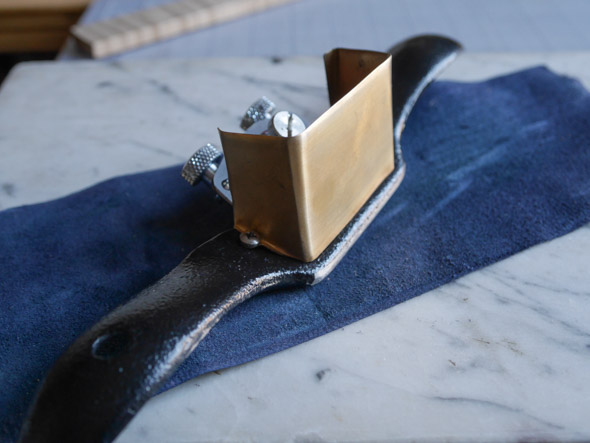
English trained bookbinders often use a modified spokeshave for long shallow bevels on the turn-ins, reducing the thickness in the spine area of a full leather binding, preparing a new piece of leather for rebacking, and for beveling binder’s board.
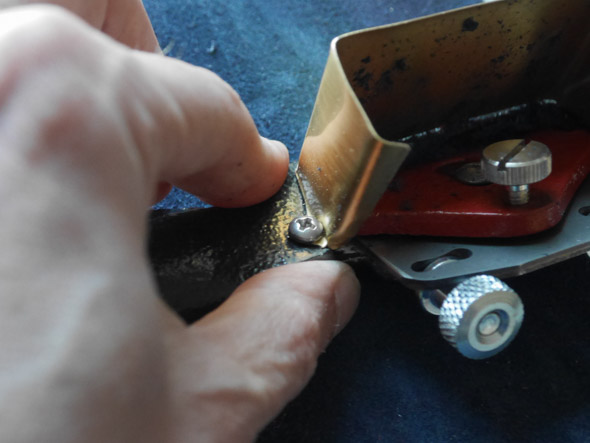
I’ve improved the modified Stanley 151 spokeshave that I make and sell by adding a shaving collector. I first saw this on a spokeshave James Brockman was using in 1990. I can’t quite explain why it has taken me so long to get around to making one for myself — I’ve been busy??? He kindly shared details of the design with me, and mentioned he first saw this while working at Roger Powell‘s shop in the late 1960’s or early 1970’s.
The shaving collector really speeds up work with the spokeshave, since you don’t have to stop and clean off stray shavings every couple of minutes, and they don’t get trapped under your leather, which can cause tearing or holes. Additionaly, it is easy to dump the full collector into the trash. More information about spokeshaves for leather.
Other modifications to the spokeshave include: reducing the effective cutting angle by grinding the base, truing the adjustment knobs, rounding and lessening the surface area of the sole, opening the mouth, flattening the blade bed by filing and filling with epoxy, flattening the blade cap, and replacing the thin chrome vanadium original blade with a Lee Valley PM-V11 one. This blade is reground to a lower angle, sharpened, and the corners slightly rounded to prevent ridges formed in the leather. All of these modifications make the spokeshave a much more precise instrument and reduce chatter
Even if you rough out the leather with Scharffix or Brockman leather paring machine, this spokeshave can quickly help reduce the ridges and unevenness the results from overlapping cuts and blade changes if you are working on large pieces. It is also essential for gradual bevels wider than the width of a double edge razor blade. And it is a lot of fun to use.
MODIFIED 151 SPOKESHAVE: $275.00 How to purchase

