Heat Treated Tonkin Hera

Tonkin

I’ve done some research and ramped up the quality of the bamboo I use to make hera.

First I have decided to use Tonkin, a super strong and resilient bamboo which is used by bamboo fly fishing rod makers. As evident in the image above, it has a preponderance of dark “power fibers”, which give it strength and a pleasing density.  Look at the end of a chopstick for comparison, which is generally pure white weak pith. There are over 1,000 species of bamboo.

I’ve also decided to heat treat the bamboo after initial shaping.  Dr. Wolfram Schott has a fantastic paper, Bamboo in the Laboratory, if you are interested in more details. His Bamboo under the Microscope is also highly recommended. Both breaking strength and modulus of elasticity increases according to his research and tradition in rod making. I’m not totally convinced it makes a difference for such small tools, but it certainly doesn’t seem to hurt. And the stove adds a comfortable warmth on these increasingly cold fall days!

Heat treated Tonkin Hera for sale, $25


New Hera

Feeding Fingers

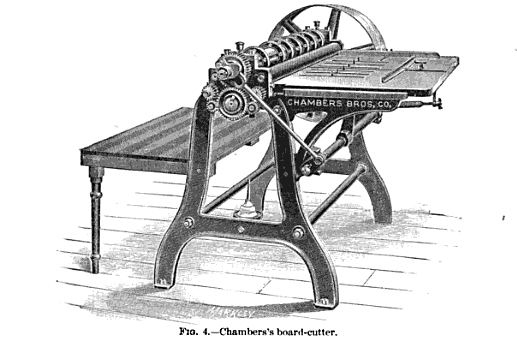
Appletons’ Modern Mechanism Supplement of 1895 contains an excellent bookbinding machinery section. The article mentions that machines haven’t changed significantly in the past decade, but performance and efficiency are improved. Chamber’s rotary board cutter is a particular beauty.  I find these hybrid cast iron and wood machines quite interesting since we usually think of machinery as consisting one of the other, not both. Note the automatic board advancement pins on the bed of the machine, which are called “feeding fingers”. OUCH!

An Easy Way to Improve an Olfa Knife

olfa

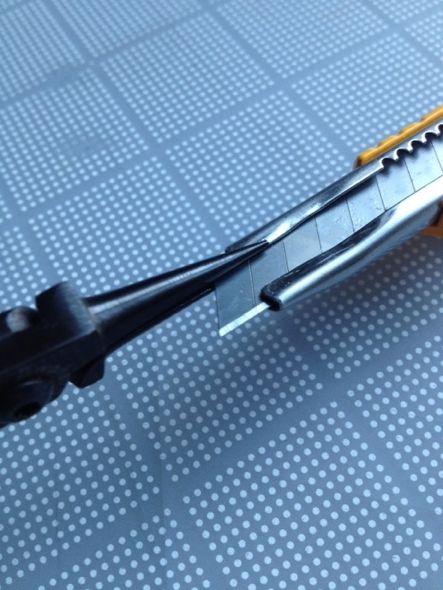
 Be sure to tighten the blade holder with the blade in place!

Almost every bookbinder I have met uses 9mm Olfa snap off knives. Simply by squeezing the blade holder a bit tighter with a needle nose pliers, the performance and feel of any Olfa  knife is greatly improved: it doesn’t wiggle around so much, it is easier to place more accurately, the knife feels more solid, there is no more annoying rattle, and the blade breaks off more consistently. Why didn’t I think of this 25 years ago?