Fish gelatin: Spreading the word about a book conservator’s new friend

Written by Ashleigh Ferguson Schieszer, Special Collections Conservator and Co-Lab Manager of the Preservation Lab of the University of Cincinnati. Reblogged with permission. Originally published 27 November 2023.

Last year around this time, the lab was fortunate to bring in book conservator and toolmaker, Jeff Peachey for a week-long intensive workshop to learn leather rebacking. While I always expect to walk away with new anticipated skills as advertised by the workshop, I’m ALSO always pleasantly surprised by the tangential tips and tricks shared along the way.  In the case of Peachey’s workshop, there were many!

One of my favorites was his use of a fish gelatin. While adhering spine linings to our text blocks, Peachey pulled out a small baggie of fish gelatin he brought with him to the workshop.  He poured the dry flaky powder into a small jar, added room temperature cold water, and mixed it until a liquid-y consistency.  He then added strained wheat starch paste to the gelatin and mixed with water until he was happy with the consistency.  He estimated it was a 40:60 ratio of gelatin to paste. 

Jeff Peachey taught a workshop at the Preservation Lab in Oct. 2022 where he first introduced us to a low-bloom fish gelatin for book conservation that didn’t require heat for use.

If you’ve ever used gelatin before, you might be wondering – how is it possible to mix the gelatin without heating?  That’s the beauty of this product – it has a high molecular weight with low bloom strength and is produced from cold water fish which gives it this ability.  It might not be the strongest of the films with a 0-bloom strength, but for a book conservator doing paper repairs that need to be reversible yet strong, this combo still had an amazing tack when dry!

Peachey explained he first heard about the gelatin on a lab tour at the Weissman Center. He recalled Alan Puglia might have been the one who originally investigated the adhesive for pigment consolidation of hundreds of manuscripts for a show. The mention of a high molecular weight Norland fish gelatin was shared during a talk given at the American Institute for Conservation’s 44th annual meeting.  The talk was titled, The Challenge of Scale: Treatment of 160 Illuminated Manuscripts for Exhibition,” by Debora D. Mayer and Alan Puglia.

Peachey also doesn’t take credit for mixing the gelatin with wheat starch paste. He notes that even in Dudin’s 18th century manual, it discusses the “union” of paste and glue in the last paragraph below.
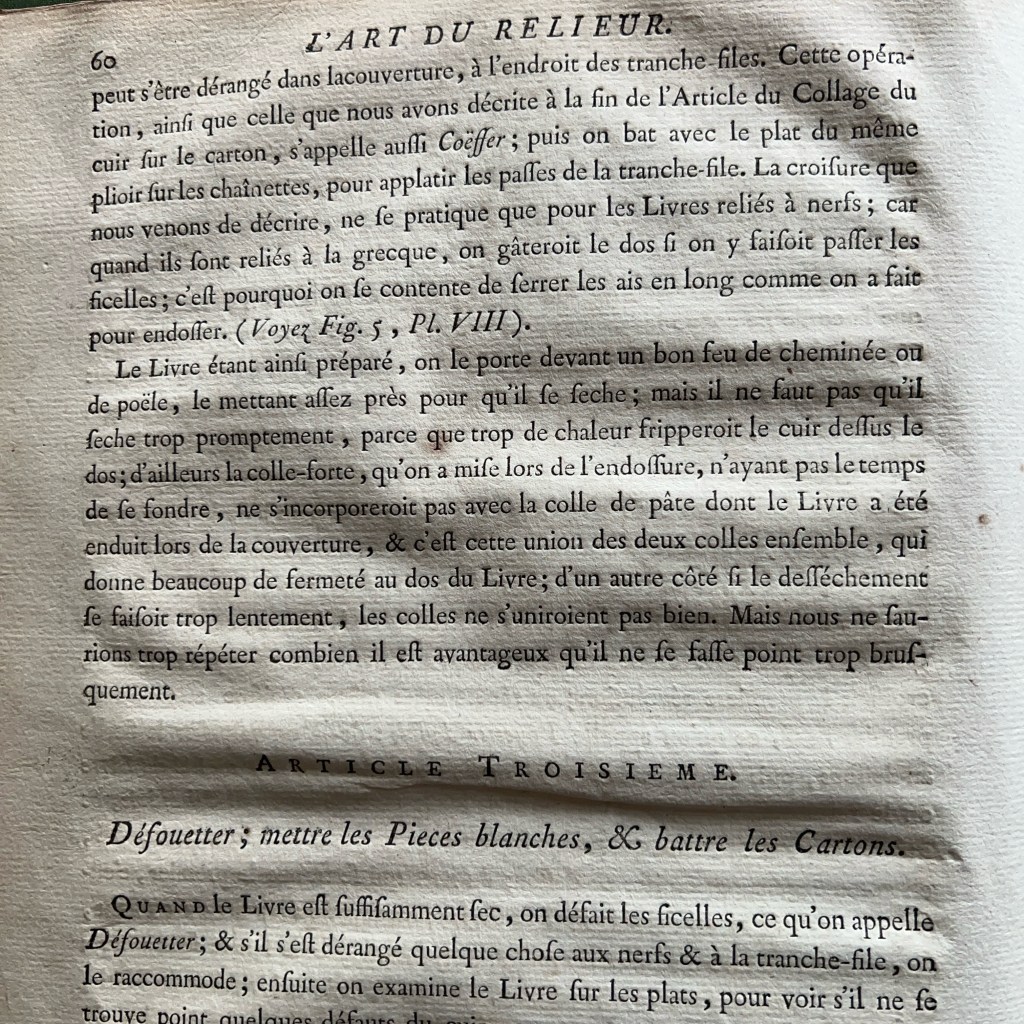
“It is the union of the two pastes [hide glue and flower paste] which gives a great deal of strength to the back” Dudin, 1772

By the end of the week-long workshop, I had fallen in love with the properties of how well it adhered.  By itself, the fish gelatin had a long working time and didn’t stick until it was nearly dry – but when mixed with wheat starch paste, it combined the best of both worlds.  There was both the initial tack from the paste and a strong adhesion from the gelatin after dry.  I wasted no time in ordering my own sample supply.

Over the past year, I’ve slowly incorporated the fish gelatin in treatments and testing more applications. 

Ashleigh Ferguson Schieszer uses the 40:60 mixture of fish gelatin and wheat starch paste to hinge encapsulations into an album, ensuring the heavy encapsulations with paper hinges stay adhered.

I first successfully used it to hinge-in heavy encapsulated sleeves into an album containing lung cross sections. After ultrasonically welding a paper hinge into an encapsulated sleeve, I applied the mix of wheat starch paste and fish gelatin to adhere the hinge to the scrapbook stubbing and had wonderful success.  I was able to adhere with confidence that the encapsulation would stay in place and was able to avoid disbinding and resewing.  At one point during treatment, I found I needed to reposition a hinge.  I am happy to report the mixture was as easily reversible as wheat starch paste alone!
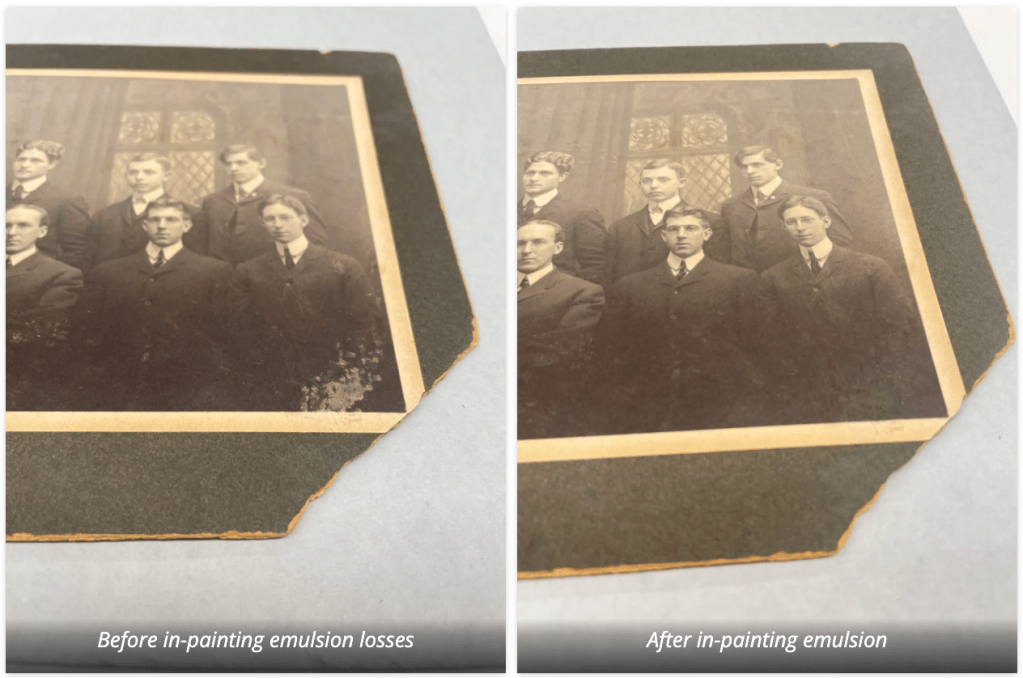
Most recently, I played around with using it for photographic emulsion consolidation. I used it first as a barrier layer before inpainting, and then to add sheen to in-painted photograph regions that were originally matte in comparison to the surrounding gelatin coating. It seemed extremely easy to apply and clean up was less messy than other photographic gelatins I’ve used in the past.  The sheen was just the right amount of gloss I needed without being overly shiny.  And, best of all, no heat required.
Examples of photographic condition issues where the fish gelatin was tested: flaking emulsion was consolidated and a barrier layer was applied before inpainting.

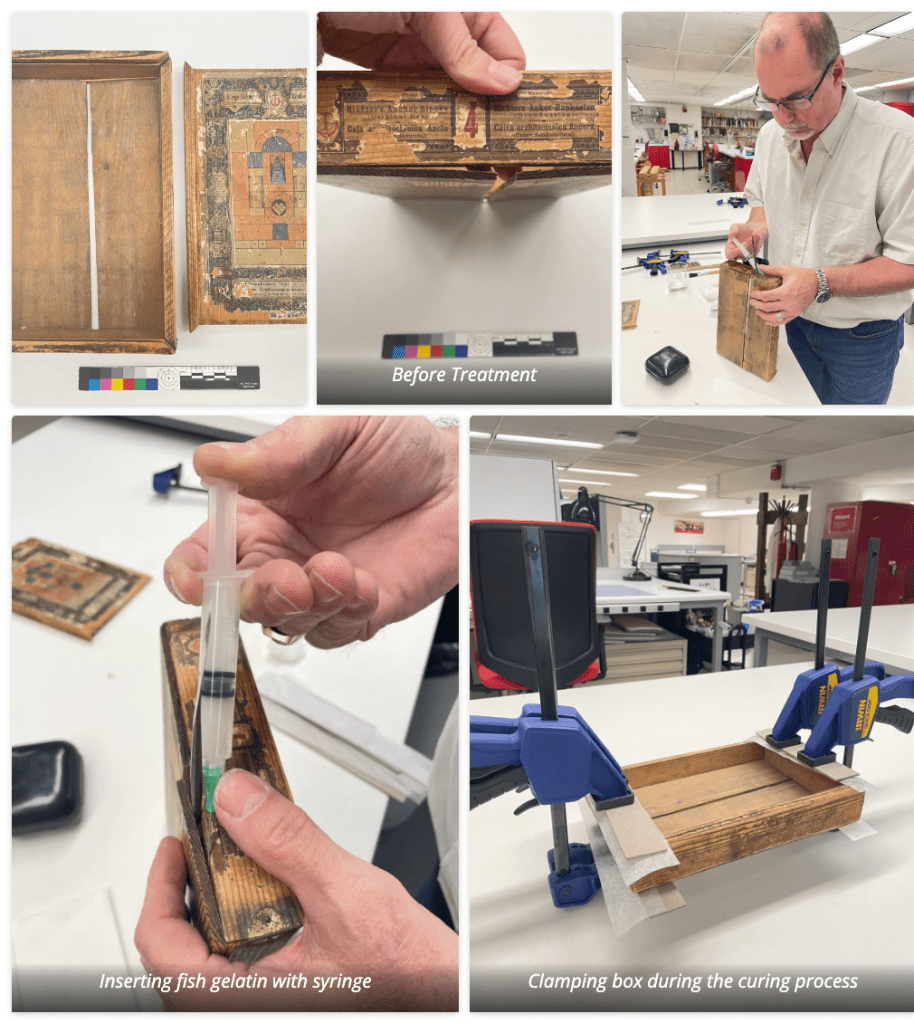
We’ve also used the gelatin to stabilize breaks in a wooden box originally used to house a Richter’s architecture game from the early 20th century. Jeff Peachey’ main use is to line spines. He’s found it not only has better adhesion than straight paste, but makes the spine feel slightly more solid and resistant to torsional forces

Applying fish gelatin to adhere spine linings

In the future, I imagine this gelatin would have excellent potential in media consolidation. In all these uses, I couldn’t be more thrilled to not have to pull out my baby bottle warmer to set a beaker of gelatin on.  As a result, there was no fuss in worrying about how long the gelatin was heated and if it was losing its properties due to heat!

Example of using a baby bottle or coffee warmer to re-heat pre-made gelatin during typical use

In terms of shelf life, the dried granules can be kept indefinitely like unmixed wheat starch paste.  Once mixed, Jeff suggests that he’s found the adhesive properties hold up for about a week in the fridge; however, it does begin to smell fishy after just a day. So unlike wheat starch paste, if you’re adverse to the fishy odor, you’ll only want to make up as much as you’re planning to use for one day. 

Interested in getting your hands on some?

I found the product used at Weisman is no longer supplied by Norland, but I was able to track down what appears to be the same product through AJINOMOTO NORTH AMERICA, INC.  If you’re interested in trying it, message Henry Havey, the Business Development Manager of Collagen & Gelatin at haveyh@ajiusa.com to request a sample of High Molecular Weight (HMW) dried fish gelatin. 

They provided me with a 500- gram sample at no cost and confirmed it was a Type A fish gelatin with a zero bloom strength. Henry Harvey can also provide a pricing quote should you be interested in ordering a full supply which comes in 25 kg packs. They also provided the following product data info sheets.

Fish gelatin sample acquired by the lab in a 500 gram sample bag

While I still covet my isinglass cast films I created from boiling dried fish bladders, as well as our mammalian photographic grade type B gelatin, this HMW fish gelatin is a welcome addition I’ve added to my tool kit.

Ashleigh Ferguson Schieszer [CHPL[] – Special Collections Conservator, Co-Lab Manager

Bibliography

Dudin, M. The Art of the Bookbinder and Gilder. Trans. by Richard Macintyre Atkinson. Leeds: The Elmete Press, 1977, p. 51. (Originally 1772)

Nanke C. Schellmann, Animal glues: a review of their key properties relevant to conservation, Reviews in Conservation, No. 8, 2007, pages 55-66

Foskett; An investigation into the properties of isinglass, SSCR Journal ; The Quarterly News Magazine of the Scottish Society for Conservation and Restoration, Volume 5, Issue 4, November 1994, pages 11-14

World Sturgeon Conservation Society, A Quick Look at an Ancient Fish, 4th International symposium on sturgeon, Oshkosh, Wisconsin, July 8-13, 2001 https://www.wscs.info/publications/proceedings-of-the-4th-international-symposium-on-sturgeons-iss4/

Soppa, Karolina; Zumbuhl, Stefan; and Hugli, Tamara,  Mammalian and Fish Gelatines at Fluctuating Relative Humidity, AIC 51st Annual Meeting, 2023
A Painting of Eighteenth Century French Trade Bindings and Paper Wrappers

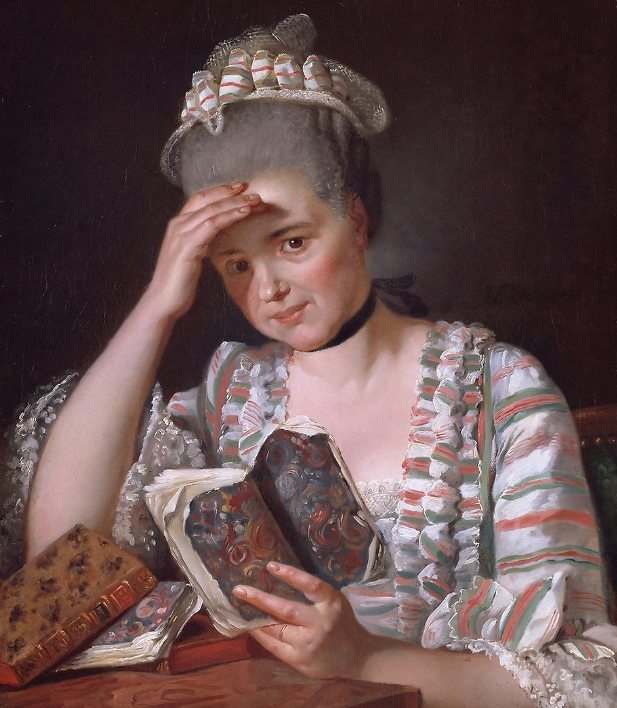
Bookbinder Colin Urbina recently posted a number of great images of books in art he noticed at the Art Institute of Chicago on his low_mountain instagram feed. In particular, the painting of Madame Francois Buron by Jean Louis-David caught my eye. It may give us some insight into how books were used in the eighteenth century, though there is always the possibility the books depicted were props.

Jean Louis-David, Madame François Buron, 1769. The Art Institute of Chicago.

If this is an actual depiction of reading, it adds to the mountain of evidence that full leather trade bindings and “temporary” marbled paper wrapper bindings were consumed simultaneously. This type of pictorial evidence, along with the evidence from bindings that book historians such as David Pearson have gathered, and the usual working method of bookbinders, are all closing the coffin lid on the longstanding idea that paper bindings were intended to be rebound into a proper leather binding before use. The wear on the paper bindings —deftly painted with a white line along the top edge of the book Mme. Buron is reading — suggests these books may have been read before. 

But it is a little strange to have four books so close at hand, since she doesn’t appear to be a scholar, and three of the books aren’t open to specific pages: evidence of cross-referencing. It could simply be her reading desk, though.

If the books are intended to be props, what can they tell us about the sitter, and how do they relate to the painting? Why has she interrupted her reading to look at us? And what could  she be reading?  Louis-David’s painting technique evokes the solidity of the leather bound books in contrast with the loose airiness of paper ones. The way the paper book is cradled in her hand is incredibly realistic. The brush work on the splayed page edges blend with the her blouse, and the triangular composition is anchored by the books. The books are a key aspect of the composition.

The details of the bindings are rendered exquisitely. The cat’s paw decoration on the full leather trade binding is instantly recognizable. The red over black title labels, full guilt spine, and single blind line on the boards is historically accurate. The paper bindings are covered in a common, or french snail marbled pattern. The pattern is rendered loosely, almost abstractly, in some areas. Or could it depict a spoiled sheet, not good enough for endsheets or other purposes?

Jean Louis-David, Madame François Buron, 1769. Detail. The Art Institute of Chicago.

The book she is holding, with its thick flatish spine apparent at the head, appears to have multiple signatures. Intriguingly, the paper covered book lying flat appears to be a single signature, which would be very unlikely for a letterpress book; could it be a blank book, notebook, or journal? Is it possible she is reading something private, like a diary?

She is shielding her eyes from the light source (truth?), but at the same time the page she is reading is in the shadows. She looks out at us with a concern, and possibly a bit of weary annoyance. The Hasty Book List also noticed she seems a little caught off guard or shy. A full size image is here.

Upcoming Workshop: 18th Century French Binding at The Georgia Archives, November 6-10, 2017

Eighteenth century French binding models made in Historic Book Structures for Conservators 2017 workshop.


Late 18th Century French Binding Structure
Date: November 6-10, 2017
Location: The Georgia Archives in Morrow, Georgia

This workshop will focus on reconstructing a typical 18th century full leather French binding by comparing and contrasting three 18th century technical descriptions, examining extant bindings and using historic tools.

In some respects, this structure is the end of 1,200 years of utilitarian leather binding; fifty years later, the cloth case becomes the dominant inexpensive rigid board structure. The making of the book is very organic and does not rely on numeric measuring. This class is a hands-on explication of historic written texts. We will try to understand how and why these books were made the way they were made — then model as many aspects as possible — all the while acknowledging our inaccuracies and incomplete understanding.

Techniques to be learned:
-Using a beating hammer to beat the textblock before sewing
-Sewing on thin raised single cords
-Lacing in slips into handmade pasteboards in a typical three hole pattern
-Beating the boards
-Trimming all three edges with a plough in-boards while using trindles for the foreedge
-Coloring the edges with vermillion
-Applying vellum transverse spine liners
-Sewing endbands on rolled paper cores
-Paring and covering in full calfskin
-Marbling, pastewashing, and burnishing the leather
-Applying simple blind tooled decoration

Reproductions of 18th century French tools, constructed from plates in Diderot’s Encylopedie (1751-1780) will be available for use. Participants will learn to use and maintain a plough and investigate the problems in translating written descriptions of bookbinding into the construction of a model. Extensive notations (in English) on Gauffecourt’s Traite de la Relieure des Livres (1763) and Dudin’s L’Art du Relieur-doreur de Livres (1772) will be provided.

Basic bookbinding skills are a prerequisite, but this class can serve as an introduction to leather paring. Discussions will include treatment decision making for this particular structure in relation to institutions and private clients. This class is open to all levels of experience: pre-program students, technicians, and mid-career conservators who desire a full week at the bench. Ideally, a variety of participant experience levels will result in an invigorating exchange of information on binding techniques, institutional protocols, and treatment approaches. Students should bring basic bookbinding tools.

A review of this workshop from 2016 by Constant Lem, Book Conservator at the National Library of the Netherlands: <https://jeffpeachey.com/2017/02/07/review-of-18th-century-french-bookbinding-workshop/&gt;

To apply, applicants must submit a resume and brief, one-paragraph statement of intent. Prospective students should outline educational hopes for this class, and review their background in book conservation, bookbinding, or other crafts.

Fee: $700 and a $100 materials fee

Application deadline: September 15, 2017

Send applications to: Kim Norman:  Kim <dot> Norman <at> usg <dot> edu
Include any questions about the facilities, hotels, or transportation (Morrow is close to Atlanta). For questions about the class: Jeff Peachey: jeffrey <dot> peachey <at> gmail <dot> com