
From: The Bookbinder, London, Raithby, Lawerence & Co., 1889.

Book Conservation
From: The Bookbinder, London, Raithby, Lawerence & Co., 1889.
There are many techniques to make thin strips of tissue, useful for paper repairs between lines of text or even between letters on a page. One relatively easy method I’ve been using involves modifying a standard ‘2a’ jewelers tweezers. I find Dumont, Swiss made, to be of superior quality. It is a fairly easy way to get long, parallel strips, or intricately curved parallel strips.
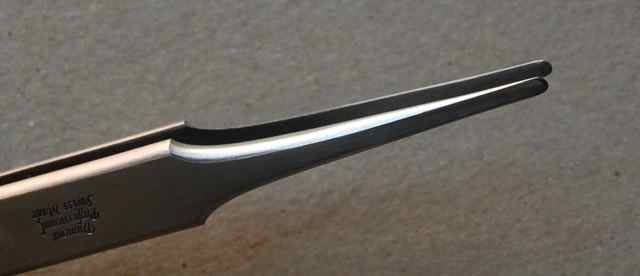
The tips are reshaped, either by filing or abrasives, made round, thinner and can be sharpened. A sharper tip will cut through more fibers, with less of a feathered edge. A more rounded tip will create a larger feathered edge. Tweezers are made from unhardened steel, so they are easy to reshape. The number of fibers cut through can also be controlled by the amount of pressure when scoring, and by the hardness of the material that the tissue is scored on.
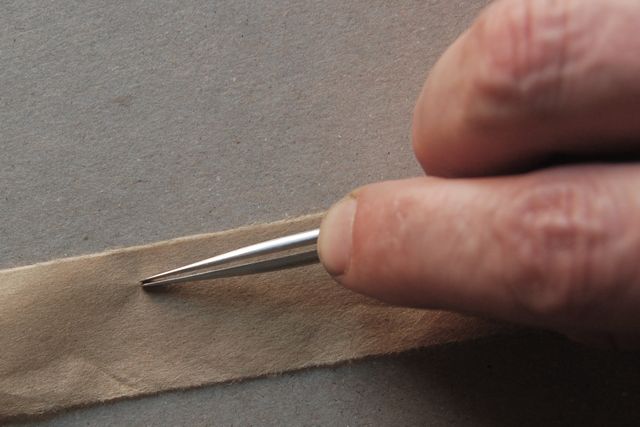
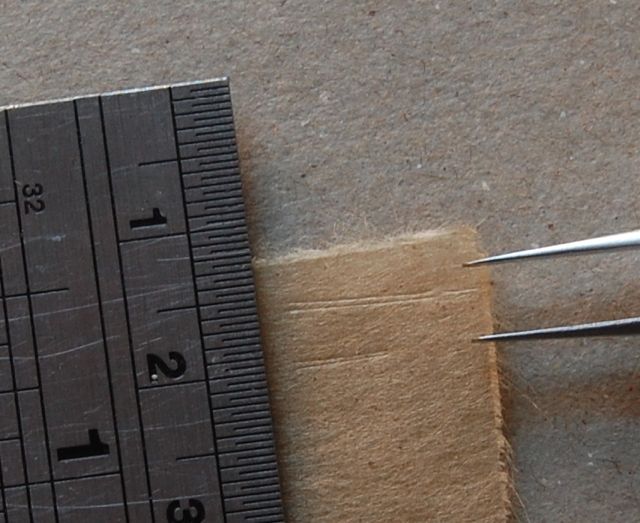
The width of the lines scored can be easily adjusted by using holding your index finger in between the blades. Someday I will thread a screw through one of the blade arms, to allow an even more precise adjustment. But even as it is, it is possible to score strips as thin as .5 mm, and scoring both sides of the repair halves the amount of time spent scoring.

Just an old brush, which looks pretty similar to the string bound paste brushes that bookbinders and conservators use. How many of us would even give it a second thought– passing over it at a flea market, or when cleaning out our own stash toss it? But this brush can be located and dated to the Mason House, Guilford, Virginia from about 1730. And according to Gaynor and Hagedorn, it is the only known surviving pre-1800 American brush.
This book contains a great defense of the value of tools, how they help us understand human culture, and the importance of preserving their original condition. And it contains lots of beautifully photographed tool porn.
___________________
Gaynor, James M. And Nancy L Hagedorn. Tools: Working Wood in Eighteenth-Century America. Colonial Williamsburg, Williamsburg, Virginia, 1993. p. 111.
 Peachey Conservation