
Tom Conroy speculated in an informative comment on my post about millboard shears, that the basic principals underlying the board shear may have originated from playing card shears of the 1760’s. I thank him for bringing this to my attention, and I’ve commented on some of his points, and added some visuals for clarity. The images below are from ARTFL, an on-line project that reproduces the first printing of the Paris edition of Diderot’s Encyclopedie, a wonderful resource with over 21 million words and 2,569 plates — over 75,000 objects identified. Incroyable!
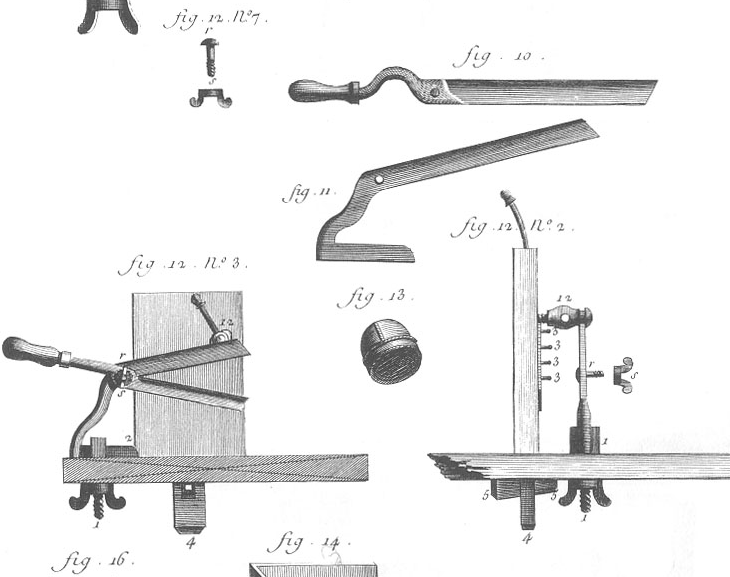
Fig. A. Detail of two types of playing card shears, from Diderot’s Cartier (Plate III)
Pictured above are the playing card shears as depicted in Diderot’s cartier. I’m puzzled by the top piece (rod? screw?) in Fig. 12, No. 2, the text mentions it forms a blade stop– to keep the upper blade rigid, and move it in and out? It almost appears this same piece is stuck into part 12, in Fig. 12, No. 3? The pins (number ‘3’) are identified in the text to guide the card, in order to keep it from bending to achieve accurate alignment? The wing nut under the shear could be loosened to move the shear, or wedge under the board, to alter the width of the cut, which presumably would not be done very often, if the playing cards were a standard size. It is an appealing idea that playing card makers adapted a guillotine type cutter from the type more suited for aristocratic neck trimming; alas, no evidence supports this. Supposedly, in 1789, French physician J. I. Guillotin thought a blade falling more compassionate than the traditional use of an axe, and created the guillotine. The guillotine paper cutter seems to be a mid 19th century, English invention, however this is another topic which needs more investigation.

Fig. B. Detail of Diderot’s Cartier (Plate I) Carton shears in action.
The shears themselves look like large gardening loppers, and must have been capable of cutting through playing cards, which at this time were made from four layers of paste-board: a double layer of brown paper in the middle (to prevent show through of the printing) sandwiched between playing-card paper and pot paper on the outside. It is hard to imagine they could cut through a thicker material like the boards binders used, however.
French bookbinders at this time would have used a thicker pasteboard which would be cut to the desired size with a large pointe. A little later, English binders would have used a millboard shears to rough out board to size. Afterwards, the boards were trimmed more precisely with a plough. The board shear combined both of these functions in one machine– cutting down large sheets of thick board with precision, which was perfect for later, out-of-boards binding styles.
In Salamon’s Dictionary of leather-working tools, there is an illustration of what is labeled a “bench knife (Card shears)” (p. 9) Regretably, the source of and date of this illustration is not recorded, but it seems to date between the French card cutter and the early board shears. The upper blade is curved, and it has a class two lever, an integral handle, a 12-25 inch blade and this one clamps onto holes in a bench. Salamon mentions some of them have their own base– an early version of what we now call a paper cutter. Many of us have fond memories of these green, gridded, dangerous machines from grade school art projects.

Fig. C. ‘Card Shears’ image, reproduced in Salaman’s Dictionary of Leather-Working Tools. Early 19th Century?
If playing card shears served as a precursor to board shears, the question might be how and when did playing card shears evolve from a class one lever to a class two lever occur? One tiny clue might be the handle of some of the early shears — they often look small and stuck on, as it they are an afterthought. It also looks like the length might be adjustable, yet any advantage in leverage would seem to be negated by the additional deflection of the thin supporting arm. Of course, there are other important, as yet untraced defining characteristics of board shear: its curved upper blade, fairly obtuse cutting angle, the lower blade mounted flush to the table, a bottom gauge fixed at 90 degrees, and the foot clamp.

Fig. D. From Knight’s A Day at the Bookbinders, 1842. ( p. 341) Later used in Dodd’s Days at the Factories (1843), and Walker’s The Art of Book-Binding (1850).

 Peachey Conservation

