Jig For Planing Thin Wood Boards

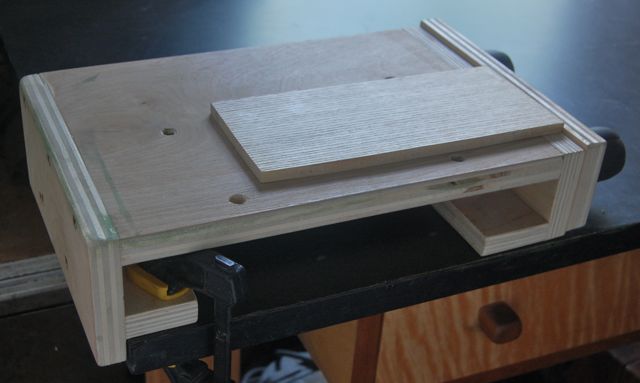
A couple of years ago, I devised a simple jig to make planing of thin wood boards easier.  I noticed Christopher Martyn, who writes the blog Finely Strung, and is a stringed instrument maker in Winchester, United Kingdom, came up of a surprisingly similar jig. We exchanged some information on the topic and he posted an image his jig and mine, although his is quite fancy compared to my pedestrian design!

Recently, I needed to plane some larger boards, so recently improved my design quite a bit.  This jig is also useful for book conservation labs who don’t have a dedicated woodworking bench, since it can clamp, with a standard “Quick-Grip” or  C-Clamp onto an existing bench while protecting your benchtop.  This one is about 12 x 9″, although it could be made to any size.  The adjustable, and replaceable, stop is held on with a 1/4 x 20 x 2″ carriage bolt, and tightened with soft grip knobs so that no tools are necessary to adjust it.  I find if convenient to rout a slot so that it can be raised up and planed flat if it gets damaged in use.  This one was made of birch faced plywood, and held together with drywall screws driven deep under the surface of the wood.  The height is 3 layers of 3/4″ plywood to allow for a variety of clamping options.  It can also function as a bench hook and can be used with tapered pieces of wood. It seems to grip the wood being planed better by not applying any finish to it.  I’m not left handed, but the light was better for the photo in this position.
The Use of Parchment to Reinforce Split Wooden Bookboards

I was quite pleased to receive the new Journal of the Institute of Conservation, Vol. 33, No. 1, 2010, since Alexis Hagadorn and I have an article included in it titled “The use of parchment to reinforce split wooden bookboards, with preliminary observations into the effects of RH cycling on these repairs”

Here is the abstract:

Split wooden boards are a common problem in early book bindings, and treatment can be complicated by the need to disturb original components as little as possible. A technique used to reinforce or rejoin fully or partially split wooden boards using parchment has been evaluated. A reinforcing parchment strip has sometimes been employed to treat cracks in wooden musical instruments and examples of reinforcing strip repairs to wooden bookboards have also been observed. The books considered in this article presented an opportunity to use this technique and make observations about its merits. With favourable results but some questions, the authors undertook a systematic study of this method, considering and comparing several options for re-joining split wooden boards. Samples of some common repair techniques were made and subjected to relative humidity cycling to compare how each method might withstand extreme RH fluctuations at a constant temperature. The response of reinforcing strip repairs to RH changes showed a negative impact on join adhesion within the sample group, which may indicate that modifications are necessary to improve this technique. When re-examined after three years, the treated boards were intact and stable.”

It took over four years from the start of the project until the revised manuscript was accepted for publication, but it is gratifying to see the results of our research, and images of a couple of my treatments in a peer reviewed journal.  Unfortunately, the journal is not available online yet, although I have heard it is in the works.  And if you are not a member of ICON, this single issue costs, gulp, $228.oo!


Sharpening on a Book on Sharpening

Most bookbindings function as protection for the text contained within.  This, however, is a bookbinding that also functions as a strop. I rebound Ron Hock’s The Perfect Edge: The Ultimate Guide to Sharpening for Woodworkers in reverse calf in order to make it work as a not-so-fine binding/ strop.  This book is one of the best on sharpening, containing an excellent overall assortment of information.  It is loaded with practical advice, overviews of the various sharpening systems and informative photos.  I recommend it as a textbook to accompany the sharpening workshops I teach.

Anyway, this was the first time I constructed a reverse calf binding– the paring took a bit more time since most of the strength of the leather (hair side) was cut away, and the caps were a bit tricky to form. The book was sewn on 5 quarter inch linen tapes, the edges decorated with Golden Fluid Acrylics chromium oxide green mixed with airbrush medium and Staedtler Karat water-soluble  pencils, and the endbands simply sewn in purple silk over a cord core.  The front cover was coated with a .5 micron chromium oxide honing compound, for preliminary stropping, the back left bare for a final polish.  It will be interesting to see how it looks in a couple of months when the metal particles start to build up.