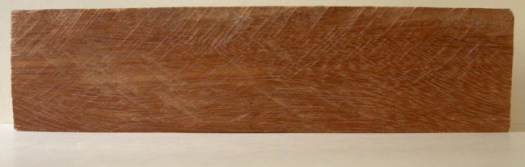
Dipteryx Panamensis

pipteryx-panamsis


A friend of mine gave me this piece of Dipteryx panamensis.  It is an incredibly dense wood– it measures 29 x 7 x 4 cm and weighs 881 grams. (11.25 x 2.75 x 1.5 inches, 1lb, 15 oz.), and can have a specific gravity up to 1.09.  I will most likely never get another example of this wood, I think it is now banned for export.

I considered making tool handles or something else out of this, then realized there was nothing I could do to improve– it is perfect the way it is.  Any shaping or transformation would only diminish it.

18th c. French Bookbinding With Jeff Peachey

(Please welcome guest blogger Liz Dube, Conservator for the University of Notre Dame Libraries.  She kindly agreed to write up some impressions from the workshop and share some images.  Jeff)

I ventured to New York City in April to take part in a rare and enlightening reenactment of 18th c. French bookbinding. During this four-day workshop organized by the New York Chapter of the Guild of Book Workers, our group of about a dozen bookbinders tucked ourselves away in the Conservation Lab of the New York Academy of Medicine and under the direction of Jeff Peachey, determined to bind books in the style of 18th c. France. 

The effort was informed by two contemporaneous bookbinding manuals: Traite de la Relieure des Livres (1762/63) by Jean-Vincent Capronnier Gauffecort and L’art du Relieur de Livres (1772) by Rene Martin Dudin. Jeff provided the group with packets that included organized copies of the manuals, along with some of his own notes. Samples of period bindings were inspected and discussed

artifacts
FIGURE ONE.  Examining the 18th c. artifacts

and Jeff characterized the bookbinding industry of the time. We learned that in 1776, 75% of the bookbinders in Paris were located on just one block within the University community. Bookbinders and printers at that time were associated with guilds that regulated the trade, so they were no doubt a tight-knit and highly regulated community. Jeff underscored that this pre-industrial era period was the end of the hand-bound book era, and how fortunate we are to have two manuals documenting how the work was performed in France at this time.

The manuals had to be taken in context, however. Dudin’s book was not written for contemporary or would-be bookbinders but rather for the book-buying public, to educate readers on the details of a properly bound book so they could avoid being cheated by an unscrupulous bookbinder. That said, Dudin’s wasn’t just a casual survey of “what to look for” in a bound book. Jeff notes in our course packet that Dudin devotes “12 (!) pages and 7 plates” to folding, and that, even if Dudin exaggerated, the extent of paper beating that occurred in this period appears to have been, according to current bookbinding sensibilities, rather extreme: 

“…judging from these descriptions…they were beating these books a lot; beating the sheets before folding, pressing after folding, beating after pressing, and pressing a second time … The boards are beaten before they are attached, and after covering. And as a final step, before returning the book to its owner, Dudin has us beat the four inside corners!” 

With this in mind, we folded the paper into sections and wielded hammers, proceeding to pound paper and raise such a racket that other workers in the serene house of research were drawn follow the noise to find its source, and to inquire whether we had any aspirin. We beat until we were sore and could no longer pick up a hammer.

beating


FIGURE TWO:  Beating.

more beaters


FIGURE THREE: More Beating.

 Alas, in the end, we concluded that our best efforts still would not have satisfied Dudin! 

But we were there to make books, not to pulverize paper, so we had to move on. Lovely 18th c. marbled paper made by Iris Nevins was employed for the endsheets. Kerfs were sawn into the spine and our textblocks were sewn on cords.

sewing

FIGURE FOUR:  Sewing on cords. 

Various sewing frames and a variety of sewing keys were experimented with, including Jeff’s small/collapsible travel sewing frame. While not mentioned in Dudin or Gauffecort, some even went for the ultimate simplicity of using nails as sewing keys, as documented in several later bookbinding manuals.

nail


FIGURE FIVE: Nail as a sewing key.

Pretty neat trick, that! Once the books were sewn, the cord laces were frayed and pasted, and the boards were prepared (again with the beating!) and laced on. Textblocks and board edges were then ploughed in-boards, using a prototype Peachey custom travel-sized plough.

ploughing

FIGURE SIX:  Jeff working up a sweat speed-ploughing.

Our super smooth textblock edges were then colored (red, of course), paneling (aka, adhering paper or parchment transverse spine linings) was performed, and endbands were sewn on.

enbanding

FIGURE SEVEN:  Sewing endbands

The time had finally arrived for covering our books. Vegetable-tanned calf skin prepared by Richard E. Meyer & Sons was on hand for the task. But first, we were treated to a mini Peachey workshop on knives, spokeshaves, and knife honing, the completion of which found my knife was sharper than it’s ever been! For resharpening a knife, Jeff recommends pressure sensitive adhesive backed 3M microfinishing film mounted on a very smooth surface such as glass or marble, or—even better—strips of aluminum, the surface which was first hand lapped smooth. Jeff’s set was super light and travel friendly and worked really well—just add water and hone.

honing

FIGURE EIGHT:  Knife honing station, complete with bacon band-aids

To maintain his sharp edges, Jeff uses a strop made of horsebutt laminated to calf skin, both flesh side out.  The first stroping is on the horsebutt, which contains a .5 micron green honing compound, followed by a final polish on the naked calf skin. Jeff then demoed paring and covering-in (particularly impressing the group with his trick of paring all four edges of the leather in one swoop of the knife).

covering

FIGURE NINE: Jeff demonstrating leather covering

We then followed suit and tied up our books to dry a bit. They were then finished off with speckling (we passed on the traditional chemicals, instead opting for Golden Fluid Acrylics) followed by a couple of blind lines on the boards and spine. At the end of the four-day session, our group was very satisfied with the results of our labor! Thanks Jeff!

(Thanks back at you, Liz!)

There is another review of this workshop by Brenna Campbell on the NY Chapter of the Guild of Bookworkers website.

Board Slotting as a Structure for Artist’s Books

Although board slotting was originally developed as a strong, minimally invasive method of conserving books, I’ve wanted to try it on an artist’s book for a while.  Slotting seemed a great way to firmly attach wooden or alternative material without visually interfering with cover.  Accra Shepp created this artist book titled “Atlas”, in an edition of 12.  It was a perfect candidate for board slotting- the boards were an oversize (18 x 12″) medium density fiberboard, covered with a gorgeous burl veneer that deserved to be unobscured by covering material or interior linings.

A number of the NYC bookarts community worked on this project– Paul Wong, of Dieu Donne  Papermill, made the paper, Edward Fausty printed the collotypes, Earl Kallemeyn printed the polymer plates,  Dikko Faust of Purgatory Pie Press printed the metal type and letterpress and even the leaves came from the NY Botanical Garden.

shepp1


There were some technical challenges- the entire book weighed 5.25 lbs, there were many fragile plants imbedded in the paper and the book included a final signature made up of a single folio!   In keeping with the overall meaning of the book, the artist wanted a simple, unobtrusive, elegant method of binding this book that used natural materials. We decided slotting was the best method of accomplishing this goal, in conjunction with a non-adhesive modified longstich spine.  In keeping with the natural and open nature of this text, I slotted completely through the ends of the board, hoping it to become a decorative element reflecting its visual honesty.

 The binding had to be very flexible, with lots of throw-up and minimal page drape to keep the tissue paper collage elements and actual plant materials from unduly flexing. The spine is a Japanese linen bookcloth that was laminated with PVA to a piece of Strathmore 400.   This not only stiffened the cloth, helping to control the opening and lessen the text block from torsion, but it prevented the sewing holes from opening up excessively and the interior white lining visually lessened the impact of the slight gaps between the signatures.  It was sewn longstich with Best Blake 18/6 unbleached linen thread. The  relatively loose twist in the thread allowed it to be flattened and firmly consolidated in the spine folds, adding a pleasant feeling solidity to this non-adhesive structure.  There were only 5 signatures, and numerous collage elements, so the extra swell helped to keep the boards relatively parallel.  The technical information on how a board slotting machine was modified to accommodate these oversize boards is at the board slotting blog.

It might be possible to devise some kind of endband for this structure, somehow incorporating the slot at the end of the boards, and I’m interested in trying it with alternative materials, such as plexy or metal.  Even the hinge in the slot could be made non-adhesive with some type of treenail, pegging or sewn attachment.  

This structure seems useful when a flat opening, cost effective, non-adhesive, unobtrusive binding style is desired.  I could imagine it being useful on a variety of artist books. To my knowledge, this is the first time board slotting has been used in making a new artist’s book.  


shepp2