
Yours truly is teaching Week 3, Aug. 10-14.
Flights are fairly reasonable right now....
Hope to see you there!

MONTEFIASCONE PROJECT
SUMMER 2009

Montefiascone is a small medieval walled city about 100 k (80 miles)
north of Rome, on Lake Bolsena. Since 1988 conservators and others
interested in books and their history have come together to work, to
learn and to enjoy this special place. The summer 2009 programme is as
follows:

Week 1:  July 27th-31st
Re-creating the medieval Palette
Through illustrated lectures, participants will examine the story of
colour in medieval times. The class will address the history, geography,
chemistry and iconographic importance, and the actual techniques of
colour manufacture, with special reference to manuscript painting. Using
original recipes, participants will make and paint out the colours. No
previous experience is necessary.
Course tutor: Cheryl Porter

Week 2: August 3rd-7th
Multi-quire, wooden boarded codex from Egypt
The multi-quire, wooden boarded codex from Egypt is a small family of
bindings that structurally predate the familiar sewn through the fold,
laced on wooden board, leather covered binding of later eras. The model
made in this class is based on a reconstruction by Charles Lamacraft,
restorer at the British Museum in the early decades of the 20th c. In
1925, a ceramic jar was uncovered in Egypt containing 5 parchment
codices dating to the 6th c. AD.  Two of the five had bare wood boards,
stamped leather spines and multiple leather slips laced through the
boards (with no connection to the unsupported  sewing) leather wrapping
bands terminating in large, decorated bone slips to secure the bands and
a large decorative bookmarker.
Charles Lamacraft studied these early bindings and published an early
analysis and photographs of them.  He made at least 2 models of the book
structure based on the fairly complete but fragmented pieces of the
bindings.  One was for Chester Beatty, who purchased 3 of the ancient
books, and now resides in the Chester Beatty Library and another for
Prof. Kelsey of the University of Michigan who
purchased the other 2 remaining manuscripts in the jar. Kelsey's model
resides in the Rare Book Room of the University of Michigan Library.
Course tutor: Pamela Spitzmueller

Week 3: August 10th-14th
Late 18th century French Binding Structures
Apart from the French Revolution, one of the most exciting aspects of
late 18th C. French culture is the existence of two full-length
bookbinding manuals. This workshop will focus on reconstructing a
typical full calf French structure of this time period, by comparing and
contrasting the descriptions in these manuals and examining extant
bindings.  In some respects, this structure is the end of 1,200 years of
utilitarian leather binding- 50 years later the cloth case begins to
predominate. Some of the interesting features of this style include:
sewing on thin double cords; edges trimmed with a plough in-boards and
colored; double core endbands, vellum “comb” spine liners and
sprinkled cover decoration. Special emphasis will be placed on using
reproductions of period tools, constructed from Dudin and  Diderot’s
Encylopedie (1751-1780).  Participants will learn to use and maintain a
plough, and become fluent in translating written descriptions of
bookbinding into the construction of a model.  Extensive notations (in
English) on Gauffecourt’s Traite de la Relieure des Livres (1763) and
Dudin’s L’Art du Relieur-doreur de Livres (1772) will be provided.
Basic bookbinding skills are a prerequisite and materials will be
supplied at a nominal cost.
Course tutor: Jeff Peachey

Week 4: August 17th-21st
Ethiopian Bindings Workshop
This five day course is aimed at conservators interested in the history
of the book. The course will give an introduction to the history of
Ethiopian Bindings. Through a series of practical demonstrations and
exercises, participants will gain an understanding of the construction
of an Ethiopian binding within a cultural and historical context.
There will be an introductory lecture on Ethiopian Bindings, placing
them in the context of the history and development of book structures.
This will be followed by practical workshops focusing on:
Preparation of text block and wooden boards.
Sewing the text block and boards.
Endband construction and covering in leather.
Embossing leather with replica tools
The making of a traditional leather carrying pouch with camel skin
Participants will be required to bring some hand tools, a list will be
provided following registration. All materials will be supplied at a
nominal cost. Some knowledge of the history of bookbinding would be
desirable but is not essential.
Tutors: John Mumford / Caroline Checkley-Scott

Cheryl Porter is Manager of Conservation and Preservation at the
Thesaurus Islamicus Foundation and Deputy Director of the Project.  She
has been Director of the Montefiascone Project since its inception in
1988. After graduating from Camberwell College of Arts and Crafts, she
worked with the Paintings Analysis Unit at University College London
analysing the use of pigments in manuscripts. From 1992 to 2007 she
worked as a freelance conservator. She has published many articles
concerning colour in manuscripts and has lectured in the USA, Australia
and throughout Europe.

Pamela Spitzmueller is Needham Chief Conservator for Special
Collections at the Weissman Preservation Center in the Harvard
University Libraries.  Pam previously headed Rare Book Conservation at
the University of Iowa Libraries, worked as Book Conservator at the
Library of Congress, and the Newberry Library in Chicago.   She
specializes in historical book structures and book sewing techniques,
and incorporates what she learns into conservation treatments of rare
books and creation of one of a kind artists' books. She has taught many
workshops on these topics.

Jeffrey S. Peachey is the owner of a New York City-based studio for the
conservation of books the maker of conservation tools and machines. He
is a Professional Associate in the American Institute for Conservation
and chair emeritus of the Conservators In Private Practice. For more
than 15 years, he has specialized in the conservation of books and paper
artifacts for institutions and individuals. A consultant to major
libraries and university collections in the New York City region and
nationally, he has been the recipient of numerous grants to support his
work. A well-known teacher, Peachey also provides conservation-focused
guidance to students in art, archives, and bookbinding programs.

John Mumford is the currently head of Manuscript Conservation at the
Thesaurus Islamicus Foundation. He was formally Head of Book
Conservation at the British Library.  John served a five year
apprenticeship at the British Museum and subsequently helped establish
the Rare and Early Book Conservation Studio at the British Library. In
1992 he was appointed manager of the Oriental and India Office Book
Conservation Studio, furthering his study of early Oriental and Eastern
binding structures. In 1998 he became manager of the Oriental and
Eastern Book Conservation Studio at the new British Library at St
Pancras. He has taught frequently in Montefiascone and lectured and run
workshops throughout the UK, Argentina, Patmos and many other European
locations.

Caroline Checkley-Scott is currently head of Collection Care at the
John Ryland’s Library. Caroline, studied printing and bookbinding in
Dublin, Ireland. She was appointed trainee book conservator at the
British Library, London in 1991, where she worked at the House of Lords
in the Palace of Westminster, and the Oriental and India Office Library
and Records. Here she specialised in the conservation of early Christian
manuscripts from the Middle East. Caroline was formally head of
Conservation at the Wellcome Library and organised the planning and
design of the new Wellcome Conservation Studios. She is an accredited
member of the Institute of Paper Conservation. She has lectured both
nationally and internationally in Italy, Slovenia, Argentina and
Brazil.

The cost of the classes is: 445 British pounds  ($640 US, 500 Euro) per
week and includes all tuition(which is in English) and (most) materials.
The Montefiascone Project is a not-for-profit organization, and all
extra monies are used to finance the cataloguing and the conservation
and preservation of the collection.
For further information or to register for one week or more, please
contact Cheryl Porter: chezzaporter(at)yahoo(dot)com . More information is on
the website: www.monteproject.com
Cobbler’s Bones

Hirth & Krause, Dealers in…Leather and Findings. Shoe Store Supplies, etc. Grand Rapids, MI: 1890.( p. 46)
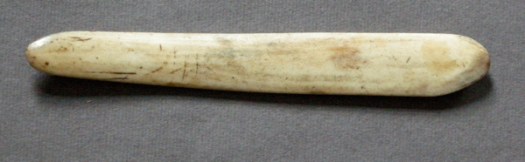
Kevin Driedger , who writes the interesting Library Preservation blog, posted a useful comment a couple of months ago, wondering if I was making an erroneous assumption about how a Turkish bone was used. I guessed it was used for marking. Lately while reading a old supply catalogue for the shoemakers I realized it that shoemakers have two distinct types of bones, termed scratch bones and slick bones. Now I’m convinced that the Turkish cobbler’s bone I wrote about is a scratch bone. Turkish shoemakers now make European style shoes, not Ottoman.
Judging from the catalog descriptions, it seems the scratch bones (similar to a scratch awl?) were used for marking, and slick bone was used for burnishing or smoothing. I wonder if the right angles on the left end were also used to scratch a line? This shape, seems to have served as the template for the most common shape that bookbinders use, with one flat and one rounded or pointed end.
Below is a slick bone that I purchased with some other shoemakers tools. It is thicker than most of the cow bone folders that are commercially available to now, and has a pleasing natural shape. The facets of the somewhat crude shape are highly burnished, suggesting it was used with a far amount of force or speed, the accumulation of glue residue and deep scratches give it a gorgeous patina from use.
The Testing of Steel for Leather Paring Knives
[Update 29 Feb 2016: Starrett now tells me their red stripe blades are M2]
As the result of my own experience, feedback from some of my colleagues, and the results of scientific testing, I’ve become convinced that A2 cryro and machine hacksaw blades (M2 or M3 steel) are the best steel types for bookbinding knives. By best, I mean they offer what I consider an optimum balance of edge retention, initial sharpness, ease of resharpening and price for a leather paring knife.
Four leather paring knives were tested by Cutlery and Allied Trades Research Association (CARTA), located in Sheffield, England. The knives were tested for Edge Angle, Hardness, Initial Cutting Performance and Cutting Edge Retention. The steels tested were O1, A2, Machine hacksaw blade, and T15. All the steels rated very good to excellent, overall. O1 is a popular, standard knife steel, which I make many styles of knives out of, and it works very well on regular, vegetable tanned goat. Machinery’s Handbook recommends it when extreme sharpness is required. A2 is a newer, high tech steel gaining favor among woodworkers, since it holds an edge longer than O1. Most large woodworker blade suppliers make both O1 and A2 versions of plane blades, so there is some personal preference involved- do you like to spend a slightly longer time sharpening (A2) or sharpen more often (O1). Some type of overall time analysis might be conducted, but I can’t imagine it would be very informative given the wide range of unique variables the affect knives in use and when resharpening. Some bookbinders also use knives made from D2- but I find the high chromium content and coarse carbide structure (up to 50 microns!) make it cut poorly, more like stainless steel than a tool steel. Fully hardened machine hacksaw blades are traditional metal (starting mid. 20th C.?) for bookbinders to make paring knives from, I assume since it can be purchased already hardened and shaped by stock reduction. Starrett told me their “Red Stripe” blades are made from M3 steel, and I have read the English Eclipse ones are made from M2. T15 is a super expensive, very high tech steel that outperformed all the other blades, but the inital cost to me, and the number of grinding belts it ate up and time it took when shaping would result in a $750 knife, and I doubt anyone would purchase a $750 knife. And you would almost require a set of diamond stones to resharpen it.
I shaped and sharpened all of these knives by hand to a 13 degree angle. I suspect it is one of the first times that these types of steel were tested at such low angles– at typical woodworking blade is usually 25+ degrees. The blades were shaped on a 2 x 72″ Cootie Belt Grinder, progressing through US grits of 36, 100, 220, followed by hand sharpening on 3M microfinishing films of 40, 15, 5 microns, then stropped on vegetable tanned horsebutt with a .5 micron chromium oxide and finished by stropping on the flesh side of undressed vegetable tanned calfskin. The sharpness was tested on a pack of test cards containing 5% silica for 60 cutting cycles, 50N test load and 50mm/sec. test speed. CATRA has invented and sells many machines for sharpening and knife testing.
1. BEVEL ANGLE
Although I was attempting a 13 degree angle, the edge angled measured between 14-16 degrees for all of the knives when measured with a laser goniometer. I think this is the result of not being able to hold the knife angle consistently enough when sharpening and the result of stropping. There also was a general tendency for the angles to be slightly more acute (.5- 1.5 degrees less) at the sides of the cutting edge as compared with the middle. This is most likely the result of natural hand motion when sharpening, since I usually sharpen parallel to the cutting edge. I suspect if I was in the habit of sharpening perpendicular to the cutting edge, the edge angle would be even more obtuse.
2. HARDNESS
Average from three testing points near the cutting edge in Rockwell C scale.
A2 – 62
Hacksaw (M3) – 64
O1 – 64
T15 – 65
3. INITIAL CUTTING PERFORMANCE (mm)
This is how “sharp” the knife is; how far it penetrated into the cards during the first three cutting strokes.
Tested in accordance with BS EN ISO 8442-5: 2004, Part 5 (Clause 3.4- Cutting Performance)
A2 – 107
Hacksaw (M3) – 107
O1 – 98
T15 – 116
4. CUTTING EDGE RETENTION (mm)
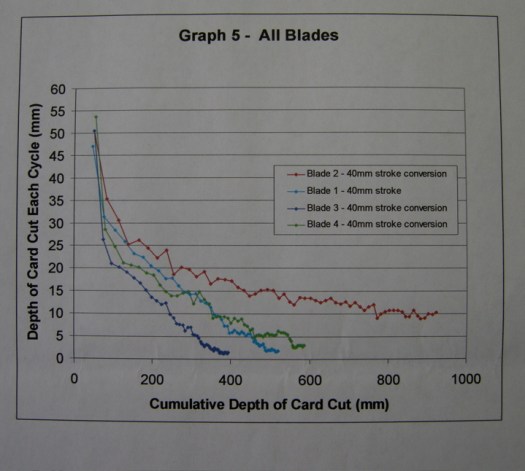
This is how long the edge lasted– ie. the ability for the edge to resist wear. This is the cumulative depth of 60 cycles of cutting the test pack.
A2 – 522
Hacksaw (M3) – 586
O1 – 395
T15 – 921
CHART OF CUTTING EDGE RETENTION RESULTS
A2 is light blue
Hacksaw is green
O1 is dark blue
T15 is red
CONCLUSIONS. Initially, A2 has a slightly slower rate of dulling, which may be an advantage, but later in the test the Hacksaw slightly surpasses it. The O1 seems to have a very constant, predictable rate of dulling- the graph is very smooth. The T15 is incredible- even at the end it was still cutting quite deep, and each cut it still quite deep. Since O1 is about 400, and A2 is about 600, does this mean A2 is 20% better? Given all the complex variables in use, it is hard to accurately observe. As with most scientific testing, a primary conclusion is the need for more testing. I would like to compare bevel angles at 2.5 degree increments, add a number of different types of steel, like some of the M and S tool steel classes, maybe some of the new high carbon stainless steels and instead of testing with a sample card containing silica, test actual tanned and tawed leather. Also the pressure on the blade may be much more than is necessary (or possible) to pare leather, and the sawing motion of the testing machine is different than a more static blade motion that bookbinders use.
 Peachey Conservation