
Over the past eighteen posts, a number of bookbinders and conservators responded to the question, “What are the five most essential bookbinding tools, and why?
The responses were interesting for a number of reasons: how the authors interpreted the question, their actual choices, and their reasoning. Some took a desert island approach, some took the “what would I grab if my studio was on fire” approach, some based their decision on frequency of use, some discussed intricacies of their handmade tools, and some recorded provenance of heirloom tools they were gifted.
I discovered new tools myself (especially thanks for the splinter forceps Jim and your beautiful curved needles Allessandro!) and was pleased that my A2 paring knife and delrin folder were frequently mentioned.
Two ancient tools, a bone folder and a needle, topped the most cited list. John C. Whittaker, in the book “Flintknapping: Making and Understanding Stone Tools” speculates that Homo hablis likely used bone tools around 2 million years ago to make arrowheads and other stone tools. The needle dates to around 50,000 years ago.
The third most commonly mentioned tool is a relative baby. Yoshino Okada invented the Olfa snap-off blade knife in 1956. He lived through the occupation of Japan by the United States in WW2, and later remembered American GIs giving him chocolate bars which could be broken into pieces. Working for a printing company, he grew tired of not having a sharp knife always at hand. Inspiration struck when he was looking at the sharp shards of a broken glass, the memory of the chocolate resurfaced, and the concept for a snap-off blade was born. At least according to official company lore.
The Olfa name has become generic for any snap-off blade. Like other brands that have become generic — Google, Popsicle, Xerox, Kleenex, Bubble Wrap, Dumpster — it is a sign of outsized influence and dominance in a market. Once a brand name reaches such market penetration, even if it is trademarked, it is no longer enforceable. Most bookbinders and conservators, myself included, use an Olfa daily.

The image above is one of the earliest extant Olfa knives. The genius of the snap-off blade design is that the breaking score line does not extend into the blade bevel, so that when it breaks it naturally forms a sharp cutting tip. The Olfa Silver is a direct decedent of this early handle design. The blade lock was not yet invented, nor the blade breaking end piece. Yet it is a clever piece of bent sheet metal engineering.
The original Olfa design was not patented, hence the plethora knockoffs that persist to today. I’d guess the reason it wasn’t is the same reason a number of new inventions are never patented today: patents now are comparatively expensive, around $13,000. It is a huge leap of faith for a novice inventor secure one, and then have additional expense to deal with infringements. At that time, Okada had no idea if his knife would be a success or not.
Once the Olfa company was established, it patented a number of later inventions. The most well known of these is a rotary cutter still extensively used by fabric crafters.

Of course, everything has antecedents. I have a rotary wallpaper knife in my collection from the early 20th century, though I think it is used with the blade locked and not rolling. It is unmarked and not patented, beautifully made and the entire knife balances precisely on one finger. Rolling cigar cutters, pizza cutters, pie crimpers all have a similar morphology and predate the rolling Olfa.
The company was originally named “Olha”which in Japanese “Ol” means to break, and “Ha” means blade. There was some confusion in French, so the name was changed to Olfa. The yellow color scheme was introduced in 1967, and intended to reference both safety and the familiarity, with the yellow evoking the warmth of an egg yolk color. Even some of the knock-offs use a similar color.
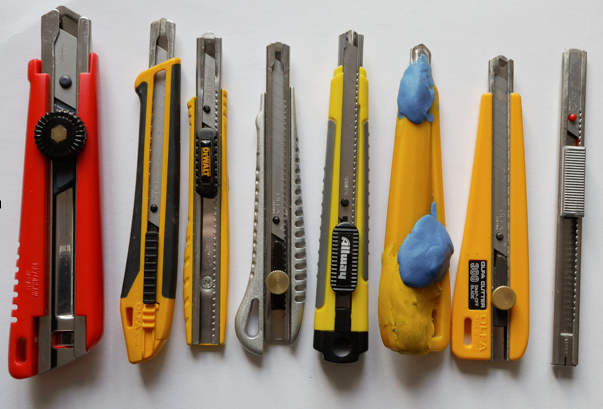
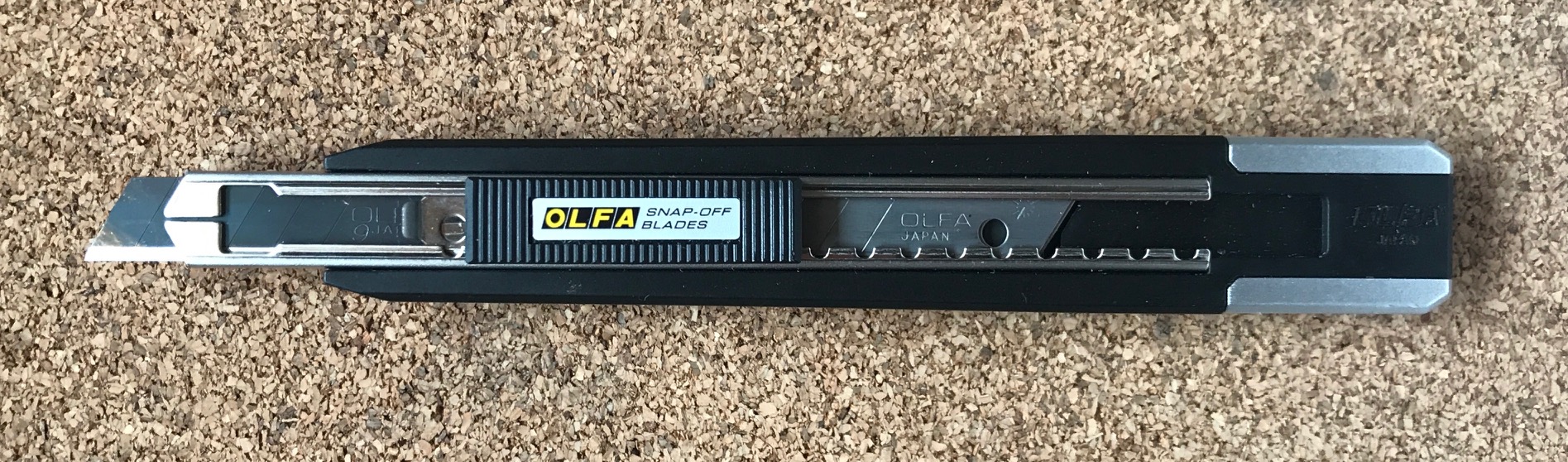
I’m a bit of an Olfa collector, and the newest handle, and one of the nicest IMHO, it the the PA-2, which stores and automatically loads five complete blades in the handle, which is more than enough for onsite work or an extended workshop. The thickness is just a bit more than the Model 300. It has a amazingly smooth action, and so far has resisted blade pull out even in thick and dense materials. The blade support at the tip is beefier than other models.
Some object, not unreasonably, that using an Olfa is wasteful since the blade is not resharpened, but discarded. It that bothers you, genuine Olfa blade steel is good quality, and can be stropped back into shape once it starts to dull.
Pay attention to what you eat and break!

 Peachey Conservation