Do Tools Matter When Making Historic Book Structures?

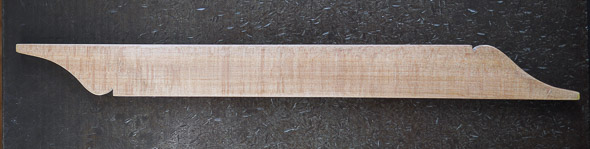
I made this reproduction 18th century French wooden straightedge. Does using it to make a historic bookbinding model *really* affect the process or outcome? Am I heading down the road of wearing a faux French craftsman costume while I do this?

Skillful use of hand tools often depends on their embodiment. They literally become become extensions of our consciousness and body.  We think through them in use, not about them. Don Idhe’s example of driving a car is useful. We don’t have to pay conscious attention to where we are on the road. We just drive. The car is a complex tool that has become embodied. We constantly unconsciously adjust to keeping it on the road. In bookbinding, paring leather is a similar unconscious complex activity. If you are interested in this kind of thing,  Don Idhe’s Technology and The Lifeworld is a exceedingly readable philosophy of technology.

All craft activities have a greater or lesser degree of embodiment, it accounts for some of their joy, relaxation and pleasure. We get out of ourselves for a while.  People often remark on how a tool fits their hand, or is an extension of it, and that it disappears in use. And how time quickly disappears when engaged by using it.

In teaching historic bookbinding structures, however, that these ingrained habits can be counterproductive when trying to recreate, or at least understand in detail, the nuances of earlier techniques.  This is one reason for using historic and reproduction tools. They can help take us out of the familiar, and challange our ingrained craft skills.  They force us to rethink our relationship to a particular tool, and by extension our relationship with the object being crafted. It is all too easy to slip into 21st century work habits when trying to construct a 16th century Gothic binding.

Using historic tools may or may not be the easiest way to do a particular task. When conserving a book there are many other considerations, including the safety of the original artifact, so many historic tools and techniques are not appropriate. And of course, the skill, experience and ability of the conservator is a significant factor. But by in large, the traditional tools of hand bookbinding have not been mechanized because they are an efficient and accurate way of working.

Possibly the most important aspect of using historic tools, or reproductions, is they aid in interpreting historic techniques. Binding a book in an historic style, even inexpertly, helps us understand deeply how older books were made. And isn’t this type of knowledge at the core of any book conservation treatment?
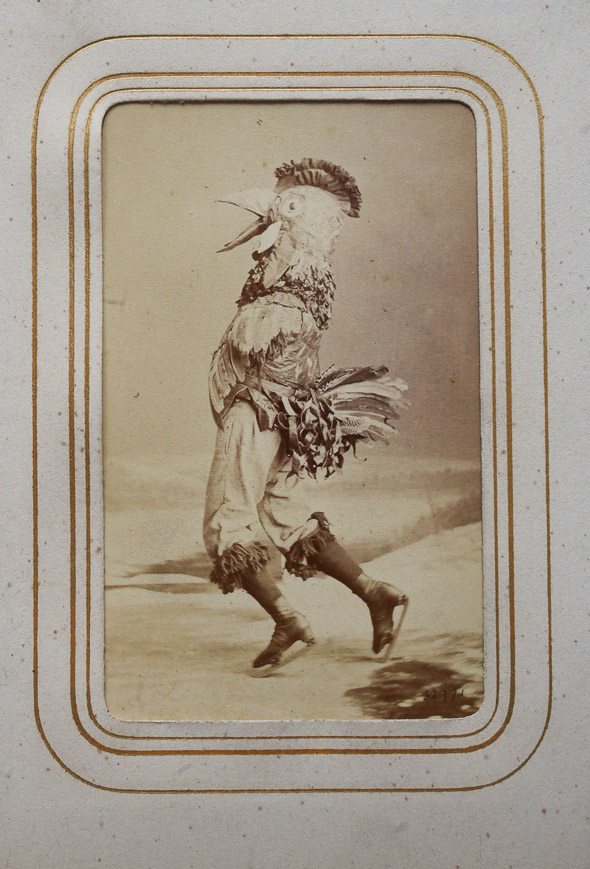
Conserving a Nineteenth Century Family Photo Album is Quite Boring Until You Notice an Image of Someone Dressed as a Chicken, Wearing Ice Skates, and Dancing

Private Collection. The back:  James Inglis / Photographer / Montreal.


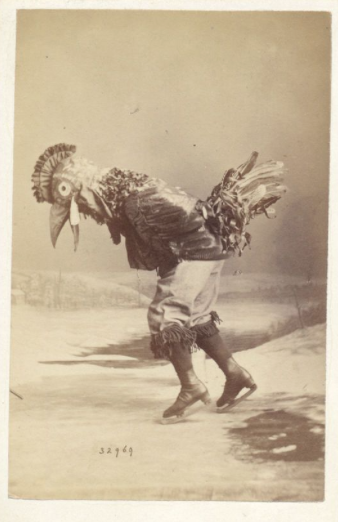
Laura Cunningham, Assistant Conservator, Economic Development & Culture, Museums & Heritage Services, City of Toronto, found some other dancing chicken images from the same shoot:

Source: https://images.google.ca/imgres?imgurl=https%3A%2F%2Fs-media-cache-ak0.pinimg.com%2F736x%2Fc4%2F61%2F80%2Fc461802fa72751818343b3431a597901.jpg&imgrefurl=https%3A%2F%2Fwww.pinterest.com%2Fvthokie2000%2F1800-1860s-fancy-dress%2F&docid=ubzu89jNsi48rM&tbnid=J_DuGZmjxKGV6M%3A&vet=1&w=642&h=1000&source=sh%2Fx%2Fim


And she found another skater on the same backdrop:

http://collections.musee-mccord.qc.ca/scripts/large.php?accessnumber=MP-1978.134.1&zoomify=true&Lang=1&imageID=154314

And the same image I saw in this composite image, middle of the lower left quarter:

http://collections.musee-mccord.qc.ca/scripts/large.php?accessnumber=MP-0000.210&zoomify=true&Lang=1&imageID=150544


Thanks Laura!

Vesalius, Sixteenth Century German Bookbinding Thread and Dissection Tools

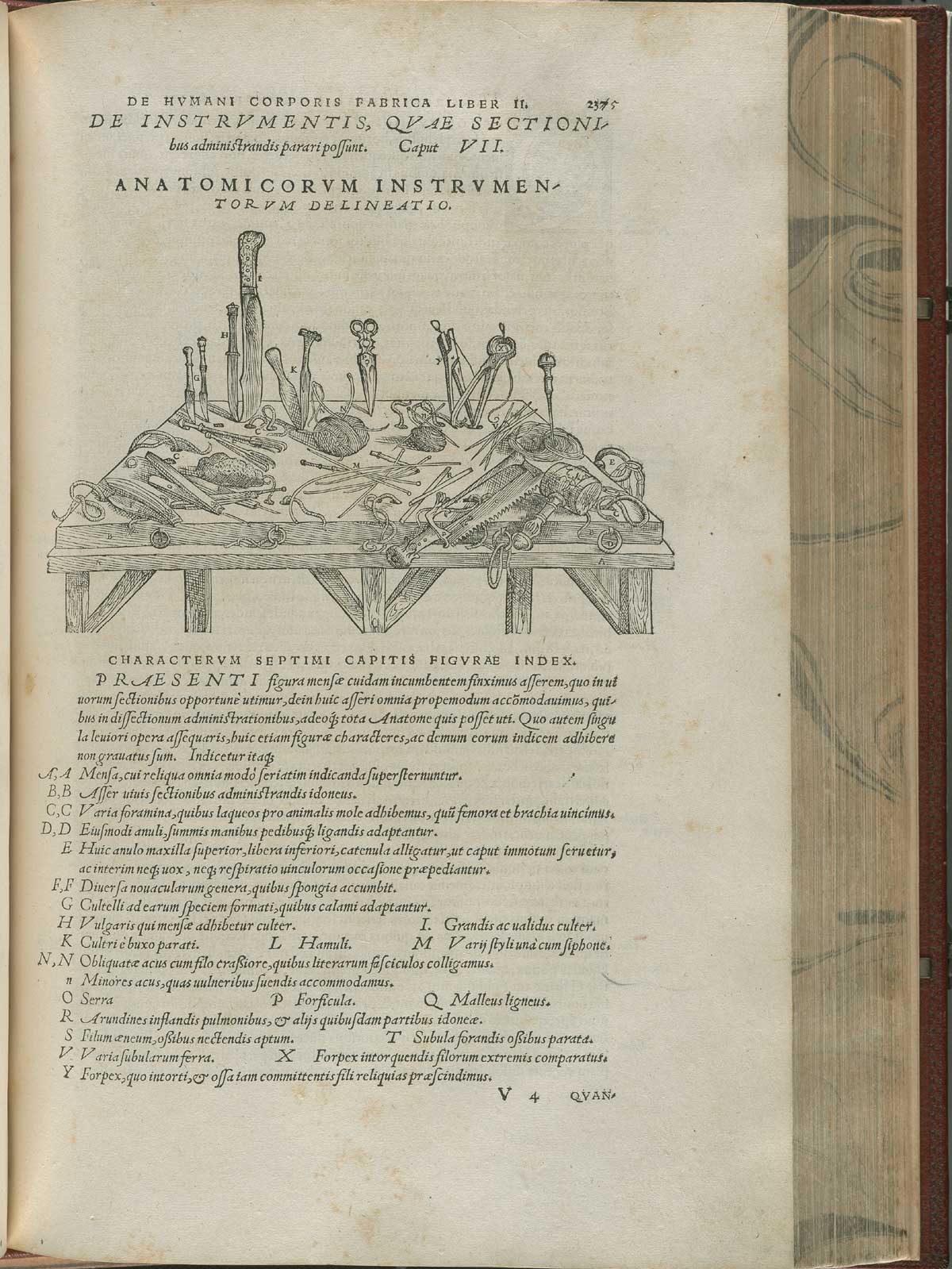
Vesalius, De humani corporis fabrica libri septem, 1543, 235. Source: https://www.nlm.nih.gov/exhibition/historicalanatomies/Images/1200_pixels/Vesalius_Pg_235.jpg

While looking at the surgical tools in De Humani Corporis, I ran across an interesting bit of information from a Cambridge University Online Exhibition. The image is huge, and can be examined in detail. In the text, Vesalius mentions that either silk threads or bookbinder’s threads could be used to prepare a cadaver. In his opinion, German bookbinding thread is the best quality, since it is stronger, thinner, and more well-twisted than thread from other countries. I haven’t noticed this about German 16th C. sewing thread (in large part due to the inflexible spines, see the post below) but it is certainly true for their typically tightly cabled sewing supports. One takeaway is that the thread bookbinders used was the best quality available. Vesalius also describes heating a needle  in order to bend it into a “C” or parenthesis shape, a practice bookbinders still perform today. I’m assuming these bent needles, labeled “N” are stuck in bookbinding thread wrapped up in a bun shape.  This is likely the earliest image of bookbinding thread.

Anthropodermic bibliopegy, or the binding of books in human skin, has a lurid and enduring fascination. Here; however, we have the cadaver fabricated using a bookbinding material and borrowed or shared tools: Bibliodermic anthropegy???

***

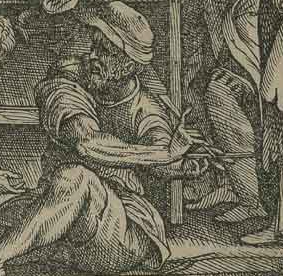
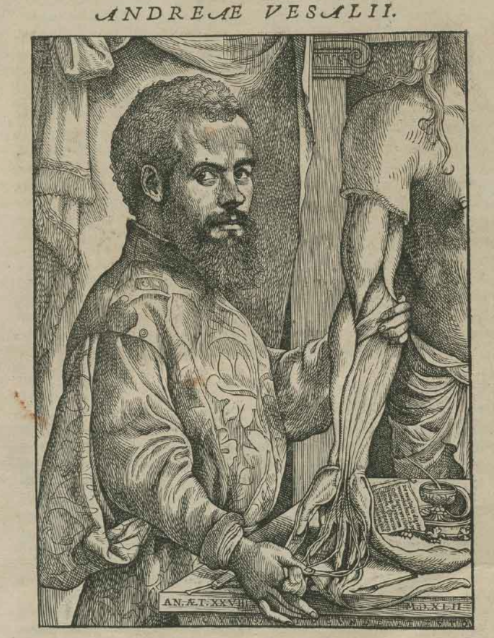
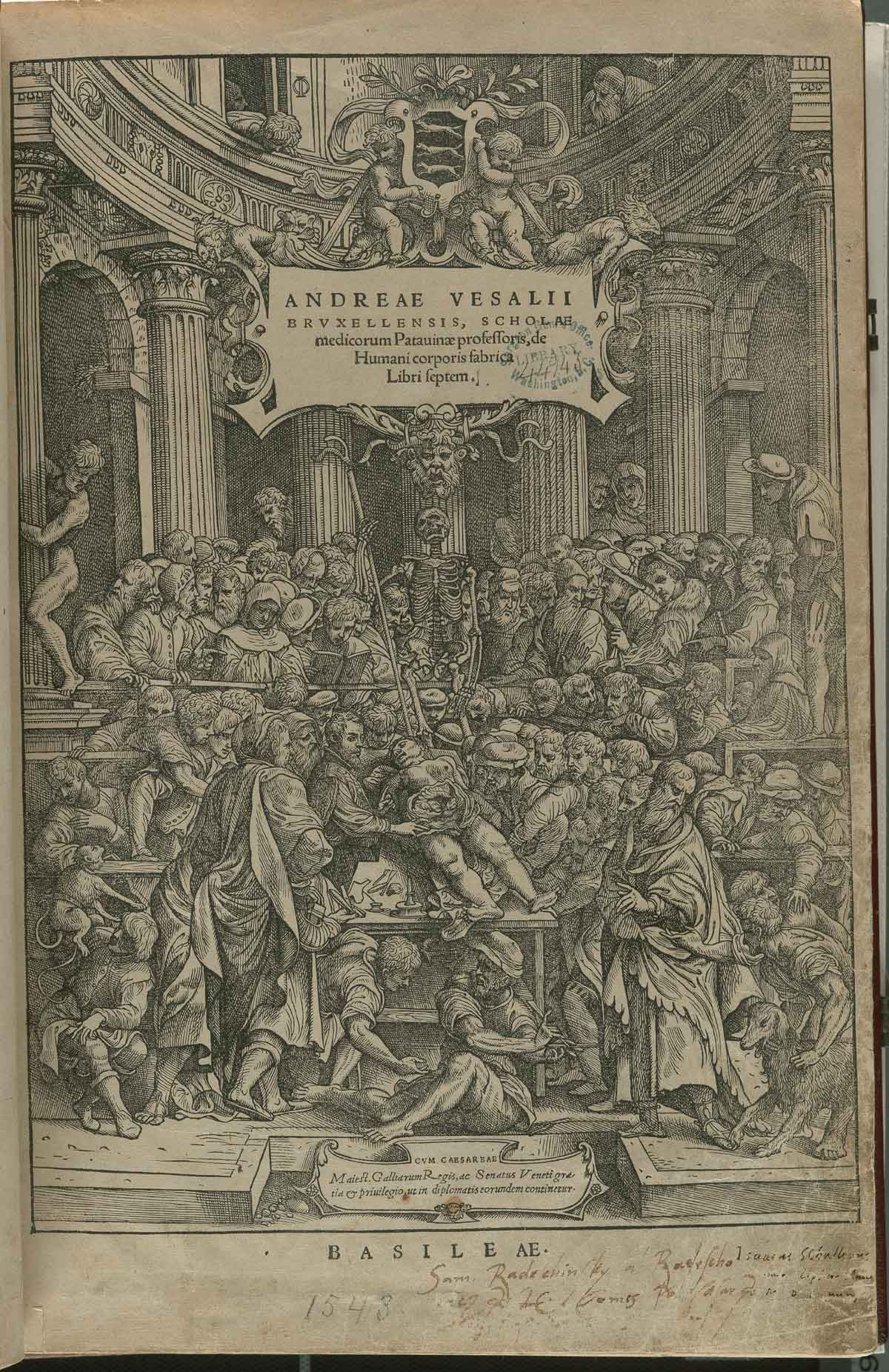
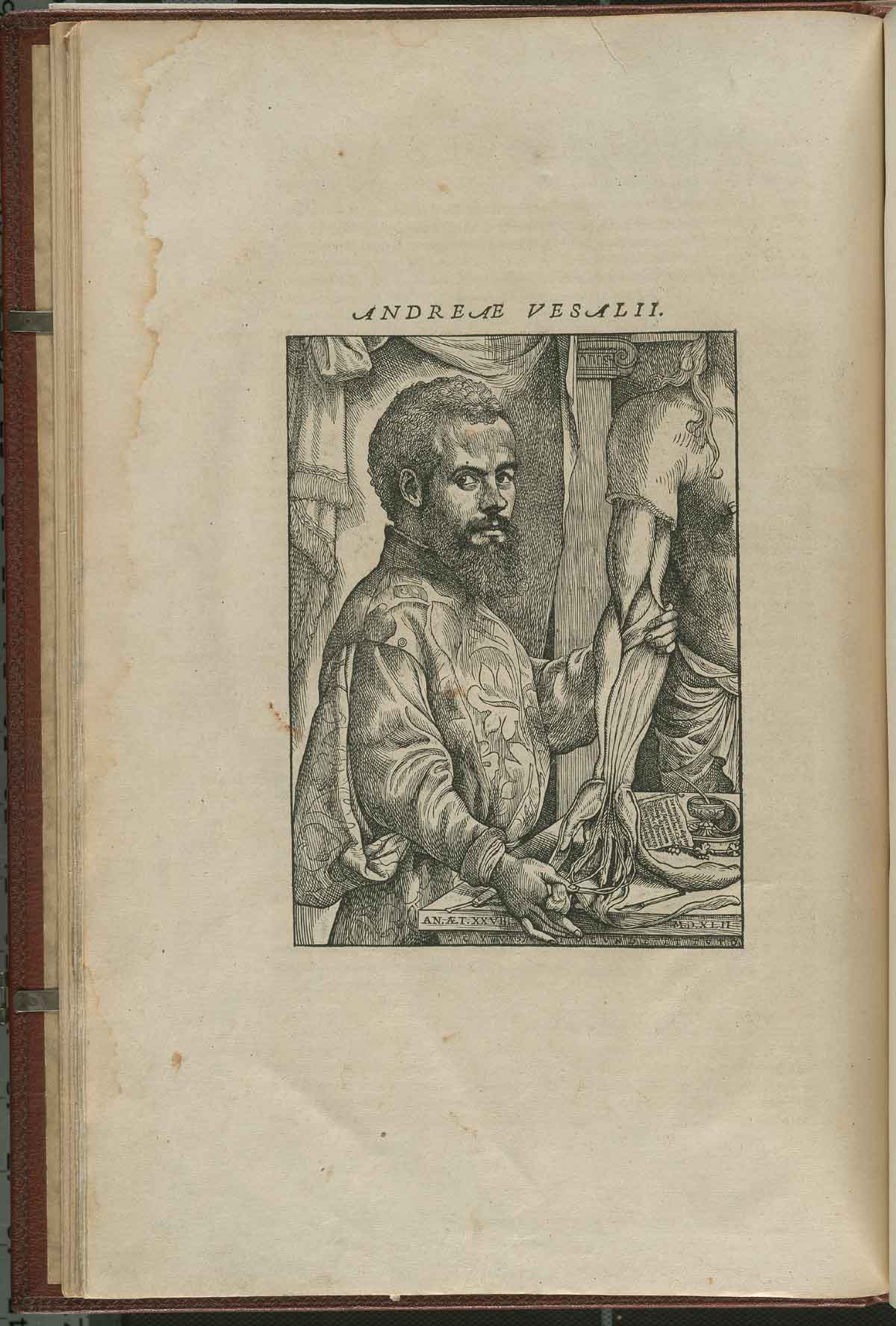
More tools appear on the title page of this book, where a man is stropping or sharpening his razor under the dissection table. The portrait of Vesalius also contains a partially hidden razor lying on the table as he holds body parts of a cadaver. In this case, the razor represents his practical knowledge and experience. His intellectual and theoretical prowess is symbolized by the inkwell and manuscript page on the table behind arm.

The Cambridge exhibition considers that these are ordinary tools, altered by Vesalius, a testament to his manual dexterity. He didn’t need “fancy” instruments, but could use commonly available ones. I wonder about this interpretation, though. Given how many tools even today are shared — and altered — by many crafts, I wonder how many specialist instruments were made only for surgeons. There is no mention of this kind of specialization in J.B. Himsworth’s 1953 The Story of Cutlery, Although it is an excellent resource, it is far from comprehensive.


Detail: Title page, Vesalius, De humani corporis fabrica libri septem, 1543. Source:https://www.nlm.nih.gov/exhibition/historicalanatomies/Images/1200_pixels/Vesalius_TitlePg.jpg


Vesalius, De humani corporis fabrica libri septem, 1543, xii. Source:https://www.nlm.nih.gov/exhibition/historicalanatomies/Images/1200_pixels/Vesalius_Portrait.jpg